Thank you for visiting SNEWPapers!
Sign up free
Story
May 14, 1899
The Record Union
Sacramento, Sacramento County, California
What is this article about?
Article discusses the persistence and growth of summer schools in the US despite some closures, noting better organization, university involvement, and increased participation in 1899 compared to prior years.
Clipping
OCR Quality
98%
Excellent
Full Text
Summer Schools.
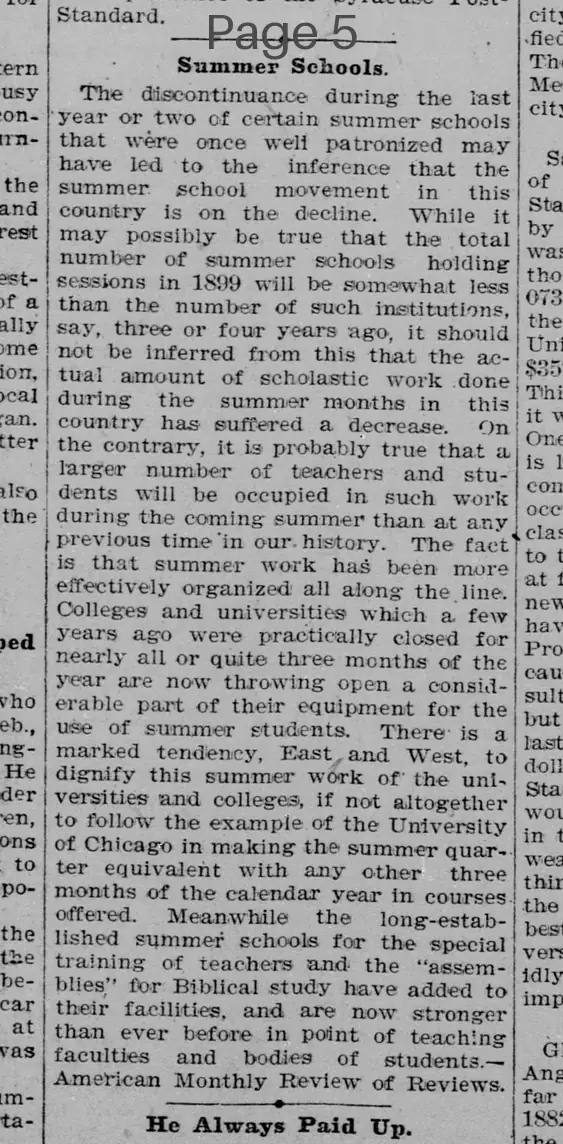
The discontinuance during the last year or two of certain summer schools that were once well patronized may have led to the inference that the summer school movement in this country is on the decline. While it may possibly be true that the total number of summer schools holding sessions in 1899 will be somewhat less than the number of such institutions, say, three or four years ago, it should not be inferred from this that the actual amount of scholastic work done during the summer months in this country has suffered a decrease. On the contrary, it is probably true that a larger number of teachers and students will be occupied in such work during the coming summer than at any previous time in our history. The fact is that summer work has been more effectively organized all along the line. Colleges and universities which a few years ago were practically closed for nearly all or quite three months of the year are now throwing open a considerable part of their equipment for the use of summer students. There is a marked tendency, East and West, to dignify this summer work of the universities and colleges, if not altogether to follow the example of the University of Chicago in making the summer quarter equivalent with any other three months of the calendar year in courses offered. Meanwhile the long-established summer schools for the special training of teachers and the "assemblies" for Biblical study have added to their facilities, and are now stronger than ever before in point of teaching faculties and bodies of students.—American Monthly Review of Reviews.
The discontinuance during the last year or two of certain summer schools that were once well patronized may have led to the inference that the summer school movement in this country is on the decline. While it may possibly be true that the total number of summer schools holding sessions in 1899 will be somewhat less than the number of such institutions, say, three or four years ago, it should not be inferred from this that the actual amount of scholastic work done during the summer months in this country has suffered a decrease. On the contrary, it is probably true that a larger number of teachers and students will be occupied in such work during the coming summer than at any previous time in our history. The fact is that summer work has been more effectively organized all along the line. Colleges and universities which a few years ago were practically closed for nearly all or quite three months of the year are now throwing open a considerable part of their equipment for the use of summer students. There is a marked tendency, East and West, to dignify this summer work of the universities and colleges, if not altogether to follow the example of the University of Chicago in making the summer quarter equivalent with any other three months of the calendar year in courses offered. Meanwhile the long-established summer schools for the special training of teachers and the "assemblies" for Biblical study have added to their facilities, and are now stronger than ever before in point of teaching faculties and bodies of students.—American Monthly Review of Reviews.
What sub-type of article is it?
Educational Report
Institutional Analysis
What keywords are associated?
Summer Schools
Education Trends
University Summer Sessions
Teacher Training
Biblical Assemblies
Where did it happen?
United States, East And West
Story Details
Location
United States, East And West
Event Date
1899
Story Details
The article counters the perception of decline in summer schools by highlighting improved organization, increased university participation, and larger attendance expected in 1899, with examples like the University of Chicago.