Thank you for visiting SNEWPapers!
Sign up free
Literary
May 27, 1836
Southern Telegraph
Rodney, Jefferson County, Mississippi
What is this article about?
A poignant poem by C. Swain depicting the speaker's profound loneliness and grief in an empty home after the death of loved ones, culminating in solace from faith in God.
Clipping
OCR Quality
95%
Excellent
Full Text
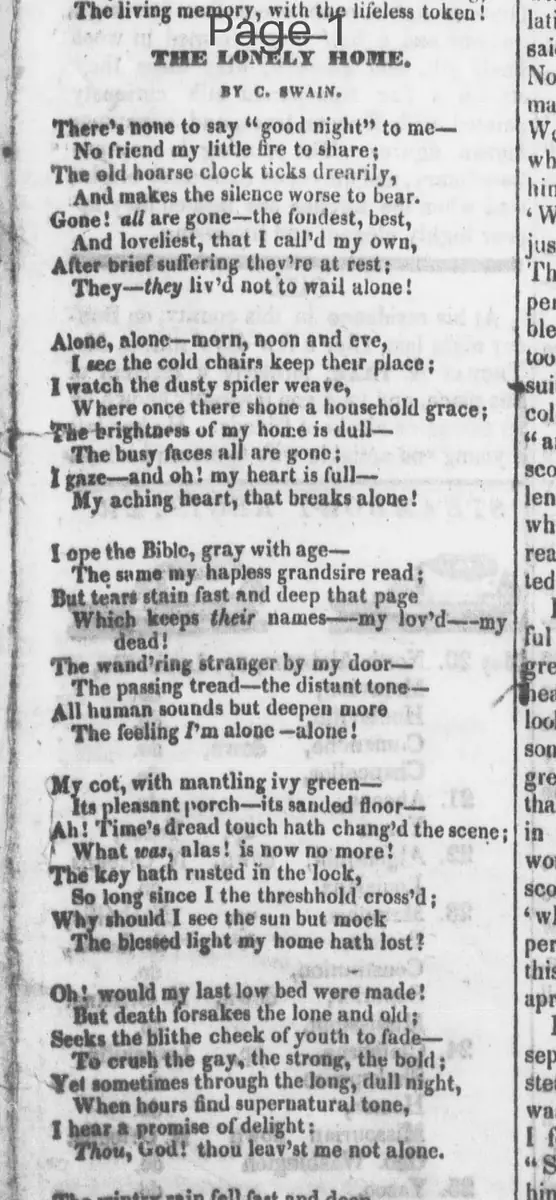
THE LONELY HOME,
BY C. SWAIN.
There's none to say "good night" to me—
No friend my little fire to share;
The old hoarse clock ticks drearily,
And makes the silence worse to bear.
Gone! all are gone—the fondest, best,
And loveliest, that I call'd my own,
After brief suffering they're at rest;
They—they liv'd not to wail alone!
Alone, alone—morn, noon and eve,
I see the cold chairs keep their place;
I watch the dusty spider weave,
Where once there shone a household grace;
The brightness of my home is dull—
The busy faces all are gone;
I gaze—and oh! my heart is full—
My aching heart, that breaks alone!
I ope the Bible, gray with age——
The same my hapless grandsire read;
But tears stain fast and deep that page
Which keeps their names—my lov'd—my dead!
The wand'ring stranger by my door—
The passing tread—the distant tone—
All human sounds but deepen more
The feeling I'm alone—alone!
My cot, with mantling ivy green—
Its pleasant porch—its sanded floor—
Ah! Time's dread touch hath chang'd the scene;
What was, alas! is now no more!
The key hath rusted in the lock,
So long since I the threshold cross'd;
Why should I see the sun but mock
The blessed light my home hath lost?
Oh! would my last low bed were made!
But death forsakes the lone and old;
Seeks the blithe cheek of youth to fade—
To crush the gay, the strong, the bold;
Yet sometimes through the long, dull night,
When hours find supernatural tone,
I hear a promise of delight:
Thou, God! thou leav'st me not alone.
BY C. SWAIN.
There's none to say "good night" to me—
No friend my little fire to share;
The old hoarse clock ticks drearily,
And makes the silence worse to bear.
Gone! all are gone—the fondest, best,
And loveliest, that I call'd my own,
After brief suffering they're at rest;
They—they liv'd not to wail alone!
Alone, alone—morn, noon and eve,
I see the cold chairs keep their place;
I watch the dusty spider weave,
Where once there shone a household grace;
The brightness of my home is dull—
The busy faces all are gone;
I gaze—and oh! my heart is full—
My aching heart, that breaks alone!
I ope the Bible, gray with age——
The same my hapless grandsire read;
But tears stain fast and deep that page
Which keeps their names—my lov'd—my dead!
The wand'ring stranger by my door—
The passing tread—the distant tone—
All human sounds but deepen more
The feeling I'm alone—alone!
My cot, with mantling ivy green—
Its pleasant porch—its sanded floor—
Ah! Time's dread touch hath chang'd the scene;
What was, alas! is now no more!
The key hath rusted in the lock,
So long since I the threshold cross'd;
Why should I see the sun but mock
The blessed light my home hath lost?
Oh! would my last low bed were made!
But death forsakes the lone and old;
Seeks the blithe cheek of youth to fade—
To crush the gay, the strong, the bold;
Yet sometimes through the long, dull night,
When hours find supernatural tone,
I hear a promise of delight:
Thou, God! thou leav'st me not alone.
What sub-type of article is it?
Poem
Elegy
What themes does it cover?
Death Mortality
Religious
What keywords are associated?
Loneliness
Grief
Loss
Home
Faith
Death
Solitude
What entities or persons were involved?
By C. Swain
Literary Details
Title
The Lonely Home
Author
By C. Swain
Key Lines
Gone! All Are Gone—The Fondest, Best,
And Loveliest, That I Call'd My Own,
After Brief Suffering They're At Rest;
They—They Liv'd Not To Wail Alone!
Thou, God! Thou Leav'st Me Not Alone.