Thank you for visiting SNEWPapers!
Sign up free
Editorial
December 17, 1802
The National Intelligencer And Washington Advertiser
Washington, District Of Columbia
What is this article about?
An anonymous patriotic writer addresses the U.S. Legislature, urging them to heal partisan divisions amid national prosperity and to enact an efficient militia law to safeguard liberties, warning against the dangers of standing armies. Dated December 17, 1802, Washington City.
Clipping
OCR Quality
95%
Excellent
Full Text
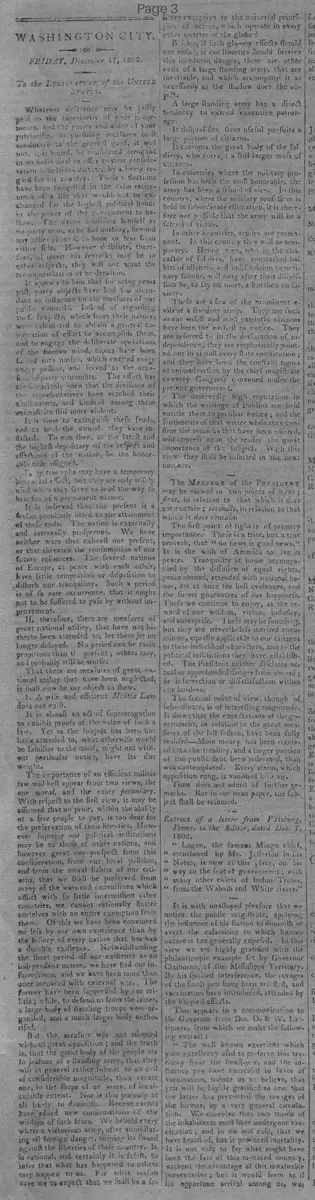
WASHINGTON CITY
FRIDAY, December 17, 1802.
To the LEGISLATURE of the UNITED STATES.
Whatever difference may be justly paid to the superiority of your judgments, and the purity and ardor of your patriotism, in pursuing measures most conducive to the general good, it will not, it is hoped, be considered arrogant in an individual to offer to your consideration reflections dictated by a lively regard for his country. These reflections have been suggested in the calm retirement of a life that would not be exchanged for the highest political honor in the power of the government to bestow. The writer considers himself as no party man, as he has nothing, beyond any other citizen, to hope or fear from either side. However destitute, therefore, of merit his remarks may be in other respects, they will not want the recommendation of moderation.
It appears to him that for many years past, party objects have had too abundant an influence on the measures of our public council. Instead of regarding those subjects, which from their nature, were calculated to obtain a general co-operation of effort to accomplish them, and to engage the deliberate operations of the human mind, topics have been forced into notice, which excited every angry passion, and served as the occasion of party triumphs. The effect has too invariably been that the divisions of the representatives have reached their constituents, and kindled among them animosities still more violent.
It is time to extinguish these feuds, and to heal the wounds they have inflicted. To you then, as the latest and the highest depository of the respect and affections of the nation, be the honorable task assigned.
Party triumphs may have a temporary beneficial effect, but they are only worthy when they serve to lead the way to her bliss of a permanent nature.
It is believed that the present is a season peculiarly suited to the attainment of these ends. The nation is externally and internally prosperous. We have neither wars that exhaust our present, or that threaten the consumption of our future resources. The several nations of Europe, at peace with each other, have little temptation or disposition to disturb our tranquility. Such a period is of so rare occurrence, that it ought not to be suffered to pass by without improvement.
If, therefore, there are measures of great national utility, that have not hitherto been attended to, let them be no longer delayed. No period can be more propitious than the present; others may, and probably will be worse.
That there are measures of great rational utility that have been neglected, it shall now be my object to show.
I. A wise and efficient Militia Law does not exist.
It is almost an act of supererogation to exhibit proofs of the value of such a law. Yet as the subject has been but little attended to, what otherwise would be familiar to the mind, might not without particular notice, have its due weight.
The importance of an efficient militia law will best appear from two views, the one moral, and the other pecuniary.
With respect to the first view, it may be affirmed that no price, within the ability of a free people to pay, is too dear for the preservation of their liberties. However superior our political institutions may be to those of other nations, and however great our prospect from this consideration, from our local position, and from the moral habits of our citizens, that we shall be preserved from many of the wars and convulsions which affect with so little intermission other countries, we cannot rationally flatter ourselves with an entire exemption from them. Of this we have been convinced no less by our own experience than by the history of every nation that has had a durable existence. Notwithstanding the short period of our existence as an independent nation, we have had our insurrections, and we have been more than once menaced with external war. The former have been suppressed by our militia: while, to defend us from the latter, a large body of standing troops were organized, and a much larger body authorized.
But the measure was not adopted without great opposition; and the truth is, that the great body of the people are so jealous of a standing army, that they will in general rather submit to an evil of considerable magnitude, than create one, in the shape of an army, of incalculable extent. Nor is this jealousy at all likely to diminish. Recent events have added new confirmations of the wisdom of such fears. We behold everywhere a victorious army, after annihilating all foreign danger, turning its sword against the liberties of their country. It is rational, and certainly it is safest, to infer that what has happened to others may happen to us. For what reason have we to expect that we shall be a solitary exception to the universal principles of action, which operate in every other quarter of the globe?
Besides, if such gloomy effects should not ensue, if our liberties should survive this imminent danger, there are other evils of a large standing army, that are inevitable, and which accompany it as necessarily as the shadow does the object.
A large standing army has a direct tendency to extend executive patronage.
It disqualifies from useful pursuits a large portion of citizens.
It corrupts the great body of the soldiery, who corrupt a still larger mass of citizens.
In countries where the military profession has been the most honorable, the army has been a school of vice. In this country, where the military profession is held in subordinate estimation, it is therefore not possible that the army will be a school of virtue.
In other countries, armies are permanent. In this country they will be temporary. Hence men, who in the character of soldiers, have contracted habits of idleness, and indisposition to ordinary labour, will long after their dismission be, to say no more, a burden on society.
These are a few of the prominent evils of a standing army. They are such as our wisest and most patriotic citizens have been the earliest to notice. They are referred to in the declaration of independence, they are emphatically pointed out in almost every state constitution; and they have been the constant topics of animadversion by the chief magistrate to every Congress convened under the present government.
The deservedly high reputation in which the writings of Publius are held entitle them to peculiar notice: and the sentiments of that writer while they confirm the remarks that have been offered, will impress upon the reader the great importance of the subject. With this view they shall be inserted in the next number.
FRIDAY, December 17, 1802.
To the LEGISLATURE of the UNITED STATES.
Whatever difference may be justly paid to the superiority of your judgments, and the purity and ardor of your patriotism, in pursuing measures most conducive to the general good, it will not, it is hoped, be considered arrogant in an individual to offer to your consideration reflections dictated by a lively regard for his country. These reflections have been suggested in the calm retirement of a life that would not be exchanged for the highest political honor in the power of the government to bestow. The writer considers himself as no party man, as he has nothing, beyond any other citizen, to hope or fear from either side. However destitute, therefore, of merit his remarks may be in other respects, they will not want the recommendation of moderation.
It appears to him that for many years past, party objects have had too abundant an influence on the measures of our public council. Instead of regarding those subjects, which from their nature, were calculated to obtain a general co-operation of effort to accomplish them, and to engage the deliberate operations of the human mind, topics have been forced into notice, which excited every angry passion, and served as the occasion of party triumphs. The effect has too invariably been that the divisions of the representatives have reached their constituents, and kindled among them animosities still more violent.
It is time to extinguish these feuds, and to heal the wounds they have inflicted. To you then, as the latest and the highest depository of the respect and affections of the nation, be the honorable task assigned.
Party triumphs may have a temporary beneficial effect, but they are only worthy when they serve to lead the way to her bliss of a permanent nature.
It is believed that the present is a season peculiarly suited to the attainment of these ends. The nation is externally and internally prosperous. We have neither wars that exhaust our present, or that threaten the consumption of our future resources. The several nations of Europe, at peace with each other, have little temptation or disposition to disturb our tranquility. Such a period is of so rare occurrence, that it ought not to be suffered to pass by without improvement.
If, therefore, there are measures of great national utility, that have not hitherto been attended to, let them be no longer delayed. No period can be more propitious than the present; others may, and probably will be worse.
That there are measures of great rational utility that have been neglected, it shall now be my object to show.
I. A wise and efficient Militia Law does not exist.
It is almost an act of supererogation to exhibit proofs of the value of such a law. Yet as the subject has been but little attended to, what otherwise would be familiar to the mind, might not without particular notice, have its due weight.
The importance of an efficient militia law will best appear from two views, the one moral, and the other pecuniary.
With respect to the first view, it may be affirmed that no price, within the ability of a free people to pay, is too dear for the preservation of their liberties. However superior our political institutions may be to those of other nations, and however great our prospect from this consideration, from our local position, and from the moral habits of our citizens, that we shall be preserved from many of the wars and convulsions which affect with so little intermission other countries, we cannot rationally flatter ourselves with an entire exemption from them. Of this we have been convinced no less by our own experience than by the history of every nation that has had a durable existence. Notwithstanding the short period of our existence as an independent nation, we have had our insurrections, and we have been more than once menaced with external war. The former have been suppressed by our militia: while, to defend us from the latter, a large body of standing troops were organized, and a much larger body authorized.
But the measure was not adopted without great opposition; and the truth is, that the great body of the people are so jealous of a standing army, that they will in general rather submit to an evil of considerable magnitude, than create one, in the shape of an army, of incalculable extent. Nor is this jealousy at all likely to diminish. Recent events have added new confirmations of the wisdom of such fears. We behold everywhere a victorious army, after annihilating all foreign danger, turning its sword against the liberties of their country. It is rational, and certainly it is safest, to infer that what has happened to others may happen to us. For what reason have we to expect that we shall be a solitary exception to the universal principles of action, which operate in every other quarter of the globe?
Besides, if such gloomy effects should not ensue, if our liberties should survive this imminent danger, there are other evils of a large standing army, that are inevitable, and which accompany it as necessarily as the shadow does the object.
A large standing army has a direct tendency to extend executive patronage.
It disqualifies from useful pursuits a large portion of citizens.
It corrupts the great body of the soldiery, who corrupt a still larger mass of citizens.
In countries where the military profession has been the most honorable, the army has been a school of vice. In this country, where the military profession is held in subordinate estimation, it is therefore not possible that the army will be a school of virtue.
In other countries, armies are permanent. In this country they will be temporary. Hence men, who in the character of soldiers, have contracted habits of idleness, and indisposition to ordinary labour, will long after their dismission be, to say no more, a burden on society.
These are a few of the prominent evils of a standing army. They are such as our wisest and most patriotic citizens have been the earliest to notice. They are referred to in the declaration of independence, they are emphatically pointed out in almost every state constitution; and they have been the constant topics of animadversion by the chief magistrate to every Congress convened under the present government.
The deservedly high reputation in which the writings of Publius are held entitle them to peculiar notice: and the sentiments of that writer while they confirm the remarks that have been offered, will impress upon the reader the great importance of the subject. With this view they shall be inserted in the next number.
What sub-type of article is it?
Military Affairs
Partisan Politics
Constitutional
What keywords are associated?
Militia Law
Standing Army
Party Feuds
National Unity
Liberty Preservation
Executive Patronage
What entities or persons were involved?
Legislature Of The United States
Publius
Editorial Details
Primary Topic
Advocacy For Efficient Militia Law Over Standing Armies
Stance / Tone
Moderate Patriotic Exhortation For Unity And Reform
Key Figures
Legislature Of The United States
Publius
Key Arguments
Party Divisions Have Excessively Influenced Public Measures And Inflamed Animosities
Current Prosperous Period Is Ideal To Heal Feuds And Enact Neglected National Utilities
No Wise And Efficient Militia Law Exists Despite Its Value For Liberty Preservation
Standing Armies Pose Moral Dangers Including Threats To Liberties And Executive Overreach
Militia Has Proven Effective Against Insurrections While Standing Troops Face Public Jealousy