Thank you for visiting SNEWPapers!
Sign up free
Editorial
May 13, 1813
Virginia Argus
Richmond, Virginia
What is this article about?
Editorial from Albany Argus, reprinting Baltimore American, condemns Federalist threats of New England secession from the Union amid War of 1812. Warns of economic ruin for seceders and criticizes hypocrisy in peace professions. Quotes Boston Palladium proposing a 'Commercial League' and notes rising food prices due to blockade.
Clipping
OCR Quality
97%
Excellent
Full Text
Albany Argus.
From the Baltimore American.
THE UNION.
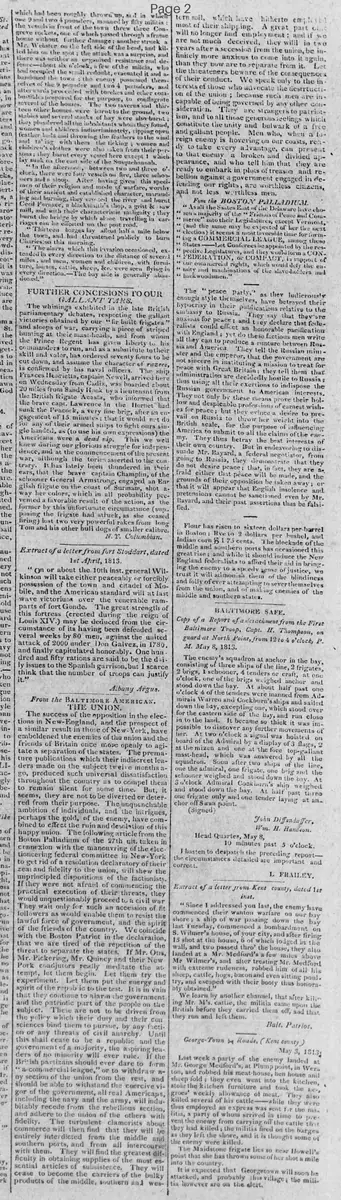
The success of the opposition in the elections in New-England, and the prospect of a similar result in those of New-York, have emboldened the enemies of the union and the friends of Britain once more openly to agitate a separation of the states. The premature publications which their indiscreet leaders made on the subject twelve months ago, produced such universal dissatisfaction throughout the country as to compel them to remain silent for some time. But, it seems, they are not to be diverted or deterred from their purpose. The unquenchable ambition of individuals, and the intrigues, perhaps the gold, of the enemy, have combined to effect the ruin and desolation of this happy union. The following article from the Boston Palladium of the 27th ult. taken in connexion with the manoeuvring of the electioneering federal committee in New-York to get rid of a resolution declaratory of their zeal and fidelity to the union, will shew the unprincipled dispositions of the factionists. If they were not afraid of commencing the practical execution of their threats, they would unquestionably proceed to a civil war They wait only for such an accession of fit followers as would enable them to resist the lawful force of government, and the spirit of the friends of the country. We coincide with the Boston Patriot in the declaration, that we are tired of the repetition of the threat to separate the states. If Mr. Otis, Mr. Pickering, Mr. Quincy and their New York coadjutors really meditate the attempt, let them begin. Let them try the experiment. Let them put the energy and spirit of the republic to the test. It is in vain that they continue to alarm the government and the patriotic part of the people on the subject. These are not to be driven from the policy which their duty and their consciences bind them to pursue, by any faction or any threats of civil anarchy. Until this shall cease to be a republic and the government of a majority, the aspiring leaders of no minority will ever rule. If the British partizans should ever dare to form "a Commercial league," or to withdraw any section of the union from the rest, and should be able to withstand the coercive vigor of the government, all real Americans, including the navy and the army, will indubitably recede from the rebellious section, and adhere to the union of the others with fidelity. The turbulent clamorists about commerce will then find that they will be entirely interdicted from the middle and southern ports, and from all intercourse with them. They will find the greatest difficulty in obtaining supplies of the most essential articles of subsistence. They will cease to become the carriers of the bulky products of the middle, southern and western soil, which have hitherto enriched most of their shipping. A great part will no longer find employment: and if we are not much deceived, they will in two years after a secession from the union, be infinitely more anxious to come into it again, than they now are to separate from it. Let the threatenors beware of the consequences of their conduct. We speak only to the interests of those who advocate the destruction of the union; because such men are incapable of being governed by any other consideration. They are strangers to patriotism, and to all those generous feelings which constitute the unity and bulwark of a free and gallant people. Men who, when a foreign enemy is hovering on our coasts, ready to take every advantage, can present to that enemy a broken and divided appearance, and who tell him that they are ready to embark in plots of treason and rebellion against a government engaged in defending our rights, are worthless citizens, and not less worthless men.
From the BOSTON PALLADIUM.
"As all the States East of the Delaware have chosen a majority of the "Friends of Peace and Commerce" into their Legislatures, except Vermont, (and the same may be expected of her the next election) it seems a most favorable time for forming a COMMERCIAL LEAGUE, among these States. Let Conferences be appointed by the respective Legislatures, and they would form a CONFEDERATION, OR COMPACT, in support of our commercial rights, which would defy the enmity and combinations of the slave-holders and backwoodsmen.
The "peace party," as they ludicrously enough style themselves, have betrayed their hypocrisy in their publications relative to the embassy to Russia. They say that they are anxious for peace; and they declare that federalists could effect an honorable pacification with England; yet do these factious men write all they can to produce a rupture between Russia and America. They tell the Russian minister and the emperor, that the government are not sincere in instituting a mission to treat for peace with Great Britain: they tell them that administration are decidedly hostile to Russia; thus using all their exertions to indispose the Russian government to American interests. They not only by these means prove their hollow and despicable professions of earnest wishes for peace; but they evince a desire to prevail on Russia to throw her weight into the British scale, for the purpose of influencing America to submit to all the claims of the enemy. They thus betray the best interests of their own country. But in endeavoring to dissuade Mr. Bayard, a federal negotiator, from going to Russia, they demonstrate that they do not desire peace; that, in fact, they are afraid either that peace will be made, and the grounds of their opposition be taken away: or that it will appear that English insolence and pretensions cannot be sanctioned even by Mr. Bayard, and their past assertions thus be falsified.
Flour has risen to sixteen dollars per barrel in Boston; Rye to 2 dollars per bushel, and Indian corn 1 75 cents. The blockade of the middle and southern ports has occasioned this great rise; and while it should induce the New England federalists to afford their aid in bringing the enemy to a speedy sense of justice, we trust it will admonish them of the blindness and folly of ever attempting to sever themselves from the union, and of making enemies of the middle and southern states."
From the Baltimore American.
THE UNION.
The success of the opposition in the elections in New-England, and the prospect of a similar result in those of New-York, have emboldened the enemies of the union and the friends of Britain once more openly to agitate a separation of the states. The premature publications which their indiscreet leaders made on the subject twelve months ago, produced such universal dissatisfaction throughout the country as to compel them to remain silent for some time. But, it seems, they are not to be diverted or deterred from their purpose. The unquenchable ambition of individuals, and the intrigues, perhaps the gold, of the enemy, have combined to effect the ruin and desolation of this happy union. The following article from the Boston Palladium of the 27th ult. taken in connexion with the manoeuvring of the electioneering federal committee in New-York to get rid of a resolution declaratory of their zeal and fidelity to the union, will shew the unprincipled dispositions of the factionists. If they were not afraid of commencing the practical execution of their threats, they would unquestionably proceed to a civil war They wait only for such an accession of fit followers as would enable them to resist the lawful force of government, and the spirit of the friends of the country. We coincide with the Boston Patriot in the declaration, that we are tired of the repetition of the threat to separate the states. If Mr. Otis, Mr. Pickering, Mr. Quincy and their New York coadjutors really meditate the attempt, let them begin. Let them try the experiment. Let them put the energy and spirit of the republic to the test. It is in vain that they continue to alarm the government and the patriotic part of the people on the subject. These are not to be driven from the policy which their duty and their consciences bind them to pursue, by any faction or any threats of civil anarchy. Until this shall cease to be a republic and the government of a majority, the aspiring leaders of no minority will ever rule. If the British partizans should ever dare to form "a Commercial league," or to withdraw any section of the union from the rest, and should be able to withstand the coercive vigor of the government, all real Americans, including the navy and the army, will indubitably recede from the rebellious section, and adhere to the union of the others with fidelity. The turbulent clamorists about commerce will then find that they will be entirely interdicted from the middle and southern ports, and from all intercourse with them. They will find the greatest difficulty in obtaining supplies of the most essential articles of subsistence. They will cease to become the carriers of the bulky products of the middle, southern and western soil, which have hitherto enriched most of their shipping. A great part will no longer find employment: and if we are not much deceived, they will in two years after a secession from the union, be infinitely more anxious to come into it again, than they now are to separate from it. Let the threatenors beware of the consequences of their conduct. We speak only to the interests of those who advocate the destruction of the union; because such men are incapable of being governed by any other consideration. They are strangers to patriotism, and to all those generous feelings which constitute the unity and bulwark of a free and gallant people. Men who, when a foreign enemy is hovering on our coasts, ready to take every advantage, can present to that enemy a broken and divided appearance, and who tell him that they are ready to embark in plots of treason and rebellion against a government engaged in defending our rights, are worthless citizens, and not less worthless men.
From the BOSTON PALLADIUM.
"As all the States East of the Delaware have chosen a majority of the "Friends of Peace and Commerce" into their Legislatures, except Vermont, (and the same may be expected of her the next election) it seems a most favorable time for forming a COMMERCIAL LEAGUE, among these States. Let Conferences be appointed by the respective Legislatures, and they would form a CONFEDERATION, OR COMPACT, in support of our commercial rights, which would defy the enmity and combinations of the slave-holders and backwoodsmen.
The "peace party," as they ludicrously enough style themselves, have betrayed their hypocrisy in their publications relative to the embassy to Russia. They say that they are anxious for peace; and they declare that federalists could effect an honorable pacification with England; yet do these factious men write all they can to produce a rupture between Russia and America. They tell the Russian minister and the emperor, that the government are not sincere in instituting a mission to treat for peace with Great Britain: they tell them that administration are decidedly hostile to Russia; thus using all their exertions to indispose the Russian government to American interests. They not only by these means prove their hollow and despicable professions of earnest wishes for peace; but they evince a desire to prevail on Russia to throw her weight into the British scale, for the purpose of influencing America to submit to all the claims of the enemy. They thus betray the best interests of their own country. But in endeavoring to dissuade Mr. Bayard, a federal negotiator, from going to Russia, they demonstrate that they do not desire peace; that, in fact, they are afraid either that peace will be made, and the grounds of their opposition be taken away: or that it will appear that English insolence and pretensions cannot be sanctioned even by Mr. Bayard, and their past assertions thus be falsified.
Flour has risen to sixteen dollars per barrel in Boston; Rye to 2 dollars per bushel, and Indian corn 1 75 cents. The blockade of the middle and southern ports has occasioned this great rise; and while it should induce the New England federalists to afford their aid in bringing the enemy to a speedy sense of justice, we trust it will admonish them of the blindness and folly of ever attempting to sever themselves from the union, and of making enemies of the middle and southern states."
What sub-type of article is it?
Partisan Politics
War Or Peace
Constitutional
What keywords are associated?
Union Preservation
State Secession
Federalist Threats
Commercial League
War Of 1812
New England Elections
Russian Embassy
Economic Consequences
What entities or persons were involved?
Mr. Otis
Mr. Pickering
Mr. Quincy
New York Coadjutors
British Partisans
Boston Palladium
Boston Patriot
Mr. Bayard
Editorial Details
Primary Topic
Opposition To Threats Of Union Separation By New England Federalists
Stance / Tone
Strongly Pro Union And Anti Secessionist
Key Figures
Mr. Otis
Mr. Pickering
Mr. Quincy
New York Coadjutors
British Partisans
Boston Palladium
Boston Patriot
Mr. Bayard
Key Arguments
Threats Of State Separation Are Empty And Driven By Ambition And British Influence
Secession Would Lead To Economic Ruin For New England, Including Loss Of Trade And Supplies
Federalists' Hypocrisy In Peace Professions Shown By Efforts To Sabotage Russian Embassy
Real Americans Would Adhere To The Union Against Any Rebellious Section
Rising Food Prices Due To Blockade Highlight Folly Of Severing Ties With Other States