Thank you for visiting SNEWPapers!
Sign up free
Letter to Editor
February 6, 1792
National Gazette
Philadelphia, Philadelphia County, Pennsylvania
What is this article about?
A Philadelphia writer critiques Mr. Brackenridge's justifications for the Indian war in the National Gazette, arguing that Indians retain rights to their lands despite claims of no original title or forfeiture by the U.S.-British treaty. He warns against aggressive sentiments that could lead to their extirpation.
Clipping
OCR Quality
98%
Excellent
Full Text
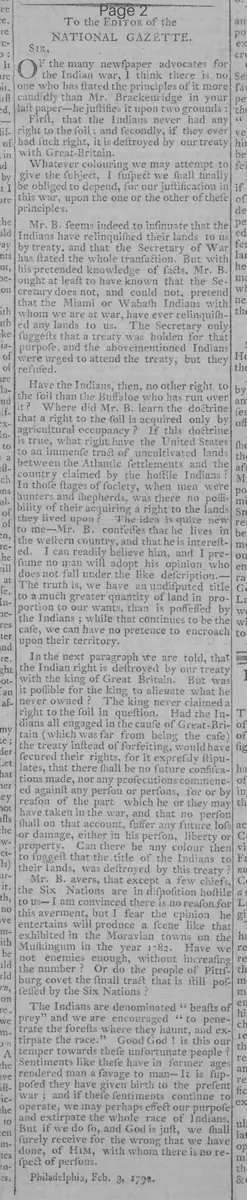
To the Editor of the NATIONAL GAZETTE.
SIR,
Of the many newspaper advocates for the Indian war, I think there is no one who has stated the principles of it more candidly than Mr. Brackenridge in your last paper—he justifies it upon two grounds: First, that the Indians never had any right to the soil: and secondly, if they ever had such right, it is destroyed by our treaty with Great-Britain.
Whatever colouring we may attempt to give the subject, I suspect we shall finally be obliged to depend, for our justification in this war, upon the one or the other of these principles.
Mr. B. seems indeed to insinuate that the Indians have relinquished their lands to us by treaty, and that the Secretary of War has stated the whole transaction. But with his pretended knowledge of facts, Mr. B. ought at least to have known that the Secretary does not, and could not, pretend that the Miami or Wabash Indians with whom we are at war. have ever relinquished any lands to us. The Secretary only suggests that a treaty was holden for that purpose, and the abovementioned Indians were urged to attend the treaty, but they refused.
Have the Indians. then, no other right to the soil than the Buffalo who has run over it? Where did Mr. B. learn the doctrine that a right to the soil is acquired only by agricultural occupancy ? If this doctrine is true, what right have the United States to an immense tract of uncultivated lands between the Atlantic settlements and the country claimed by the hostile Indians ? In those stages of society, when men were hunters and shepherds, was there no possibility of their acquiring a right to the lands they lived upon ? The idea is quite new to me—Mr. B. confesses that he lives in the western country, and that he is interested. I can readily believe him, and I presume no man will adopt his opinion who does not fall under the like description.—
The truth is, we have an undisputed title to a much greater quantity of land in proportion to our wants, than is possessed by the Indians ; while that continues to be the case, we can have no pretence to encroach upon their territory.
In the next paragraph we are told, that the Indian right is destroyed by our treaty with the king of Great Britain. But was it possible for the king to alienate what he never owned ? The king never claimed a right to the soil in question. Had the Indians all engaged in the cause of Great-Britain (which was far from being the case) the treaty instead of forfeiting, would have secured their rights, for it expressly stipulates, that there shall be no future confiscations made, nor any prosecutions commenced against any person or persons, for or by reason of the part which he or they may have taken in the war, and that no person shall on that account, suffer any future loss or damage, either in his person, liberty or property. Can there be any colour then to suggest that the title of the Indians to their lands, was destroyed by this treaty?
Mr. B. avers, that except a few chiefs. the Six Nations are in disposition hostile to us— I am convinced there is no reason for this averment, but I fear the opinion he entertains will produce a scene like that exhibited in the Moravian towns on the Muskingum in the year 1782. Have we not enemies enough, without increasing the number ? Or do the people of Pittsburgh covet the small tract that is still possessed by the Six Nations ?
The Indians are denominated "beasts of prey" and we are encouraged "to penetrate the forests where they haunt, and extirpate the race." Good God ! is this our temper towards these unfortunate people ? Sentiments like these have in former ages rendered man a savage to man— It is supposed they have given birth to the present war ; and if these sentiments continue to operate, we may perhaps effect our purpose and extirpate the whole race of Indians, But if we do so, and God is just, we shall surely receive for the wrong that we have done, of HIM, with whom there is no respect of persons.
Philadelphia, Feb. 3 1792.
SIR,
Of the many newspaper advocates for the Indian war, I think there is no one who has stated the principles of it more candidly than Mr. Brackenridge in your last paper—he justifies it upon two grounds: First, that the Indians never had any right to the soil: and secondly, if they ever had such right, it is destroyed by our treaty with Great-Britain.
Whatever colouring we may attempt to give the subject, I suspect we shall finally be obliged to depend, for our justification in this war, upon the one or the other of these principles.
Mr. B. seems indeed to insinuate that the Indians have relinquished their lands to us by treaty, and that the Secretary of War has stated the whole transaction. But with his pretended knowledge of facts, Mr. B. ought at least to have known that the Secretary does not, and could not, pretend that the Miami or Wabash Indians with whom we are at war. have ever relinquished any lands to us. The Secretary only suggests that a treaty was holden for that purpose, and the abovementioned Indians were urged to attend the treaty, but they refused.
Have the Indians. then, no other right to the soil than the Buffalo who has run over it? Where did Mr. B. learn the doctrine that a right to the soil is acquired only by agricultural occupancy ? If this doctrine is true, what right have the United States to an immense tract of uncultivated lands between the Atlantic settlements and the country claimed by the hostile Indians ? In those stages of society, when men were hunters and shepherds, was there no possibility of their acquiring a right to the lands they lived upon ? The idea is quite new to me—Mr. B. confesses that he lives in the western country, and that he is interested. I can readily believe him, and I presume no man will adopt his opinion who does not fall under the like description.—
The truth is, we have an undisputed title to a much greater quantity of land in proportion to our wants, than is possessed by the Indians ; while that continues to be the case, we can have no pretence to encroach upon their territory.
In the next paragraph we are told, that the Indian right is destroyed by our treaty with the king of Great Britain. But was it possible for the king to alienate what he never owned ? The king never claimed a right to the soil in question. Had the Indians all engaged in the cause of Great-Britain (which was far from being the case) the treaty instead of forfeiting, would have secured their rights, for it expressly stipulates, that there shall be no future confiscations made, nor any prosecutions commenced against any person or persons, for or by reason of the part which he or they may have taken in the war, and that no person shall on that account, suffer any future loss or damage, either in his person, liberty or property. Can there be any colour then to suggest that the title of the Indians to their lands, was destroyed by this treaty?
Mr. B. avers, that except a few chiefs. the Six Nations are in disposition hostile to us— I am convinced there is no reason for this averment, but I fear the opinion he entertains will produce a scene like that exhibited in the Moravian towns on the Muskingum in the year 1782. Have we not enemies enough, without increasing the number ? Or do the people of Pittsburgh covet the small tract that is still possessed by the Six Nations ?
The Indians are denominated "beasts of prey" and we are encouraged "to penetrate the forests where they haunt, and extirpate the race." Good God ! is this our temper towards these unfortunate people ? Sentiments like these have in former ages rendered man a savage to man— It is supposed they have given birth to the present war ; and if these sentiments continue to operate, we may perhaps effect our purpose and extirpate the whole race of Indians, But if we do so, and God is just, we shall surely receive for the wrong that we have done, of HIM, with whom there is no respect of persons.
Philadelphia, Feb. 3 1792.
What sub-type of article is it?
Persuasive
Political
Ethical Moral
What themes does it cover?
Military War
Politics
Morality
What keywords are associated?
Indian War
Land Rights
British Treaty
Miami Indians
Wabash Indians
Six Nations
Moravian Towns
What entities or persons were involved?
Editor Of The National Gazette
Letter to Editor Details
Recipient
Editor Of The National Gazette
Main Argument
the indian war is unjustified because indians have inherent rights to their lands as hunters and the u.s.-british treaty does not forfeit those rights; aggressive sentiments risk moral condemnation and unnecessary escalation.
Notable Details
Critiques Mr. Brackenridge's Arguments On Indian Land Rights
References Secretary Of War's Statements On Treaties
Cites Moravian Towns Massacre In 1782
Quotes Treaty Stipulations Against Confiscations
Denounces Calling Indians 'Beasts Of Prey' And Calls For Extirpation