Thank you for visiting SNEWPapers!
Sign up free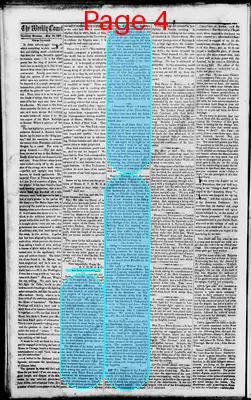
The Weekly Comet
Baton Rouge, East Baton Rouge County, Louisiana
What is this article about?
New York correspondence dated April 23, 1855, describes spring's arrival, the Maine Law's effects on liquor dealers, a lawsuit against P.T. Barnum, a French mayor's quirky notice, Bishop Hughes' response to Senator Brooks on church property, opera and theater successes, fluctuating markets, business dullness, and a lavish gift from Empress Eugenie to Austria's empress.
Merged-components note: These components form a single New York correspondence letter, with sequential reading order and adjacent bboxes; relabeling the second from foreign_news as it is part of the overall letter content.
Clipping
OCR Quality
Full Text
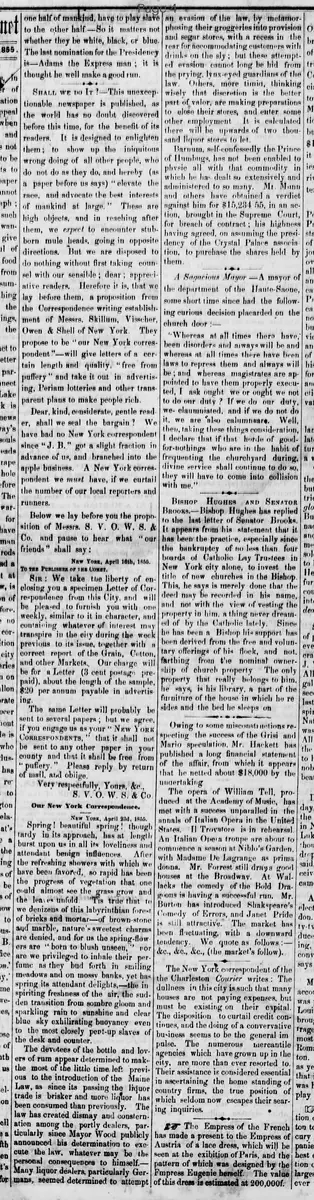
New York, April 23d, 1855.
Spring! beautiful spring! though tardy in its approach, has at length burst upon us in all its loveliness and attendant benign influences. After the refreshing showers with which we have been favored, so rapid has been the progress of vegetation that one could almost see the grass grow and the leaves unfold. 'Tis true that to we denizens of this labyrinthian forest of bricks and mortar -- of brown-stone and marble, nature's sweetest charms are denied, and for us the spring-flowers are "born to blush unseen," nor are we privileged to inhale their perfume as they bud forth in smiling meadows and on mossy banks, yet has spring its attendant delights -- the inspiriting freshness of the air, the sudden transition from sombre gloom and sparkling rain to sunshine and clear blue sky exhilirating buoyancy even to the most closely pent-up slaves of the desk and counter.
The devotees of the bottle and lovers of rum appear determined to make the most of the little time left previous to the introduction of the Maine Law, as since its passing the liquor trade is brisker and more liquor has been consumed than previously. The law has created dismay and consternation among the portly dealers, particularly since Mayor Wood publicly announced his determination to execute the law, whatever may be the personal consequences to himself. Many liquor dealers, particularly Germans, seem determined to attempt an evasion of the law, by metamorphosing their grogteries into provision and segar stores, with a recess in the rear for accommodating customers with drinks on the sly: but these attempted evasions cannot long be hid from the prying, lynx-eyed guardians of the law. Others, more timid, thinking wisely that discretion is the better part of valor, are making preparations to close their stores, and enter some other employment. It is calculated there will be upwards of two thousand liquor stores to let.
Barnum, self-confessedly the Prince of Humbugs, has not been enabled to physic all with that commodity in which he has dealt so extensively and administered to so many. Messrs. Munn and others have obtained a verdict against him for $15,284.55, in an action brought in the Supreme Court, for breach of contract: his highness having agreed, on assuming the presidency of the Crystal Palace association, to purchase the shares held by them.
A Sagacious Mayor -- A mayor of the department of the Haute-Saone, some short time since had the following curious decision placarded on the church door: --
"Whereas at all times there have been disorders and always will be and whereas at all times there have been laws to repress them and always will be; and whereas magistrates are appointed to have them properly executed. I ask ought we or ought we not to do our duty? If we do our duty, we are calumniated, and if we do not do it, we are also calumniated. Well, then, taking these things into consideration, I declare that if that horde of good-for-nothings who are in the habit of frequenting the churchyard during divine service shall continue to do so, they will have to come into collision with me."
Bishop Hughes and Senator Brooks. Bishop Hughes has replied to the last letter of Senator Brooks. It appears from his statement that it has been the practice, especially since the bankruptcy of no less than four boards of Catholic Lay Trustees in New York city alone, to invest the title of new churches in the Bishop. This, he says is merely done that the deed may be recorded in his name, and not with the view of vesting the property in him, a thing never dreamed of by the Catholic lately. Since he has been a Bishop his support has been derived from the free and voluntary offerings of his flock, and not a farthing from the nominal ownership of church property. The only property that really belongs to him, he says, is his library, a part of the furniture of the house in which he resides and the bed he sleeps on.
Owing to some misconstruction respecting the success of the Grisi and Mario speculation, Mr. Hackett has published a long financial statement of the affair, from which it appears that he netted about $18,000 by the undertaking.
The opera of William Tell, produced at the Academy of Music, has met with a success unparalleled in the annals of Italian Opera in the United States. Il Trovatore is in rehearsal. An Italian Opera troupe are about to commence a season at Niblo's Garden, with Madame De Lagrange as prima donna. Mr. Forrest still draws good houses at the Broadway. At Wallack's the comedy of the Bold Dragoon is having a successful run. Mr. Burton has introduced Shakspeare's Comedy of Errors, and Janet Pride is still attractive. The market has been fluctuating, with a downward tendency. We quote as follows: -- &c., &c., &c., (the markets follow).
The New York correspondent of the Charleston Courier writes: The dullness in this city is such that many houses are not paying expenses, but must be existing on their capital. The disposition to curtail credit continues, and the doing of a conservative business seems to be the general impulse. The numerous mercantile agencies which have grown up in the city, are more than ever resorted to. Their assistance is considered essential in ascertaining the home standing of country firms, the true position of which seldom now escapes their searching inquiries.
The Empress of the French has made a present to the Empress of Austria of a lace dress, which will be seen at the exhibition of Paris, and the pattern of which was designed by the Empress Eugenie herself. The value of this dress is estimated at 200,000f.
What sub-type of article is it?
What themes does it cover?
What keywords are associated?
Letter to Editor Details
Main Argument
reports on various current events in new york, including the social and economic impacts of the maine law, legal and cultural news, and business conditions.
Notable Details