Thank you for visiting SNEWPapers!
Sign up free
Story
June 23, 1865
Worcester Daily Spy
Worcester, Worcester County, Massachusetts
What is this article about?
In a speech at Faneuil Hall, Richard H. Dana discusses post-Civil War reconstruction, arguing that if Southern states deny black suffrage, the Union may dismantle their political systems per war's law, but advocates for new state constitutions approved by the Republic to maintain federal balance.
Clipping
OCR Quality
95%
Excellent
Full Text
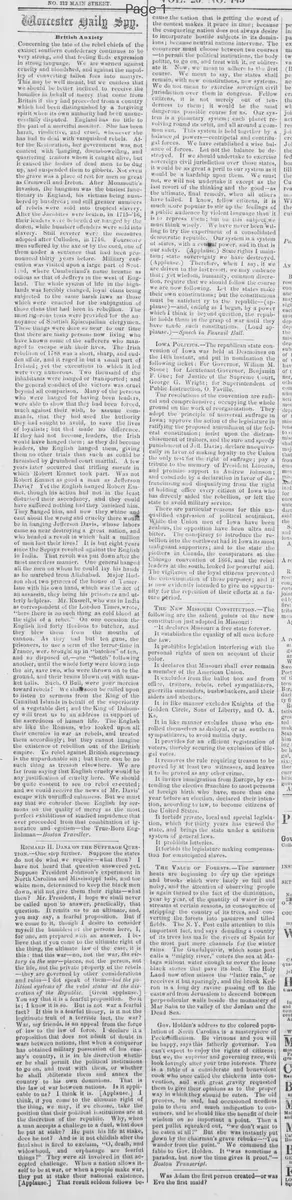
Richard H. Dana on The Suffrage Question.—One step further. Suppose the states do not do what we require—what then? I have not heard that question answered yet.
Suppose President Johnson's experiment in North Carolina and Mississippi fails, and the white men, determined to keep the black men down, will not give them their rights—what then? Mr. President, I hope we shall never be called upon to answer, practically, that question. It remits us to an ultimate, and, you may say, a fearful proposition. But if we come to it, though I desire to consider myself the humblest of the persons here, I, for one, am prepared with an answer. I believe that if you come to the ultimate right of the thing, the ultimate law of the case, it is this: that this war—no, not the war, the victory in the war—places, not the person, not the life, not the private property of the rebels—they are governed by other considerations and rules—I do not speak of them—but the political systems of the rebel states at the discretion of the Republic. [Great applause.]
You say that it is a fearful proposition. So it is; I know it is so. But is not war a fearful fact? If this is a fearful theory, is it not the legitimate fruit of a terrible fact, the war? War, my friends, is an appeal from the force of law to the law of force. I declare it a proposition that does not admit of doubt in wars between nations, that when a conqueror has obtained military possession of his enemy's country, it is in his discretion whether he shall permit the political institutions to go on, and treat with them, or whether he shall obliterate them and annex the country to his own dominions. That is the law of war between nations. Is it applicable to us? I think it is. [Applause.] I think, if you come to the ultimate right of the thing, we may, if we choose, take the position that their political institutions are at the discretion of the republic. Why, when a man accepts a challenge to a duel, what does he put at stake? He puts his life at stake, does he not? And is it not childish after the fatal shot is fired to exclaim, "O, death, and widowhood, and orphanage are fearful things!" They were all involved in that accepted challenge. When a nation allows itself to be at war, or when a people make war, they put at stake their national existence [Applause.] That result seldom follows because the nation that is getting the worst of the contest makes peace in time; because the conquering nation does not always desire to incorporate hostile subjects in its dominions; because neutral nations intervene. The conqueror must choose between two courses—to permit the political institutions, the body politic, to go on, and treat with it, or obliterate it. Now, we mean to adhere to the first course. We mean to say, the states shall remain, with new constitutions, new systems. We do not mean to exercise sovereign civil jurisdiction over them in congress. Fellow citizens, it is not merely out of tenderness to them; it would be the most dangerous possible course for us. Our system is a planetary system; each planet revolving round its orbit, and all around a common sun. This system is held together by a balance of powers—centripetal and centrifugal forces. We have established a wise balance of forces. Let not the balance be destroyed. If we should undertake to exercise sovereign civil jurisdiction over those states, it would be as great a peril to our system as it would be a hardship upon them. We must not, we will not undertake it except as the last resort of the thinking and the good—as the ultimate, final remedy, when all others have failed. I know, fellow citizens, it is much more popular to stir up the feelings of a public audience by violent language than it is to repress them; but on this subject we must think wisely. We have never been willing to try the experiment of a consolidated democratic republic. Our system is a system of states, with a central power, and in that is our safety. (Applause.) State rights I maintain; state sovereignty we have destroyed. (Applause.) Therefore, when I say, if we are driven to the last resort, we may embrace that; yet wisdom, humanity, common discretion, require that we should follow the course we are now following. Let the states make their own constitutions; but the constitutions must be satisfactory to the republic—(applause)—and, ending as I began, by a power which I think is beyond question, the republic holds them in the grasp of war until they have made such constitutions. (Loud applause.)—Speech in Faneuil Hall.
Suppose President Johnson's experiment in North Carolina and Mississippi fails, and the white men, determined to keep the black men down, will not give them their rights—what then? Mr. President, I hope we shall never be called upon to answer, practically, that question. It remits us to an ultimate, and, you may say, a fearful proposition. But if we come to it, though I desire to consider myself the humblest of the persons here, I, for one, am prepared with an answer. I believe that if you come to the ultimate right of the thing, the ultimate law of the case, it is this: that this war—no, not the war, the victory in the war—places, not the person, not the life, not the private property of the rebels—they are governed by other considerations and rules—I do not speak of them—but the political systems of the rebel states at the discretion of the Republic. [Great applause.]
You say that it is a fearful proposition. So it is; I know it is so. But is not war a fearful fact? If this is a fearful theory, is it not the legitimate fruit of a terrible fact, the war? War, my friends, is an appeal from the force of law to the law of force. I declare it a proposition that does not admit of doubt in wars between nations, that when a conqueror has obtained military possession of his enemy's country, it is in his discretion whether he shall permit the political institutions to go on, and treat with them, or whether he shall obliterate them and annex the country to his own dominions. That is the law of war between nations. Is it applicable to us? I think it is. [Applause.] I think, if you come to the ultimate right of the thing, we may, if we choose, take the position that their political institutions are at the discretion of the republic. Why, when a man accepts a challenge to a duel, what does he put at stake? He puts his life at stake, does he not? And is it not childish after the fatal shot is fired to exclaim, "O, death, and widowhood, and orphanage are fearful things!" They were all involved in that accepted challenge. When a nation allows itself to be at war, or when a people make war, they put at stake their national existence [Applause.] That result seldom follows because the nation that is getting the worst of the contest makes peace in time; because the conquering nation does not always desire to incorporate hostile subjects in its dominions; because neutral nations intervene. The conqueror must choose between two courses—to permit the political institutions, the body politic, to go on, and treat with it, or obliterate it. Now, we mean to adhere to the first course. We mean to say, the states shall remain, with new constitutions, new systems. We do not mean to exercise sovereign civil jurisdiction over them in congress. Fellow citizens, it is not merely out of tenderness to them; it would be the most dangerous possible course for us. Our system is a planetary system; each planet revolving round its orbit, and all around a common sun. This system is held together by a balance of powers—centripetal and centrifugal forces. We have established a wise balance of forces. Let not the balance be destroyed. If we should undertake to exercise sovereign civil jurisdiction over those states, it would be as great a peril to our system as it would be a hardship upon them. We must not, we will not undertake it except as the last resort of the thinking and the good—as the ultimate, final remedy, when all others have failed. I know, fellow citizens, it is much more popular to stir up the feelings of a public audience by violent language than it is to repress them; but on this subject we must think wisely. We have never been willing to try the experiment of a consolidated democratic republic. Our system is a system of states, with a central power, and in that is our safety. (Applause.) State rights I maintain; state sovereignty we have destroyed. (Applause.) Therefore, when I say, if we are driven to the last resort, we may embrace that; yet wisdom, humanity, common discretion, require that we should follow the course we are now following. Let the states make their own constitutions; but the constitutions must be satisfactory to the republic—(applause)—and, ending as I began, by a power which I think is beyond question, the republic holds them in the grasp of war until they have made such constitutions. (Loud applause.)—Speech in Faneuil Hall.
What sub-type of article is it?
Historical Event
What themes does it cover?
Justice
Fortune Reversal
What keywords are associated?
Suffrage Question
Civil War Victory
Rebel States
Political Reconstruction
Law Of War
What entities or persons were involved?
Richard H. Dana
President Johnson
Where did it happen?
Faneuil Hall
Story Details
Key Persons
Richard H. Dana
President Johnson
Location
Faneuil Hall
Story Details
Richard H. Dana argues that if Southern states refuse to grant suffrage to black men after the Civil War victory, the Republic holds discretion over their political systems under the law of war, preferring reconstruction with new constitutions satisfactory to the Union rather than direct jurisdiction.