Thank you for visiting SNEWPapers!
Sign up free
Editorial
December 9, 1887
The Iola Register
Iola, Allen County, Kansas
What is this article about?
Rev. T. De Witt Talmage's sermon 'Thirst in a Cavern' uses the biblical story of King David's thirst for Bethlehem's well during battle to metaphorically describe spiritual thirst quenched by the Gospel, emphasizing salvation, comfort, and eternal life through Christ.
Clipping
OCR Quality
95%
Excellent
Full Text
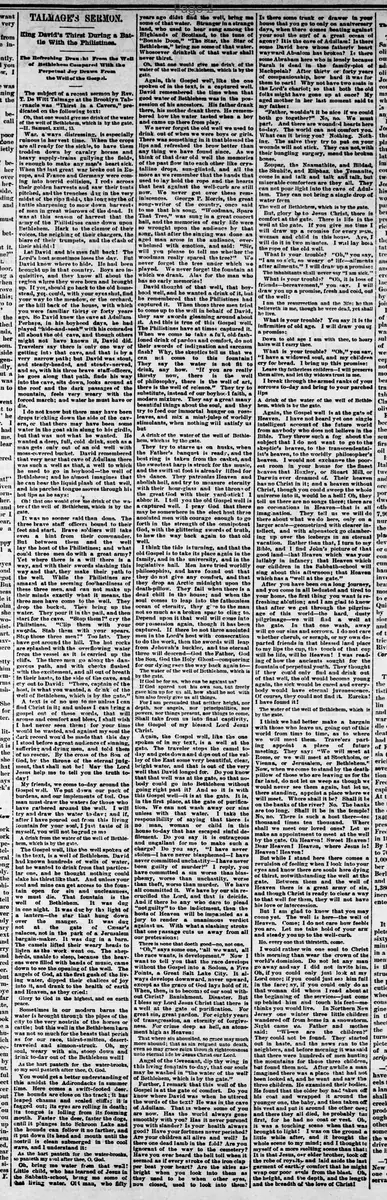
TALMAGE'S SERMON.
King David's Thirst During a Battle With the Philistines.
The Refreshing Draught From the Well of Bethlehem Compared With the Perpetual Joy Drawn From the Well of the Gospel.
The subject of a recent sermon by Rev. T. De Witt Talmage at the Brooklyn Tabernacle was "Thirst in a Cavern," predicated on the following text:
Oh, that one would give me drink of the water of the well of Bethlehem, which is by the gate,—II. Samuel, xxiii., 15.
War, always distressing, is especially ruinous in harvest time. When the crops are ready for the sickle, to have them trodden down by cavalry horses and heavy supply-trains galling the fields, is enough to make any man's heart sick.
When the last great war broke out in Europe, and France and Germany were coming into horrid collision, I rode across their golden harvests and saw their tents pitched, and the trenches dug in the very midst of the ripe field, the long scythe of battle sharpening to mow down harvest of men in great windrows of the dead.
It was at this season of harvest that the army of the Philistines came down upon Bethlehem. Hark to the clamor of their voices, the neighing of their chargers, the blare of their trumpets, and the clash of their shields!
Let David and his men fall back! The Lord's host sometimes loses the day. But David knew where to hide. He had been brought up in that country. Boys are inquisitive, and they know all about the region where they were born and brought up. If you should go back to the old homestead, you could, with your eyes shut, find your way to the meadow, or the orchard, or the hill back of the house, with which you were familiar thirty or forty years ago. So David knew the cave at Adullam. Perhaps, in his boyhood days, he had played "hide-and-seek" with his comrades all about the old cave, and though others might not have known it, David did.
Travelers say there is only one way of getting into that cave, and that is by a very narrow path; but David was stout, and steady-headed, and steady-nerved, and so, with his three brave staff-officers, he goes along that path, finds his way into the cave, sits down, looks around at the roof and the dark passages of the mountain, feels very weary with the forced march; and water he must have or die.
I do not know but there may have been drops trickling down the side of the cavern, or that there may have been some water in the goat skin slung to his girdle, but that was not what he wanted. He wanted a deep, full, cold drink, such as a man gets only out of an old well with moss-covered bucket. David remembered that very near that cave of Adullam there was such a well as that, a well to which he used to go in boyhood—the well of Bethlehem; and he almost imagines that he can hear the liquid plash of that well, and his parched tongue moves through his hot lips as he says:
Oh! that one would give me drink of the water of the well of Bethlehem, which is by the gate.
It was no sooner said than done. The three brave staff officers bound to their feet and start. Brave soldiers will take a hint from their commander.
But between them and the well lay the host of the Philistines; and what could three men do with a great army?
Yet where there is a will there is a way, and with their swords slashing this way and that, they make their path to the well. While the Philistines are amazed at the seeming foolhardiness of these three men, and can not make up their minds exactly what it means, the three men have come to the well. They drop the bucket. They bring up the water. They pour it in the pail, and then start for the cave. "Stop them!" cry the Philistines. "Clip them with your swords. Stab them with your spears. Stop those three men!" Too late! They have got around the hill. The hot rocks are splashed with the overflowing water from the vessel as it is carried up the cliffs. The three men go along the dangerous path, and with cheeks flushed with the excitement, and all out of breath in their haste, to the side of the cave, and cry out to David: "There, captain of the host, is what you wanted, a drink of the well of Bethlehem, which is by the gate."
A text is of no use to me unless I can find Christ in it; and unless I can bring a gospel out of these words, that will arouse and comfort and bless, I shall wish I had never seen them; for your time would be wasted, and against my soul the dark record would be made that this day I stood before a great audience of sinning, suffering and dying men, and told them of no rescue. By the cross of the Son of God, by the throne of the eternal judgment, that shall not be! May the Lord Jesus help me to tell you the truth to-day!
My friends, we come to-day around the Gospel well. We put down our pack of burdens, and our implements of toil. One man must draw the waters for those who have gathered around, and the well, I will try and draw the water to-day; and if, after I have poured out from this living fountain for your soul, I just taste of it myself, you will not begrudge me a drink from the water of the well of Bethlehem, which is by the gate.
The Gospel well, like the well spoken of in the text, is a well of Bethlehem. David had known hundreds of wells of water, but he wanted to drink from that particular one, and he thought nothing could slake his thirst like that. And unless your soul and mine can get access to the fountain open for sin and uncleanness, we must die.
That fountain is the well of Bethlehem. It was dug in one night. It was dug by the light of a lantern—the star that hung down over the manger. It was dug not at the gate of Caesar's palaces, not in the park of a Jerusalem bargain-maker. It was dug in a barn.
The camels lifted their weary heads to listen as the work went on. The shepherds, unable to sleep, because the heavens were filled with bands of music, came down to see the opening of the well. The angels of God, at the first gush of the living water, dipped their chalices of joy into it, and drank to the health of earth and Heaven, as they cried:
Glory to God in the highest, and on earth peace.
Sometimes in our modern barns the water is brought through the pipes of the city to the very nostrils of the horses or cattle; but this well in the Bethlehem barn was not so much for the beasts that perish as for our race, thirst-smitten, desert-traveled and simoon-struck.
Oh, my soul, weary with sin, stoop down and drink to-day out of the Bethlehem well
As the hart panteth for the water-brooks, so my soul panteth after thee, O, God.
You would get a better understanding of this amidst the Adirondacks in summer time. Here comes a swift-footed deer. The hounds are close on the track; it has leaped chasms and scaled cliffs; it is fagged out; its eyes are rolling in death; its tongue is lolling from its foaming mouth. Faster the deer, faster the dogs, until it plunges into Schroon Lake and the hounds can follow it no farther, and it put down its head and mouth until the nostril is clean submerged in the cool wave, and I understand it:
As the hart panteth for the water-brooks, so panteth my soul after thee, O, God.
Oh, bring me water from that well!
Little child, who has learned of Jesus in the Sabbath-school, bring me some of that living water. Old man, who fifty years ago didst find the well, bring me some of that water. Stranger in a strange land, who used to hear sung among the Highlands of Scotland, to the tune of "Bonnie Doon," "The Star, the Star of Bethlehem," bring me some of that water.
Whosoever drinketh of that water shall never thirst.
Oh, that one would give me drink of the water of the well of Bethlehem, which is by the gate.
Again, this Gospel well, like the one spoken of in the text, is a captured well. David remembered the time when that good water of Bethlehem was in the possession of his ancestors. His father drank there, his mother drank there. He remembered how the water tasted when a boy and came up there from play.
We never forget the old well we used to drink out of when we were boys or girls. There was something in it that blessed the lips and refreshed the brow better than anything we have found since. As we think of that dear old well the memories of the past flow into each other like crystalline drops, sun-glinted, and all the more as we remember that the hands that used to lay hold the rope and the hearts that beat against the well-curb are still now. We never get over these reminiscences. George P. Morris, the great song-writer of the country, once said to me that his song, "Woodman, Spare That Tree," was sung in a great concert hall, and the memories of early life were so wrought upon the audience by that song, that after the singing was done an aged man arose in the audience, overwhelmed with emotion, and said: "Sir, will you please to tell me whether the woodman really spared the tree?" We never forget the tree under which we played. We never forget the fountain at which we drank. Alas for the man who has no early memories!
David thought of that well, that boyhood well, and he wanted a drink of it, but he remembered that the Philistines had captured it. When those three men tried to come up to the well in behalf of David, they saw swords gleaming around about it. And this is true of this Gospel well. The Philistines have at times captured it.
When we come to take a full, old-fashioned drink of pardon and comfort, do not their swords of indignation and sarcasm lash? Why, the skeptics tell us that we cannot come to this fountain. They say the water is not fit to drink, anyhow. "If you are really thirsty now, there is the well of philosophy, there is the well of art, there is the well of science." They try to substitute, instead of our boyhood faith, a modern mixture. They say a great many beautiful things about the soul, and they try to feed our immortal hunger on rose-leaves, and mix a mint-julep of worldly stimulants, when nothing will satisfy us but a drink of the water of the well of Bethlehem, which is by the gate.
They try to starve us on husks, when the Father's banquet is ready, and the best ring is taken from the casket, and the sweetest harp is struck for the music, and the swiftest foot is already lifted for the dance. They patronize Heaven and abolish hell, and try to measure eternity with their hour-glass and the throne of the great God with their yard-stick! I abhor it. I tell you the old Gospel well is a captured well. I pray God that there may be somewhere in the elect host three anointed men with courage enough to go forth in the strength of the omnipotent God, with the glittering swords of truth, to hew the way back again to that old well.
I think the tide is turning, and that the old Gospel is to take its place again in the family, and in the university, and in the legislative hall. Men have tried worldly philosophies, and have found out that they do not give any comfort, and that they drop an Arctic midnight upon the death-pillow. They fail when there is a dead chill in the house; and when the soul comes to leap into the fathomless ocean of eternity, they give to the man not so much as a broken spar to cling to.
Depend upon it that well will come into our possession again, though it has been captured. If there be not three anointed men in the Lord's host with consecration to do the work, then the swords will leap from Jehovah's buckler, and the eternal three will descend—God the Father, God the Son, God the Holy Ghost—conquering for our dying race the way back again to—
The water of the well of Bethlehem, which is by the gate.
If God be for us, who can be against us! If God spared not his own Son, but freely gave him up for us all, how shall he not with him also freely give us all things. For I am persuaded that neither height, nor depth, nor angels, nor principalities, nor powers, nor things present, nor things to come, shall take from us into final captivity the Gospel of my blessed Lord Jesus Christ.
Again, the Gospel well, like the one spoken of in my text, is a well at the gate. The traveler stops the camel to-day and gets down and dips out of the valley of the East some very beautiful, clear, bright water, and that is out of the very well that David longed for. Do you know that that well was at the gate, so that nobody could go into Bethlehem without going right past it? And so it is with this Gospel well—it is at the gate. It is, in the first place, at the gate of purification. We cannot wash away our sins unless with that water. I take the responsibility of saying that there is no man, woman or child in this house to-day that has escaped sinful defilement. Do you say it is outrageous and ungallant for me to make such a charge? Do you say, "I have never stolen—I have never blasphemed—I have never committed unchastity—I have never been guilty of murder?" I reply, you have committed a sin worse than blasphemy, worse than unchastity, worse than theft, worse than murder. We have all committed it. We have by our sin re-crucified the Lord, and that is deicide.
And if there be any who dare to plead "not guilty" to the indictment, then the hosts of Heaven will be impaneled as a jury to render a unanimous verdict against us. With what a slashing stroke that one passage cuts us away from all our pretensions:
There is none that doeth good—no, not one.
"Oh," says someone, "all we want, all the race wants, is development." Now I want to tell you that the race develops without the Gospel into a Sodom, a Five Points, a Great Salt Lake City. It always develops downward, never upward, except as the grace of God lays hold of it.
When, then, becomes of our soul without Christ? Banishment. Disaster. But I bless my Lord Jesus Christ that there is a well at the gate of purification. For great sin, great pardon. For eighty years of transgression, an eternity of forgiveness. For crime deep as hell, an atonement high as Heaven:
That where sin abounded, so grace may much more abound; that as sin reigned unto death, even so may grace reign through righteousness unto eternal life by Jesus Christ our Lord.
Angel of the covenant, dip thy wing in this living fountain to-day, that our souls may be washed in "the water of the well of Bethlehem, which is by the gate."
Further, I remark that this well of the Gospel is at the gate of comfort. Do you know where David was when he uttered the words of the text? He was in the cave of Adullam. That is where some of you are now. Has the world always gone smoothly with you? Has it never pursued you with slander? Is your health always good? Have your fortunes never perished? Are your children all alive and well? Is there no dead lamb in the fold? Are you ignorant of the way to the cemetery? Have you ever heard the bell toll when it seemed as if every stroke of the iron clapper beat your heart? Are the skies as bright when you look into them as they used to be when other eyes, now closed, used to look into them?
Is there some trunk or drawer in your house that you go to only on anniversary days, when there comes beating against your soul the surf of a great ocean of agony? It is the cave of Adullam! Is there some David here whose fatherly heart wayward Absalom has broken? Is there some Abraham here who is lonely because Sarah is dead in the family-plot of Machpelah? After thirty or forty years of companionship, how hard it was for them to part! Why not have two seats in the Lord's chariot; so that both the old folks might have gone up at once? My aged mother in her last moment said to my father:
"Father, wouldn't it be nice if we could both go together?" No, no. We must part. And there are wounded hearts here to-day. The world cannot comfort you. What can it bring you? Nothing. Nothing. The salve they try to put on your wounds will not stick. They cannot with their bungling surgery, mend the broken bones.
Zophar, the Naamathite, and Bildad, the Shuhite, and Eliphaz, the Temanite, come in and talk and talk and talk, but miserable comforters are they all. They cannot pour light into the cave of Adullam. They cannot bring a single drop of water from the well of Bethlehem, which is by the gate.
But, glory be to Jesus Christ, there is comfort at the gate. There is life in the well at the gate. If you give me time I will draw up a promise for every man, woman and child in this house. Aye, I will do it in two minutes. I will lay hold both the rope of the old well.
What is your trouble? "Oh," you say, "I am so sick, so weary of life—ailment after ailment." I will draw up a promise:
The inhabitants shall never say "I am sick."
What is your trouble? "Oh, it is loss of friends—bereavement," you say. I will draw you up a promise, fresh and cold, out of the well:
I am the resurrection and the life: he that believeth in me, though he were dead, yet shall he live.
What is your trouble? You say it is the infirmities of old age. I will draw you up a promise:
Down to old age I am with thee, to hoary hairs will I carry thee.
What is your trouble? "Oh," you say, "I have a widowed soul, and my children cry for bread." I bring up this promise:
Leave thy fatherless children—I will preserve them alive, and let thy widows trust in me.
I break through the armed ranks of your sorrows to-day and bring to your parched lips a drink of the water of the well of Bethlehem, which is by the gate.
Again, the Gospel well is at the gate of Heaven. I have not heard yet one single intelligent account of the future world from anybody who does not believe in the Bible. They throw such a fog about the subject that I do not want to go to the skeptic's heaven, to the transcendentalist's heaven, to the worldly philosopher's heaven. I would not exchange the poorest room in your house for the finest heaven that Huxley, or Stuart Mill, or Darwin ever dreamed of. Their heaven has no Christ in it; and heaven without Christ, though you could sweep the whole universe into it, would be a hell! Oh, they tell us there are no songs there; there are no coronations in Heaven—that is all imagination. They tell us we will do there about what we do here, only on a larger scale—geometrizing with clearer intellect, and with alpenstock go clambering up over the icebergs in an eternal vacation. Rather than that, I turn to my Bible, and I find John's picture of that good land—that Heaven which was your lullaby in infancy: that Heaven which our children in the Sabbath-school will sing about this afternoon: that Heaven which has a "well at the gate."
After you have been on a long journey, and you come in all bedusted and tired to your home, the first thing you want is refreshing ablution: and I am glad to know that after we get through the pilgrimage of this world—the hard, dusty pilgrimage—we will find a well at the gate.
In that one wash, away will go our sins and sorrows. I do not care whether cherub, or seraph, or my own departed friends in that blessed land place to my lips the cup, the touch of that cup will be life, will be Heaven! I was reading of how the ancients sought for the fountain of perpetual youth. They thought if they could only find and drink out of that well, the old would become young again, the sick would be cured and everybody would have eternal juvenescence. Of course, they could not find it. Eureka! I have found it!
The water of the well of Bethlehem, which is by the gate.
I think we had better make a bargain with those who leave us, going out of this world from time to time, as to where we will meet them. Travelers parting appoint a place of future meeting. They say:
"We will meet at Rome, or we will meet at Stockholm, or Vienna, or Jerusalem, or Bethlehem."
Now, when we come to stand by the death pillow of those who are leaving us for the far land, do not let us weep as though we would never see them again, but let us, there standing, appoint a place where we will meet. Where shall it be? Shall it be on the banks of the river? No. The banks are too long. Shall it be in the temple? No, no. There is such a host there—ten thousand times ten thousand. Where shall we meet our loved ones? Let us make an appointment to meet at the well by the gate. Oh Heaven! Sweet Heaven! Dear Heaven! Heaven, where Jesus is! Heaven! Heaven!
But while I stand here there comes a revulsion of feeling when I look into your eyes and know there are souls here dying of thirst, notwithstanding the well at the gate. Between them and the well of Heaven there is a great army of sin, and though Christ is ready to clear a way to that well for them, they will not have his love or intercession.
But I am glad to know that you may come yet. The well is here—the well of Heaven. Come: I do not care how feeble you are. Let me take hold of your arm and steady you up to the well-curb.
Ho, every one that thirsteth, come.
I would rather win one soul to Christ this morning than wear the crown of the world's dominion. Do not let any man go away and say I did not invite him. Oh, if you could only just look at my Lord once; if you could just see him full in the face; ay, if you could only do as that woman did whom I read about at the beginning of the services—just come up behind him and touch his feet—methinks you would live. In Northern New Jersey one winter three little children wandered off from home in a snowstorm. Night came on. Father and mother said: "Where are the children?" They could not be found. They started out in haste, and the news ran to the neighbors, and before morning it was said that there were hundreds of men hunting the mountains for those three children, but found them not. After awhile a man imagined there was a place that had not been looked at, and he went and saw the three children. He examined their bodies. He found that the older boy had taken off his coat and wrapped it around the younger one, the baby, and then taken off his vest and put it around the other one; and there they all died, he probably the first, for he had no coat or vest. Oh, it was a touching scene when that was brought to light! I was on the ground a little while after, and it brought the whole scene to my mind; and I thought to myself of a more melting scene than that: It is that Jesus, our elder brother, took off the robe of royalty and laid aside the last garment of earthly comfort that he might wrap our poor souls from the blast. Oh, the height, and the depth, and the length and the breadth of the love of Christ!
King David's Thirst During a Battle With the Philistines.
The Refreshing Draught From the Well of Bethlehem Compared With the Perpetual Joy Drawn From the Well of the Gospel.
The subject of a recent sermon by Rev. T. De Witt Talmage at the Brooklyn Tabernacle was "Thirst in a Cavern," predicated on the following text:
Oh, that one would give me drink of the water of the well of Bethlehem, which is by the gate,—II. Samuel, xxiii., 15.
War, always distressing, is especially ruinous in harvest time. When the crops are ready for the sickle, to have them trodden down by cavalry horses and heavy supply-trains galling the fields, is enough to make any man's heart sick.
When the last great war broke out in Europe, and France and Germany were coming into horrid collision, I rode across their golden harvests and saw their tents pitched, and the trenches dug in the very midst of the ripe field, the long scythe of battle sharpening to mow down harvest of men in great windrows of the dead.
It was at this season of harvest that the army of the Philistines came down upon Bethlehem. Hark to the clamor of their voices, the neighing of their chargers, the blare of their trumpets, and the clash of their shields!
Let David and his men fall back! The Lord's host sometimes loses the day. But David knew where to hide. He had been brought up in that country. Boys are inquisitive, and they know all about the region where they were born and brought up. If you should go back to the old homestead, you could, with your eyes shut, find your way to the meadow, or the orchard, or the hill back of the house, with which you were familiar thirty or forty years ago. So David knew the cave at Adullam. Perhaps, in his boyhood days, he had played "hide-and-seek" with his comrades all about the old cave, and though others might not have known it, David did.
Travelers say there is only one way of getting into that cave, and that is by a very narrow path; but David was stout, and steady-headed, and steady-nerved, and so, with his three brave staff-officers, he goes along that path, finds his way into the cave, sits down, looks around at the roof and the dark passages of the mountain, feels very weary with the forced march; and water he must have or die.
I do not know but there may have been drops trickling down the side of the cavern, or that there may have been some water in the goat skin slung to his girdle, but that was not what he wanted. He wanted a deep, full, cold drink, such as a man gets only out of an old well with moss-covered bucket. David remembered that very near that cave of Adullam there was such a well as that, a well to which he used to go in boyhood—the well of Bethlehem; and he almost imagines that he can hear the liquid plash of that well, and his parched tongue moves through his hot lips as he says:
Oh! that one would give me drink of the water of the well of Bethlehem, which is by the gate.
It was no sooner said than done. The three brave staff officers bound to their feet and start. Brave soldiers will take a hint from their commander.
But between them and the well lay the host of the Philistines; and what could three men do with a great army?
Yet where there is a will there is a way, and with their swords slashing this way and that, they make their path to the well. While the Philistines are amazed at the seeming foolhardiness of these three men, and can not make up their minds exactly what it means, the three men have come to the well. They drop the bucket. They bring up the water. They pour it in the pail, and then start for the cave. "Stop them!" cry the Philistines. "Clip them with your swords. Stab them with your spears. Stop those three men!" Too late! They have got around the hill. The hot rocks are splashed with the overflowing water from the vessel as it is carried up the cliffs. The three men go along the dangerous path, and with cheeks flushed with the excitement, and all out of breath in their haste, to the side of the cave, and cry out to David: "There, captain of the host, is what you wanted, a drink of the well of Bethlehem, which is by the gate."
A text is of no use to me unless I can find Christ in it; and unless I can bring a gospel out of these words, that will arouse and comfort and bless, I shall wish I had never seen them; for your time would be wasted, and against my soul the dark record would be made that this day I stood before a great audience of sinning, suffering and dying men, and told them of no rescue. By the cross of the Son of God, by the throne of the eternal judgment, that shall not be! May the Lord Jesus help me to tell you the truth to-day!
My friends, we come to-day around the Gospel well. We put down our pack of burdens, and our implements of toil. One man must draw the waters for those who have gathered around, and the well, I will try and draw the water to-day; and if, after I have poured out from this living fountain for your soul, I just taste of it myself, you will not begrudge me a drink from the water of the well of Bethlehem, which is by the gate.
The Gospel well, like the well spoken of in the text, is a well of Bethlehem. David had known hundreds of wells of water, but he wanted to drink from that particular one, and he thought nothing could slake his thirst like that. And unless your soul and mine can get access to the fountain open for sin and uncleanness, we must die.
That fountain is the well of Bethlehem. It was dug in one night. It was dug by the light of a lantern—the star that hung down over the manger. It was dug not at the gate of Caesar's palaces, not in the park of a Jerusalem bargain-maker. It was dug in a barn.
The camels lifted their weary heads to listen as the work went on. The shepherds, unable to sleep, because the heavens were filled with bands of music, came down to see the opening of the well. The angels of God, at the first gush of the living water, dipped their chalices of joy into it, and drank to the health of earth and Heaven, as they cried:
Glory to God in the highest, and on earth peace.
Sometimes in our modern barns the water is brought through the pipes of the city to the very nostrils of the horses or cattle; but this well in the Bethlehem barn was not so much for the beasts that perish as for our race, thirst-smitten, desert-traveled and simoon-struck.
Oh, my soul, weary with sin, stoop down and drink to-day out of the Bethlehem well
As the hart panteth for the water-brooks, so my soul panteth after thee, O, God.
You would get a better understanding of this amidst the Adirondacks in summer time. Here comes a swift-footed deer. The hounds are close on the track; it has leaped chasms and scaled cliffs; it is fagged out; its eyes are rolling in death; its tongue is lolling from its foaming mouth. Faster the deer, faster the dogs, until it plunges into Schroon Lake and the hounds can follow it no farther, and it put down its head and mouth until the nostril is clean submerged in the cool wave, and I understand it:
As the hart panteth for the water-brooks, so panteth my soul after thee, O, God.
Oh, bring me water from that well!
Little child, who has learned of Jesus in the Sabbath-school, bring me some of that living water. Old man, who fifty years ago didst find the well, bring me some of that water. Stranger in a strange land, who used to hear sung among the Highlands of Scotland, to the tune of "Bonnie Doon," "The Star, the Star of Bethlehem," bring me some of that water.
Whosoever drinketh of that water shall never thirst.
Oh, that one would give me drink of the water of the well of Bethlehem, which is by the gate.
Again, this Gospel well, like the one spoken of in the text, is a captured well. David remembered the time when that good water of Bethlehem was in the possession of his ancestors. His father drank there, his mother drank there. He remembered how the water tasted when a boy and came up there from play.
We never forget the old well we used to drink out of when we were boys or girls. There was something in it that blessed the lips and refreshed the brow better than anything we have found since. As we think of that dear old well the memories of the past flow into each other like crystalline drops, sun-glinted, and all the more as we remember that the hands that used to lay hold the rope and the hearts that beat against the well-curb are still now. We never get over these reminiscences. George P. Morris, the great song-writer of the country, once said to me that his song, "Woodman, Spare That Tree," was sung in a great concert hall, and the memories of early life were so wrought upon the audience by that song, that after the singing was done an aged man arose in the audience, overwhelmed with emotion, and said: "Sir, will you please to tell me whether the woodman really spared the tree?" We never forget the tree under which we played. We never forget the fountain at which we drank. Alas for the man who has no early memories!
David thought of that well, that boyhood well, and he wanted a drink of it, but he remembered that the Philistines had captured it. When those three men tried to come up to the well in behalf of David, they saw swords gleaming around about it. And this is true of this Gospel well. The Philistines have at times captured it.
When we come to take a full, old-fashioned drink of pardon and comfort, do not their swords of indignation and sarcasm lash? Why, the skeptics tell us that we cannot come to this fountain. They say the water is not fit to drink, anyhow. "If you are really thirsty now, there is the well of philosophy, there is the well of art, there is the well of science." They try to substitute, instead of our boyhood faith, a modern mixture. They say a great many beautiful things about the soul, and they try to feed our immortal hunger on rose-leaves, and mix a mint-julep of worldly stimulants, when nothing will satisfy us but a drink of the water of the well of Bethlehem, which is by the gate.
They try to starve us on husks, when the Father's banquet is ready, and the best ring is taken from the casket, and the sweetest harp is struck for the music, and the swiftest foot is already lifted for the dance. They patronize Heaven and abolish hell, and try to measure eternity with their hour-glass and the throne of the great God with their yard-stick! I abhor it. I tell you the old Gospel well is a captured well. I pray God that there may be somewhere in the elect host three anointed men with courage enough to go forth in the strength of the omnipotent God, with the glittering swords of truth, to hew the way back again to that old well.
I think the tide is turning, and that the old Gospel is to take its place again in the family, and in the university, and in the legislative hall. Men have tried worldly philosophies, and have found out that they do not give any comfort, and that they drop an Arctic midnight upon the death-pillow. They fail when there is a dead chill in the house; and when the soul comes to leap into the fathomless ocean of eternity, they give to the man not so much as a broken spar to cling to.
Depend upon it that well will come into our possession again, though it has been captured. If there be not three anointed men in the Lord's host with consecration to do the work, then the swords will leap from Jehovah's buckler, and the eternal three will descend—God the Father, God the Son, God the Holy Ghost—conquering for our dying race the way back again to—
The water of the well of Bethlehem, which is by the gate.
If God be for us, who can be against us! If God spared not his own Son, but freely gave him up for us all, how shall he not with him also freely give us all things. For I am persuaded that neither height, nor depth, nor angels, nor principalities, nor powers, nor things present, nor things to come, shall take from us into final captivity the Gospel of my blessed Lord Jesus Christ.
Again, the Gospel well, like the one spoken of in my text, is a well at the gate. The traveler stops the camel to-day and gets down and dips out of the valley of the East some very beautiful, clear, bright water, and that is out of the very well that David longed for. Do you know that that well was at the gate, so that nobody could go into Bethlehem without going right past it? And so it is with this Gospel well—it is at the gate. It is, in the first place, at the gate of purification. We cannot wash away our sins unless with that water. I take the responsibility of saying that there is no man, woman or child in this house to-day that has escaped sinful defilement. Do you say it is outrageous and ungallant for me to make such a charge? Do you say, "I have never stolen—I have never blasphemed—I have never committed unchastity—I have never been guilty of murder?" I reply, you have committed a sin worse than blasphemy, worse than unchastity, worse than theft, worse than murder. We have all committed it. We have by our sin re-crucified the Lord, and that is deicide.
And if there be any who dare to plead "not guilty" to the indictment, then the hosts of Heaven will be impaneled as a jury to render a unanimous verdict against us. With what a slashing stroke that one passage cuts us away from all our pretensions:
There is none that doeth good—no, not one.
"Oh," says someone, "all we want, all the race wants, is development." Now I want to tell you that the race develops without the Gospel into a Sodom, a Five Points, a Great Salt Lake City. It always develops downward, never upward, except as the grace of God lays hold of it.
When, then, becomes of our soul without Christ? Banishment. Disaster. But I bless my Lord Jesus Christ that there is a well at the gate of purification. For great sin, great pardon. For eighty years of transgression, an eternity of forgiveness. For crime deep as hell, an atonement high as Heaven:
That where sin abounded, so grace may much more abound; that as sin reigned unto death, even so may grace reign through righteousness unto eternal life by Jesus Christ our Lord.
Angel of the covenant, dip thy wing in this living fountain to-day, that our souls may be washed in "the water of the well of Bethlehem, which is by the gate."
Further, I remark that this well of the Gospel is at the gate of comfort. Do you know where David was when he uttered the words of the text? He was in the cave of Adullam. That is where some of you are now. Has the world always gone smoothly with you? Has it never pursued you with slander? Is your health always good? Have your fortunes never perished? Are your children all alive and well? Is there no dead lamb in the fold? Are you ignorant of the way to the cemetery? Have you ever heard the bell toll when it seemed as if every stroke of the iron clapper beat your heart? Are the skies as bright when you look into them as they used to be when other eyes, now closed, used to look into them?
Is there some trunk or drawer in your house that you go to only on anniversary days, when there comes beating against your soul the surf of a great ocean of agony? It is the cave of Adullam! Is there some David here whose fatherly heart wayward Absalom has broken? Is there some Abraham here who is lonely because Sarah is dead in the family-plot of Machpelah? After thirty or forty years of companionship, how hard it was for them to part! Why not have two seats in the Lord's chariot; so that both the old folks might have gone up at once? My aged mother in her last moment said to my father:
"Father, wouldn't it be nice if we could both go together?" No, no. We must part. And there are wounded hearts here to-day. The world cannot comfort you. What can it bring you? Nothing. Nothing. The salve they try to put on your wounds will not stick. They cannot with their bungling surgery, mend the broken bones.
Zophar, the Naamathite, and Bildad, the Shuhite, and Eliphaz, the Temanite, come in and talk and talk and talk, but miserable comforters are they all. They cannot pour light into the cave of Adullam. They cannot bring a single drop of water from the well of Bethlehem, which is by the gate.
But, glory be to Jesus Christ, there is comfort at the gate. There is life in the well at the gate. If you give me time I will draw up a promise for every man, woman and child in this house. Aye, I will do it in two minutes. I will lay hold both the rope of the old well.
What is your trouble? "Oh," you say, "I am so sick, so weary of life—ailment after ailment." I will draw up a promise:
The inhabitants shall never say "I am sick."
What is your trouble? "Oh, it is loss of friends—bereavement," you say. I will draw you up a promise, fresh and cold, out of the well:
I am the resurrection and the life: he that believeth in me, though he were dead, yet shall he live.
What is your trouble? You say it is the infirmities of old age. I will draw you up a promise:
Down to old age I am with thee, to hoary hairs will I carry thee.
What is your trouble? "Oh," you say, "I have a widowed soul, and my children cry for bread." I bring up this promise:
Leave thy fatherless children—I will preserve them alive, and let thy widows trust in me.
I break through the armed ranks of your sorrows to-day and bring to your parched lips a drink of the water of the well of Bethlehem, which is by the gate.
Again, the Gospel well is at the gate of Heaven. I have not heard yet one single intelligent account of the future world from anybody who does not believe in the Bible. They throw such a fog about the subject that I do not want to go to the skeptic's heaven, to the transcendentalist's heaven, to the worldly philosopher's heaven. I would not exchange the poorest room in your house for the finest heaven that Huxley, or Stuart Mill, or Darwin ever dreamed of. Their heaven has no Christ in it; and heaven without Christ, though you could sweep the whole universe into it, would be a hell! Oh, they tell us there are no songs there; there are no coronations in Heaven—that is all imagination. They tell us we will do there about what we do here, only on a larger scale—geometrizing with clearer intellect, and with alpenstock go clambering up over the icebergs in an eternal vacation. Rather than that, I turn to my Bible, and I find John's picture of that good land—that Heaven which was your lullaby in infancy: that Heaven which our children in the Sabbath-school will sing about this afternoon: that Heaven which has a "well at the gate."
After you have been on a long journey, and you come in all bedusted and tired to your home, the first thing you want is refreshing ablution: and I am glad to know that after we get through the pilgrimage of this world—the hard, dusty pilgrimage—we will find a well at the gate.
In that one wash, away will go our sins and sorrows. I do not care whether cherub, or seraph, or my own departed friends in that blessed land place to my lips the cup, the touch of that cup will be life, will be Heaven! I was reading of how the ancients sought for the fountain of perpetual youth. They thought if they could only find and drink out of that well, the old would become young again, the sick would be cured and everybody would have eternal juvenescence. Of course, they could not find it. Eureka! I have found it!
The water of the well of Bethlehem, which is by the gate.
I think we had better make a bargain with those who leave us, going out of this world from time to time, as to where we will meet them. Travelers parting appoint a place of future meeting. They say:
"We will meet at Rome, or we will meet at Stockholm, or Vienna, or Jerusalem, or Bethlehem."
Now, when we come to stand by the death pillow of those who are leaving us for the far land, do not let us weep as though we would never see them again, but let us, there standing, appoint a place where we will meet. Where shall it be? Shall it be on the banks of the river? No. The banks are too long. Shall it be in the temple? No, no. There is such a host there—ten thousand times ten thousand. Where shall we meet our loved ones? Let us make an appointment to meet at the well by the gate. Oh Heaven! Sweet Heaven! Dear Heaven! Heaven, where Jesus is! Heaven! Heaven!
But while I stand here there comes a revulsion of feeling when I look into your eyes and know there are souls here dying of thirst, notwithstanding the well at the gate. Between them and the well of Heaven there is a great army of sin, and though Christ is ready to clear a way to that well for them, they will not have his love or intercession.
But I am glad to know that you may come yet. The well is here—the well of Heaven. Come: I do not care how feeble you are. Let me take hold of your arm and steady you up to the well-curb.
Ho, every one that thirsteth, come.
I would rather win one soul to Christ this morning than wear the crown of the world's dominion. Do not let any man go away and say I did not invite him. Oh, if you could only just look at my Lord once; if you could just see him full in the face; ay, if you could only do as that woman did whom I read about at the beginning of the services—just come up behind him and touch his feet—methinks you would live. In Northern New Jersey one winter three little children wandered off from home in a snowstorm. Night came on. Father and mother said: "Where are the children?" They could not be found. They started out in haste, and the news ran to the neighbors, and before morning it was said that there were hundreds of men hunting the mountains for those three children, but found them not. After awhile a man imagined there was a place that had not been looked at, and he went and saw the three children. He examined their bodies. He found that the older boy had taken off his coat and wrapped it around the younger one, the baby, and then taken off his vest and put it around the other one; and there they all died, he probably the first, for he had no coat or vest. Oh, it was a touching scene when that was brought to light! I was on the ground a little while after, and it brought the whole scene to my mind; and I thought to myself of a more melting scene than that: It is that Jesus, our elder brother, took off the robe of royalty and laid aside the last garment of earthly comfort that he might wrap our poor souls from the blast. Oh, the height, and the depth, and the length and the breadth of the love of Christ!
What sub-type of article is it?
Moral Or Religious
What keywords are associated?
Gospel Well
Spiritual Thirst
Bethlehem Well
Salvation
Talmage Sermon
Christian Comfort
Eternal Life
What entities or persons were involved?
Rev. T. De Witt Talmage
King David
Philistines
Jesus Christ
God The Father
God The Son
God The Holy Ghost
Editorial Details
Primary Topic
Spiritual Thirst Quenched By The Gospel Well Of Bethlehem
Stance / Tone
Evangelical Exhortation To Seek Salvation Through Christ
Key Figures
Rev. T. De Witt Talmage
King David
Philistines
Jesus Christ
God The Father
God The Son
God The Holy Ghost
Key Arguments
The Biblical Story Of David's Thirst Illustrates Spiritual Longing For The Gospel
The Gospel Well Of Bethlehem Provides Purification From Sin
Skeptics And Worldly Philosophies Capture The Gospel Well But It Will Be Reclaimed
The Gospel Offers Comfort In Life's Caves Of Suffering
Heaven Has A Well At The Gate For Eternal Refreshment
All Souls Thirst And Must Drink From Christ's Living Water To Avoid Eternal Death