Thank you for visiting SNEWPapers!
Sign up free
Herald Of The Times
Newport, Newport County, Rhode Island
What is this article about?
J. F. Daniel Lobstein's essay critiques the overuse of blood-letting in medicine, arguing it causes fatal harm rather than benefit. Drawing from his experience, he advocates caution, emphasizing blood's vital role and proper crisis management in treatment, especially in fevers.
Clipping
OCR Quality
Full Text
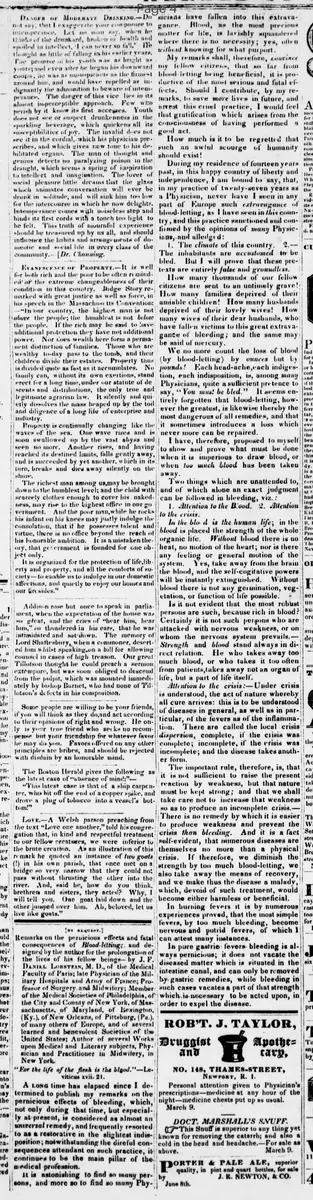
Remarks on the pernicious effects and fatal
consequences of Blood-letting: and designed
by the author for the prolongation of
the lives of his fellow beings—by J. F.
Daniel Lobstein, M. D., of the Medical
Faculty of Paris; late Physician of the Military
Hospitals and Army of France; Professor
of Surgery, and Midwifery; Member
of the Medical Societies of Philadelphia, of
the City and County of New York, of Massachusetts,
of Maryland, of Lexington,
(Ky.), of New Orleans, of Pittsburg, (Pa.).
of many others of Europe, and of several
learned and benevolent Societies of the
United States: Author of several Works
upon Medical and Literary subjects, Physician
and Practitioner in Midwifery, in
New York.
"For the life of the flesh is the blood."—Leviticus xvii. 11.
A long time has elapsed since I determined
to publish my remarks on the
pernicious effects of bleeding, which,
not only during that time, but especially
at present, is considered as almost an
universal remedy, and frequently resorted
to as a restorative in the slightest indisposition;
notwithstanding the direful consequences
attendant on such practice, it
continues to be the main pillar of the
medical profession.
It is astonishing to find so many persons,
and more so to find so many Physicians,
have fallen into this extravagance.
Blood, as the most precious
matter for life, is lavishly squandered
where there is no necessity; yet, often
without knowing for what purpose.
My remarks shall, therefore, convince
my fellow citizens, that so far from
blood-letting being beneficial, it is productive
of the most serious and fatal effects.
Should I contribute, by my remarks,
to save more lives in future, and
arrest this cruel practice, I would feel
that gratification which arises from the
consciousness of having performed a
good act.
How much is it to be regretted that
such an awful scourge of humanity
should exist!
During my residence of fourteen years
past, in this happy country of liberty and
independence, I am bound to say, that.
in my practice of twenty-seven years as
a Physician, never have I seen in any
part of Europe such extravagance of
blood-letting, as I have seen in this country,
and this practice sanctioned and confirmed
by the opinions of many Physicians,.
and alleged:
I. The climate of this country. 2.—
The inhabitants are accustomed to be
bled. But I will prove that these pretexts
are entirely false and groundless.
How many thousands of our fellow
citizens are sent to an untimely grave!
How many families deprived of their
amiable children! How many husbands
deprived of their lovely wives! How
many wives of their dear husbands, who
have fallen victims to this great extravagance
of bleeding; and the same may
be said of mercury.
We no more count the loss of blood
(by blood-letting) by ounces but by
pounds! Each head-ache, each indigestion,
each indisposition, is, among many
Physicians, quite a sufficient pretence to
say, "You must be bled." It seems entirely
forgotten that blood-letting, however
the greatest, is likewise thereby the
most dangerous of all remedies, and that
it sometimes introduces a loss which
never more can be repaired
I have, therefore, proposed to myself
to show and prove what must be done
when it is imperious to draw blood, or
when too much blood has been taken
away.
Two things which are unattended to
and of which alone an exact judgment
can be followed in bleeding, viz.:
1. Attention to the Blood. 2. Attention
to the crisis.
In the blood is the human life; in the
blood is placed the strength of the whole
organic life. Without blood there is no
heat, no motion of the heart; nor is there
any feeling or general motion of the
system. Yes, take away from the brain
the blood, and the self-cogitative powers
will be instantly extinguished. Without
blood there is not any generation, vegetation,
or function of life possible.
Is it not evident that the most robust
persons are such, because rich in blood?
Certainly it is not such persons who are
attacked with nervous weakness, or on
whom the nervous system prevails.—
Strength and blood stand always in direct
relation. He who takes away too
much blood, or who takes it too often
from patients, takes away not an organ of
life, but a part of life itself.
Attention to the crisis:—Under crisis
is understood, the act of nature whereby
all cure arrives: this is to be understood
of diseases in general, as well as in particular,
of the fevers as of the inflammation.
There are called the local crisis
dispersion, complete, if the crisis was
complete; incomplete, if the crisis was
incomplete; and the disease takes another
form.
The important rule, therefore, is, that
it is not sufficient to raise the present
reaction by weakness, but that nature
must be kept strong; and that we shall
take care not to increase that weakness
so as to produce an incomplete crisis.—
There is no remedy by which it is easier
to produce weakness and prevent the
crisis than bleeding. And it is a fact
self-evident, that numerous diseases are
themselves no more than a physical
crisis. If therefore, we diminish the
strength by too much blood-letting, we
also take away the means of recovery,
and we make thus the disease a malady
which, devoid of such treatment, would
become either harmless or beneficial.
In burning fevers it is by numerous
experiences proved, that the most simple
fevers, by too much bleeding, become
nervous and putrid fevers, of which I
can attest many instances.
In pure gastric-fevers, bleeding is always
pernicious; it does not vacate the
diseased matter which is situated in the
intestine canal, and can only be removed
by gastric remedies, while bleeding in
such cases vacates a part of that strength
which is necessary to be acted upon, in
order to expel the disease.
What sub-type of article is it?
What themes does it cover?
What keywords are associated?
What entities or persons were involved?
Literary Details
Title
Remarks On The Pernicious Effects And Fatal Consequences Of Blood Letting: And Designed By The Author For The Prolongation Of The Lives Of His Fellow Beings
Author
By J. F. Daniel Lobstein, M. D., Of The Medical Faculty Of Paris; Late Physician Of The Military Hospitals And Army Of France; Professor Of Surgery, And Midwifery; Member Of The Medical Societies Of Philadelphia, Of The City And County Of New York, Of Massachusetts, Of Maryland, Of Lexington, (Ky.), Of New Orleans, Of Pittsburg, (Pa.). Of Many Others Of Europe, And Of Several Learned And Benevolent Societies Of The United States: Author Of Several Works Upon Medical And Literary Subjects, Physician And Practitioner In Midwifery, In New York.
Subject
Prolongation Of The Lives Of His Fellow Beings
Key Lines