Thank you for visiting SNEWPapers!
Sign up free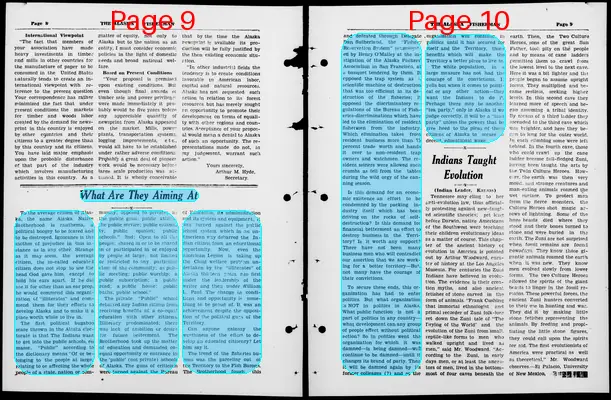
Editorial
November 15, 1931
The Alaska Fisherman
Juneau, Ketchikan, Petersburg, Alaska
What is this article about?
Editorial defends the Alaska Native Brotherhood against prejudice, highlighting their advocacy for Native access to public schools, child welfare, and opposition to discriminatory fisheries policies that favor non-resident interests over local fishermen.
Merged-components note: Continuation of editorial on Alaska Native Brotherhood across pages 9 and 10.
Clippings
1 of 2
OCR Quality
98%
Excellent
Full Text
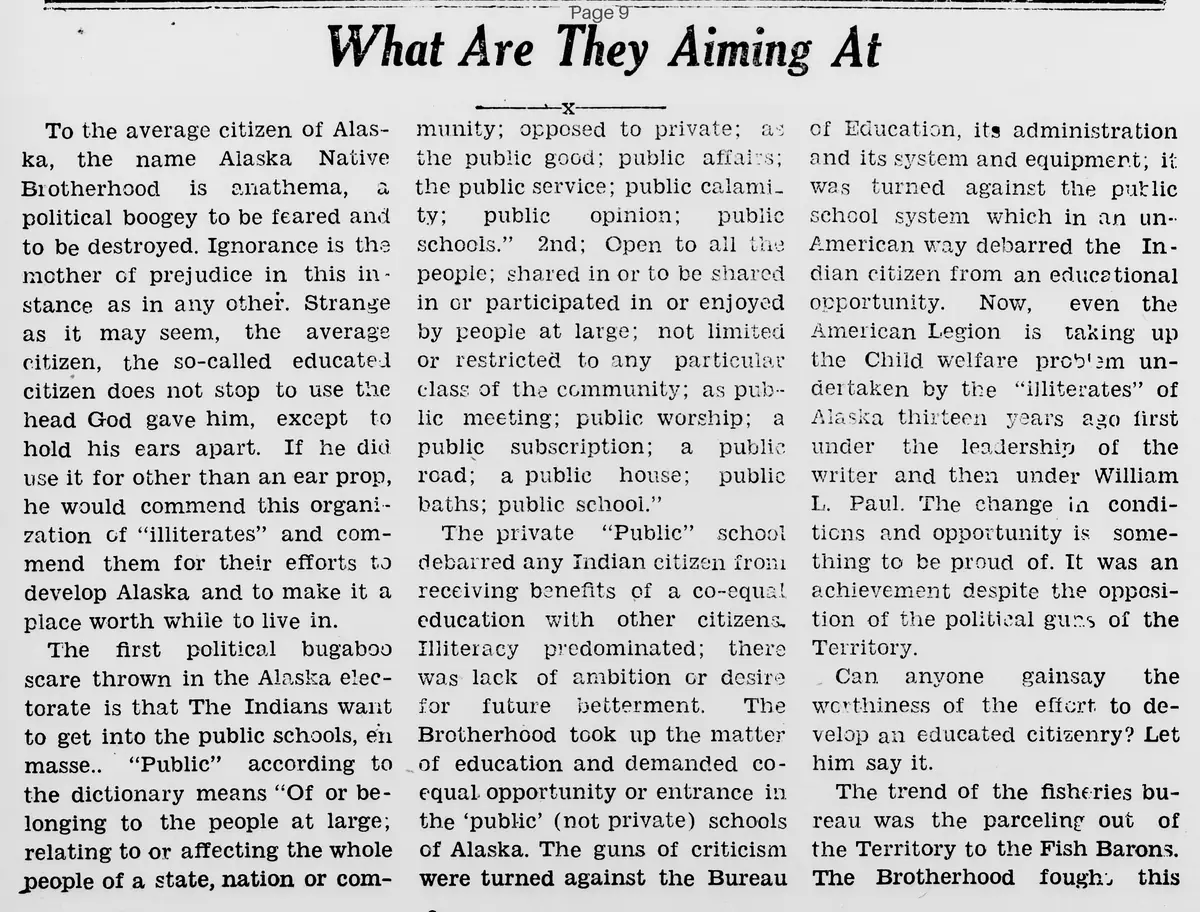
What Are They Aiming At
To the average citizen of Alaska, the name Alaska Native Brotherhood is anathema. A political boogey to be feared and to be destroyed. Ignorance is the mother of prejudice in this instance as in any other. Strange as it may seem, the average citizen, the so-called educated citizen does not stop to use the head God gave him, except to hold his ears apart. If he did use it for other than an ear prop, he would commend this organization of "illiterates" and commend them for their efforts to develop Alaska and to make it a place worth while to live in.
The first political bugaboo scare thrown in the Alaska electorate is that The Indians want to get into the public schools, en masse. "Public" according to the dictionary means "Of or belonging to the people at large; relating to or affecting the whole people of a state, nation or community; opposed to private; as the public good; public affairs; the public service; public calamity; public opinion; public schools."
2nd; Open to all the people; shared in or to be shared in or participated in or enjoyed by people at large; not limited or restricted to any particular class of the community; as public meeting; public worship; a public subscription; a public road; a public house; public baths; public school."
The private "Public" school debarred any Indian citizen from receiving benefits of a co-equal education with other citizens.
Illiteracy predominated; there was lack of ambition or desire for future betterment. The Brotherhood took up the matter of education and demanded co-equal opportunity or entrance in the 'public' (not private) schools of Alaska. The guns of criticism were turned against the Bureau of Education, its administration and its system and equipment; it was turned against the public school system which in an un-American way debarred the Indian citizen from an educational opportunity.
Now, even the American Legion is taking up the Child welfare problem undertaken by the "illiterates" of Alaska thirteen years ago first under the leadership of the writer and then under William L. Paul. The change in conditions and opportunity is something to be proud of. It was an achievement despite the opposition of the political guns of the Territory.
Can anyone gainsay the worthiness of the effort to develop an educated citizenry? Let him say it.
The trend of the fisheries bureau was the parceling out of the Territory to the Fish Barons. The Brotherhood fought this
and defeated through Delegate Dan Sutherland, the "Fishery Reservation System" promulgated by Henry O'Malley at the instigation of the Alaska Packers' Association in San Francisco, at a banquet tendered by them. It opposed the trap system as a scientific machine of destruction that was too efficient in its destruction of the fisheries: it opposed the discriminatory regulations of the Bureau of Fisheries—discriminations which have led to the elimination of resident fishermen from the industry. Which elimination takes from resident business more than 75 percent trade worth and hands it over to non-resident trap owners and watchmen. The resident seiners were allowed such crumbs as fell from the tables during the wild orgy of the canning season.
Is this demand for an economic existence an effort to be condemned by the packing industry itself which has been driving on the rocks of self-destruction? Is this demand for financial betterment an effort to destroy business in the Territory? Is it worth any support?
There have not been many business men who will contradict our assertion that we are working for a better territory But, not many have the courage of their convictions.
To secure these ends, this organization has had to enter politics. But what organization is NOT in politics in Alaska. What public function is not a part of politics in any country - what development can any group of people effect without political action? So in politics went the organization for which it . was damned- -is being damned -will continue to be damned -until it changes its brand of party. Then it will be damned again by i:s former colleages (?) and so the organization will continue in politics until it has secured for itself and the Territory, those benefits which will make the Territory a better place to live in.
The white population, in a large measure has not had the courage of its convictions. Is yells but when it comes to political or any other action-they want the Indians to do it.
Perhaps there may be another "tea party," only in Alaska if we judge correctly, it will be a "trap party" unless the powers that be give heed to the pleas of these citizens of Alaska to secure a decent, educational wage.
To the average citizen of Alaska, the name Alaska Native Brotherhood is anathema. A political boogey to be feared and to be destroyed. Ignorance is the mother of prejudice in this instance as in any other. Strange as it may seem, the average citizen, the so-called educated citizen does not stop to use the head God gave him, except to hold his ears apart. If he did use it for other than an ear prop, he would commend this organization of "illiterates" and commend them for their efforts to develop Alaska and to make it a place worth while to live in.
The first political bugaboo scare thrown in the Alaska electorate is that The Indians want to get into the public schools, en masse. "Public" according to the dictionary means "Of or belonging to the people at large; relating to or affecting the whole people of a state, nation or community; opposed to private; as the public good; public affairs; the public service; public calamity; public opinion; public schools."
2nd; Open to all the people; shared in or to be shared in or participated in or enjoyed by people at large; not limited or restricted to any particular class of the community; as public meeting; public worship; a public subscription; a public road; a public house; public baths; public school."
The private "Public" school debarred any Indian citizen from receiving benefits of a co-equal education with other citizens.
Illiteracy predominated; there was lack of ambition or desire for future betterment. The Brotherhood took up the matter of education and demanded co-equal opportunity or entrance in the 'public' (not private) schools of Alaska. The guns of criticism were turned against the Bureau of Education, its administration and its system and equipment; it was turned against the public school system which in an un-American way debarred the Indian citizen from an educational opportunity.
Now, even the American Legion is taking up the Child welfare problem undertaken by the "illiterates" of Alaska thirteen years ago first under the leadership of the writer and then under William L. Paul. The change in conditions and opportunity is something to be proud of. It was an achievement despite the opposition of the political guns of the Territory.
Can anyone gainsay the worthiness of the effort to develop an educated citizenry? Let him say it.
The trend of the fisheries bureau was the parceling out of the Territory to the Fish Barons. The Brotherhood fought this
and defeated through Delegate Dan Sutherland, the "Fishery Reservation System" promulgated by Henry O'Malley at the instigation of the Alaska Packers' Association in San Francisco, at a banquet tendered by them. It opposed the trap system as a scientific machine of destruction that was too efficient in its destruction of the fisheries: it opposed the discriminatory regulations of the Bureau of Fisheries—discriminations which have led to the elimination of resident fishermen from the industry. Which elimination takes from resident business more than 75 percent trade worth and hands it over to non-resident trap owners and watchmen. The resident seiners were allowed such crumbs as fell from the tables during the wild orgy of the canning season.
Is this demand for an economic existence an effort to be condemned by the packing industry itself which has been driving on the rocks of self-destruction? Is this demand for financial betterment an effort to destroy business in the Territory? Is it worth any support?
There have not been many business men who will contradict our assertion that we are working for a better territory But, not many have the courage of their convictions.
To secure these ends, this organization has had to enter politics. But what organization is NOT in politics in Alaska. What public function is not a part of politics in any country - what development can any group of people effect without political action? So in politics went the organization for which it . was damned- -is being damned -will continue to be damned -until it changes its brand of party. Then it will be damned again by i:s former colleages (?) and so the organization will continue in politics until it has secured for itself and the Territory, those benefits which will make the Territory a better place to live in.
The white population, in a large measure has not had the courage of its convictions. Is yells but when it comes to political or any other action-they want the Indians to do it.
Perhaps there may be another "tea party," only in Alaska if we judge correctly, it will be a "trap party" unless the powers that be give heed to the pleas of these citizens of Alaska to secure a decent, educational wage.
What sub-type of article is it?
Indian Affairs
Education
Trade Or Commerce
What keywords are associated?
Alaska Native Brotherhood
Indian Education
Public Schools
Fisheries Regulation
Trap System
Discriminatory Policies
Child Welfare
Economic Betterment
What entities or persons were involved?
Alaska Native Brotherhood
William L. Paul
Delegate Dan Sutherland
Henry O'malley
Alaska Packers' Association
Bureau Of Education
American Legion
Bureau Of Fisheries
Editorial Details
Primary Topic
Defense Of Alaska Native Brotherhood's Advocacy For Native Education And Fisheries Reform
Stance / Tone
Strongly Supportive And Defensive Against Prejudice
Key Figures
Alaska Native Brotherhood
William L. Paul
Delegate Dan Sutherland
Henry O'malley
Alaska Packers' Association
Bureau Of Education
American Legion
Bureau Of Fisheries
Key Arguments
Ignorance Fuels Prejudice Against Alaska Native Brotherhood
Public Schools Should Be Open To All Citizens Including Indians
Brotherhood Fought For Co Equal Educational Opportunities
Opposed Discriminatory Fisheries Policies Favoring Non Residents
Defeated Fishery Reservation System Through Political Action
Advocated For Child Welfare And Economic Betterment For Residents
Political Involvement Necessary For Development