Thank you for visiting SNEWPapers!
Sign up free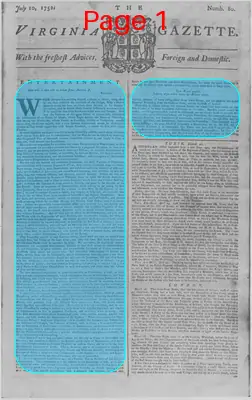
Literary
July 10, 1752
The Virginia Gazette
Richmond, Williamsburg, Richmond County, Virginia
What is this article about?
An essay exploring the rarity and requirements of true friendship, drawing on Socrates' views and discussing obstacles like selfishness, mutability, and differing principles in politics and religion, emphasizing mutual esteem, love, and shared virtues for lasting bonds.
Clipping
OCR Quality
95%
Excellent
Full Text
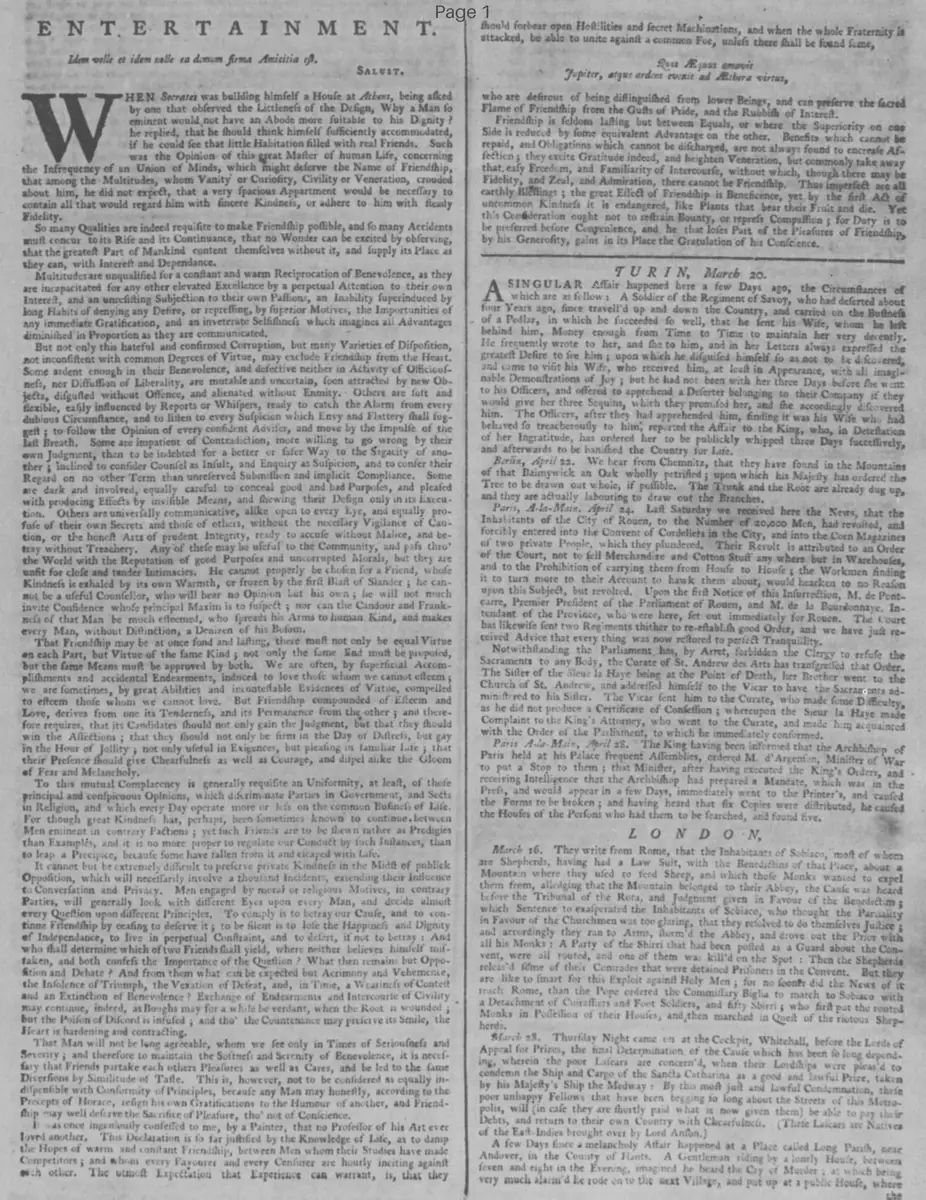
ENTERTAINMENT.
Idem velle et idem nolle ea demum firma amicitia est.
SALLUST.
Socrates was building himself a House at Athens, being asked by one that observed the Littleness of the Design, Why a Man of eminent would not have an Abode more Suitable to his Dignity? he replied, that he should think himself sufficiently accommodated, if he could see that little Habitation filled with real Friends. Such was the Opinion of this great Master of human Life, concerning the Infrequency of an Union of Minds, which might deserve the Name of Friendship, that among the Multitudes, whom Vanity or Curiosity, Civility or Veneration, crowded about him, he did not expect, that a very spacious Apartment would be necessary to contain all that would regard him with sincere Kindness, or adhere to him with steady Fidelity.
So many Qualities are indeed requisite to make Friendship possible, and So many Accidents must concur to its Rise and its Continuance, that no Wonder can be excited by observing, that the greatest Part of Mankind content themselves without it, and supply its Place as they can, with Interest and Dependance.
Multitudes are unqualified for a constant and warm Reciprocation of Benevolence, as they are incapacitated for any other elevated Excellence by a perpetual Attention to their own Interest, and an unresisting Subjection to their own Passions, an Inability superinduced by long Habits of denying any Desire, or repressing, by superior Motives, the Importunities of any immediate Gratification, and an inveterate Selfishness which imagines all Advantages diminished as they are communicated.
But not only this hateful and confirmed Corruption, but many Varieties of Disposition, not inconsistent with common Degrees of Virtue, may exclude Friendship from the Heart.
Some ardent enough in their Benevolence, and defective neither in Activity of Officiousness, nor Diffusion of Liberality, are mutable and uncertain, soon attracted by new Objects, disgusted without Offence, and alienated without Enmity.
Others are soft and flexible, easily influenced by Reports or Whispers, ready to catch the Alarm from every dubious Circumstance, and to listen to every Suspicion which Envy and Flattery shall suggest; to follow the Opinion of every confident Adviser, and move by the impulse of the Last Breath.
Some are impatient of Contradiction, more willing to go wrong by their own Judgment, than to be indebted for a better or safer Way to the Sagacity of another; inclined to consider Counsel as Insult, and Enquiry as Suspicion, and to confer their Regard on no other Term than unreserved Submission and implicit Compliance.
Some are dark and involved, equally careful to conceal good and bad Purposes, and pleased with producing Effects by invisible Means, and shewing their Design only in its Execution.
Others are universally communicative, alike open to every Lye, and equally prodigal of their own Secrets and those of others, without the necessary Vigilance of Caution, or the honest Arts of prudent Integrity, ready to accuse without Malice, and betray without Treachery.
Any of these may be useful to the Community, and pass thro' the World with the Reputation of good Purposes and uncorrupted Morals, but they are unfit for close and tender Intimacies.
He cannot properly be chosen for a Friend, whose Kindness is exhaled by its own Warmth, or frozen by the first Blast of Slander; he cannot be a useful Counsellor, who will hear no Opinion but his own; he will not much invite Confidence whose principal Maxim is to suspect; nor can the Candour and Frankness of that Man be much esteemed, who spreads his Arms to human Kind, and makes every Man, without Distinction, a Denizen of his Bosom.
That Friendship may be at once fond and lasting, there must not only be equal Virtue in each Part, but Virtue of the same Kind; not only the same End must be proposed, but the same Means must be approved by both.
We are often, by superficial Accomplishments and accidental Endearments, induced to love those whom we cannot esteem; we are sometimes, by great Abilities and incontestable Evidences of Value, compelled to esteem those whom we cannot love.
But Friendship compounded of Esteem and Love, derives from one its Tenderness, and its Permanence from the other; and therefore requires, that its Candidates should not only gain the Judgment, but that they should win the Affections; that they should not only be firm in the Day of Distress, but gay in the Hour of Jollity; not only useful in Exigences, but pleasing in familiar Life; that their Presence should give Cheerfulness as well as Courage, and dispel alike the Gloom of Fear and Melancholy.
To this mutual Complacency is generally requisite an Uniformity, at least, of those principal and conspicuous Opinions, which discriminate Parties in Government, and Sects in Religion, and which every Day operate more or less on the common Business of Life.
For though great Kindness has, perhaps, been sometimes known to continue between Men eminent in contrary Factions; yet such Friends are to be thewn rather as Prodigies than Examples, and it is no more proper to regulate our Conduct by such Instances, than to leap a Precipice, because some have fallen from it and escaped with Life.
It cannot but be extremely difficult to preserve private Kindness in the Midst of publick Opposition, which will necessarily involve a thousand Incidents, extending their Influence to Conversation and Privacy.
Men engaged by moral or religious Motives, in contrary Parties, will generally look with different Eyes upon every Man, and decide almost every Question upon different Principles.
To comply is to betray our Cause, and to continue Friendship by ceasing to deserve it; to be silent is to lose the Happiness and Dignity of Independance, to live in perpetual Constraint, and to desert, if not to betray: And who shall determine which of two Friends shall yield, where neither believes himself mistaken, and both confess the Importance of the Question?
What then remains but Opposition and Debate? And from them what can be expected but Acrimony and Vehemence, the Insolence of Triumph, the Vexation of Defeat, and, in Time, a Weariness of Contest and an Extinction of Benevolence?
Exchange of Endearments and Intercourse of Civility may continue, indeed, as Boughs may for a while be verdant, when the Root is wounded; but the Poison of Discord is infused; and tho' the Countenance may preserve its Smile, the Heart is hardening and contracting.
That Man will not be long agreeable, whom we see only in Times of Seriousness and Severity; and therefore to maintain the Softness and Serenity of Benevolence, it is necessary that Friends partake each others Pleasures as well as Cares, and be led to the same Diversions by Similitude of Taste.
This is, however, not to be considered as equally indispensible with Conformity of Principles, because any Man may honestly, according to the Precepts of Horace, resign his own Gratifications to the Humour of another, and Friendship may well deserve the Sacrifice of Pleasure, tho' not of Conscience.
It does once ingeniously confessed to me, by a Painter, that no Professor of his Art ever loved another.
This Declaration is so far justified by the Knowledge of Life, as to damp the Hopes of warm and constant Friendship between Men whom their Studies have made Competitors; and whom every Favourer and every Censor are hourly inciting against each other.
The utmost Expectation that Experience can warrant, is, that they Should forbear open Hostilities and Secret Machinations, and when the whole Fraternity is attacked, be able to unite against a common Foe, unless there shall be found some, who are desirous of being distinguished from lower Beings, and can preserve the sacred Flame of Friendship from the Gusts of Pride, and the Rubbish of Interest.
Friendship is Seldom lasting but between Equals, or where the Superiority on one Side is reduced by some equivalent Advantage on the other.
Benefits which cannot be repaid, and Obligations which cannot be discharged, are not always found to encrease Affection; they excite Gratitude indeed, and heighten Veneration, but commonly take away that easy Freedom, and Familiarity of Intercourse, without which, though there may be Fidelity, and Zeal, and Admiration, there cannot be Friendship.
Thus imperfect are all earthly Blessings; the great Effect of Friendship is Beneficence, yet by the first Act of uncommon Kindness it is endangered, like Plants that bear their Fruit and die.
Yet this Consideration ought not to restrain Bounty, or repress Compassion; for Duty is to be preferred before Convenience, and he that loses Part of the Pleasures of Friendship by his Generosity, gains in its Place the Gratulation of his Conscience.
Quas ejus amovit Jupiter, atque ardens evexit ad ethera virtus.
VIRG.
Idem velle et idem nolle ea demum firma amicitia est.
SALLUST.
Socrates was building himself a House at Athens, being asked by one that observed the Littleness of the Design, Why a Man of eminent would not have an Abode more Suitable to his Dignity? he replied, that he should think himself sufficiently accommodated, if he could see that little Habitation filled with real Friends. Such was the Opinion of this great Master of human Life, concerning the Infrequency of an Union of Minds, which might deserve the Name of Friendship, that among the Multitudes, whom Vanity or Curiosity, Civility or Veneration, crowded about him, he did not expect, that a very spacious Apartment would be necessary to contain all that would regard him with sincere Kindness, or adhere to him with steady Fidelity.
So many Qualities are indeed requisite to make Friendship possible, and So many Accidents must concur to its Rise and its Continuance, that no Wonder can be excited by observing, that the greatest Part of Mankind content themselves without it, and supply its Place as they can, with Interest and Dependance.
Multitudes are unqualified for a constant and warm Reciprocation of Benevolence, as they are incapacitated for any other elevated Excellence by a perpetual Attention to their own Interest, and an unresisting Subjection to their own Passions, an Inability superinduced by long Habits of denying any Desire, or repressing, by superior Motives, the Importunities of any immediate Gratification, and an inveterate Selfishness which imagines all Advantages diminished as they are communicated.
But not only this hateful and confirmed Corruption, but many Varieties of Disposition, not inconsistent with common Degrees of Virtue, may exclude Friendship from the Heart.
Some ardent enough in their Benevolence, and defective neither in Activity of Officiousness, nor Diffusion of Liberality, are mutable and uncertain, soon attracted by new Objects, disgusted without Offence, and alienated without Enmity.
Others are soft and flexible, easily influenced by Reports or Whispers, ready to catch the Alarm from every dubious Circumstance, and to listen to every Suspicion which Envy and Flattery shall suggest; to follow the Opinion of every confident Adviser, and move by the impulse of the Last Breath.
Some are impatient of Contradiction, more willing to go wrong by their own Judgment, than to be indebted for a better or safer Way to the Sagacity of another; inclined to consider Counsel as Insult, and Enquiry as Suspicion, and to confer their Regard on no other Term than unreserved Submission and implicit Compliance.
Some are dark and involved, equally careful to conceal good and bad Purposes, and pleased with producing Effects by invisible Means, and shewing their Design only in its Execution.
Others are universally communicative, alike open to every Lye, and equally prodigal of their own Secrets and those of others, without the necessary Vigilance of Caution, or the honest Arts of prudent Integrity, ready to accuse without Malice, and betray without Treachery.
Any of these may be useful to the Community, and pass thro' the World with the Reputation of good Purposes and uncorrupted Morals, but they are unfit for close and tender Intimacies.
He cannot properly be chosen for a Friend, whose Kindness is exhaled by its own Warmth, or frozen by the first Blast of Slander; he cannot be a useful Counsellor, who will hear no Opinion but his own; he will not much invite Confidence whose principal Maxim is to suspect; nor can the Candour and Frankness of that Man be much esteemed, who spreads his Arms to human Kind, and makes every Man, without Distinction, a Denizen of his Bosom.
That Friendship may be at once fond and lasting, there must not only be equal Virtue in each Part, but Virtue of the same Kind; not only the same End must be proposed, but the same Means must be approved by both.
We are often, by superficial Accomplishments and accidental Endearments, induced to love those whom we cannot esteem; we are sometimes, by great Abilities and incontestable Evidences of Value, compelled to esteem those whom we cannot love.
But Friendship compounded of Esteem and Love, derives from one its Tenderness, and its Permanence from the other; and therefore requires, that its Candidates should not only gain the Judgment, but that they should win the Affections; that they should not only be firm in the Day of Distress, but gay in the Hour of Jollity; not only useful in Exigences, but pleasing in familiar Life; that their Presence should give Cheerfulness as well as Courage, and dispel alike the Gloom of Fear and Melancholy.
To this mutual Complacency is generally requisite an Uniformity, at least, of those principal and conspicuous Opinions, which discriminate Parties in Government, and Sects in Religion, and which every Day operate more or less on the common Business of Life.
For though great Kindness has, perhaps, been sometimes known to continue between Men eminent in contrary Factions; yet such Friends are to be thewn rather as Prodigies than Examples, and it is no more proper to regulate our Conduct by such Instances, than to leap a Precipice, because some have fallen from it and escaped with Life.
It cannot but be extremely difficult to preserve private Kindness in the Midst of publick Opposition, which will necessarily involve a thousand Incidents, extending their Influence to Conversation and Privacy.
Men engaged by moral or religious Motives, in contrary Parties, will generally look with different Eyes upon every Man, and decide almost every Question upon different Principles.
To comply is to betray our Cause, and to continue Friendship by ceasing to deserve it; to be silent is to lose the Happiness and Dignity of Independance, to live in perpetual Constraint, and to desert, if not to betray: And who shall determine which of two Friends shall yield, where neither believes himself mistaken, and both confess the Importance of the Question?
What then remains but Opposition and Debate? And from them what can be expected but Acrimony and Vehemence, the Insolence of Triumph, the Vexation of Defeat, and, in Time, a Weariness of Contest and an Extinction of Benevolence?
Exchange of Endearments and Intercourse of Civility may continue, indeed, as Boughs may for a while be verdant, when the Root is wounded; but the Poison of Discord is infused; and tho' the Countenance may preserve its Smile, the Heart is hardening and contracting.
That Man will not be long agreeable, whom we see only in Times of Seriousness and Severity; and therefore to maintain the Softness and Serenity of Benevolence, it is necessary that Friends partake each others Pleasures as well as Cares, and be led to the same Diversions by Similitude of Taste.
This is, however, not to be considered as equally indispensible with Conformity of Principles, because any Man may honestly, according to the Precepts of Horace, resign his own Gratifications to the Humour of another, and Friendship may well deserve the Sacrifice of Pleasure, tho' not of Conscience.
It does once ingeniously confessed to me, by a Painter, that no Professor of his Art ever loved another.
This Declaration is so far justified by the Knowledge of Life, as to damp the Hopes of warm and constant Friendship between Men whom their Studies have made Competitors; and whom every Favourer and every Censor are hourly inciting against each other.
The utmost Expectation that Experience can warrant, is, that they Should forbear open Hostilities and Secret Machinations, and when the whole Fraternity is attacked, be able to unite against a common Foe, unless there shall be found some, who are desirous of being distinguished from lower Beings, and can preserve the sacred Flame of Friendship from the Gusts of Pride, and the Rubbish of Interest.
Friendship is Seldom lasting but between Equals, or where the Superiority on one Side is reduced by some equivalent Advantage on the other.
Benefits which cannot be repaid, and Obligations which cannot be discharged, are not always found to encrease Affection; they excite Gratitude indeed, and heighten Veneration, but commonly take away that easy Freedom, and Familiarity of Intercourse, without which, though there may be Fidelity, and Zeal, and Admiration, there cannot be Friendship.
Thus imperfect are all earthly Blessings; the great Effect of Friendship is Beneficence, yet by the first Act of uncommon Kindness it is endangered, like Plants that bear their Fruit and die.
Yet this Consideration ought not to restrain Bounty, or repress Compassion; for Duty is to be preferred before Convenience, and he that loses Part of the Pleasures of Friendship by his Generosity, gains in its Place the Gratulation of his Conscience.
Quas ejus amovit Jupiter, atque ardens evexit ad ethera virtus.
VIRG.
What sub-type of article is it?
Essay
What themes does it cover?
Friendship
Moral Virtue
Political
What keywords are associated?
Friendship
Benevolence
Virtue
Esteem
Loyalty
Principles
Politics
Religion
Literary Details
Key Lines
Idem Velle Et Idem Nolle Ea Demum Firma Amicitia Est.
Socrates Was Building Himself A House At Athens, Being Asked By One That Observed The Littleness Of The Design, Why A Man Of Eminent Would Not Have An Abode More Suitable To His Dignity? He Replied, That He Should Think Himself Sufficiently Accommodated, If He Could See That Little Habitation Filled With Real Friends.
That Friendship May Be At Once Fond And Lasting, There Must Not Only Be Equal Virtue In Each Part, But Virtue Of The Same Kind; Not Only The Same End Must Be Proposed, But The Same Means Must Be Approved By Both.
Friendship Is Seldom Lasting But Between Equals, Or Where The Superiority On One Side Is Reduced By Some Equivalent Advantage On The Other.
Quas Ejus Amovit Jupiter, Atque Ardens Evexit Ad Ethera Virtus.