Thank you for visiting SNEWPapers!
Sign up free
Southern Telegraph
Rodney, Jefferson County, Mississippi
What is this article about?
Excerpt from Rev. Orville Dewey's 'Moral Views of Commerce, Society and Politics' titled 'Thoughts on Society,' discussing social exclusiveness, the dignity of human nature, and the freedom of opinion, critiquing societal hierarchies, moral compromises, and the need for independent thought.
Merged-components note: Merged consecutive excerpts from 'Moral Views of Commerce, Society and Politics' by Rev. Orville Dewey into a single literary component.
Clipping
OCR Quality
Full Text
From Moral Views of Commerce, Society and Politics; by Rev. Orville Dewey.
SOCIAL EXCLUSIVENESS.
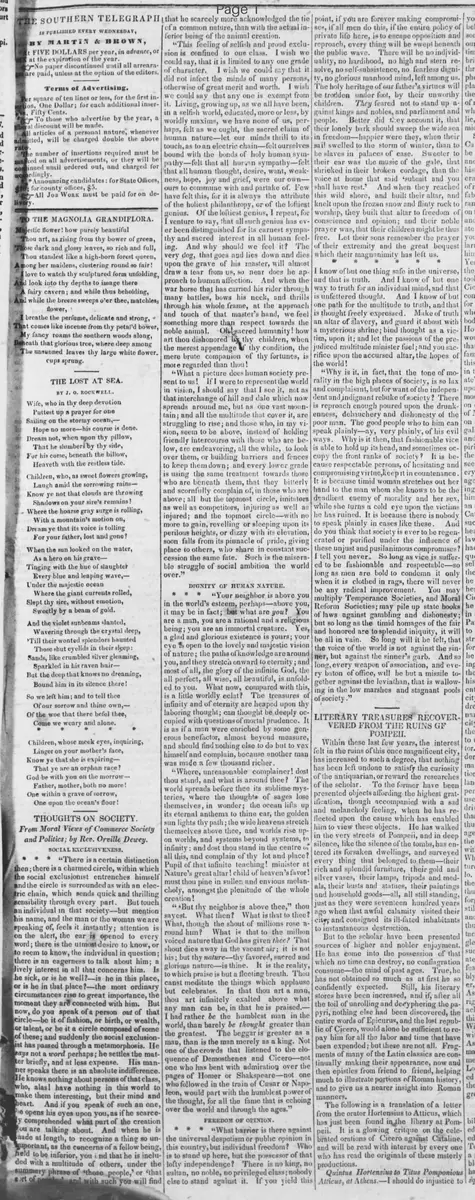
"There is a certain distinction then; there is a charmed circle, within which the social exclusionist entrenches himself and the circle is surrounded as with an electric chain, which sends quick and thrilling sensibility through every part. But touch an individual in that society—but mention his name, and the man or the woman we are speaking of, feels it instantly; attention is on the alert, the ear is opened to every word; there is the utmost desire to know, or to seem to know, the individual in question; there is an eagerness to talk about him; a lively interest in all that concerns him. Is he sick, or is he well?—is he in this place, or is he in that place?—the most ordinary circumstances rise to great importance, the moment they are connected with him. But now, do you speak of a person out of that circle—be it of fashion, or birth, or wealth, or talent, or be it a circle composed of some of these; and suddenly the social exclusionist has passed through a metamorphosis. He says not a word perhaps; he settles the matter briefly, and at less expense. His manner speaks—there is an absolute indifference. He knows nothing about persons of that class, who, alas! have nothing in this world to make them interesting, but their mind and heart. And if you speak of such an one, he opens his eyes upon you, as if he scarcely comprehended what part of the creation you are talking about. And when he is made at length, to recognize a thing so unimportant, as the concerns of a fellow being, held to be inferior, you find that he is included with a multitude of others, under the summary phrase of 'those people,' or 'that sort of people' and with such you will find that he scarcely more acknowledged the tie of a common nature, than with the actual inferior being of the animal creation.
"This feeling of selfish and proud exclusion is confined to one class. I wish we could say, that it is limited to any one grade of character. I wish we could say that it did not infect the minds of many persons, otherwise of great merit and worth. I wish we could say that any one is exempt from it. Living, growing up, as we all have been, in a selfish world, educated, more or less, by worldly maxims, we have none of us, perhaps, felt as we ought, the sacred claim of human nature—let our minds thrill to its touch, as to an electric chain—felt ourselves bound with the bonds of holy human sympathy—felt that all human sympathy—felt that all human thought, desire, want, weakness, hope, joy and grief, were our own—ours to commune with and partake of. Few have felt this, for it is always the attribute of the holiest philanthropy, or of the loftiest genius. Of the loftiest genius, I repeat, for I venture to say, that all such genius has ever been distinguished for its earnest sympathy and sacred interest in all human feeling. And why should we feel it? The very dog, that goes and lies down and dies upon the grave of his master, will almost draw a tear from us, so near does he approach to human affection. And when the war horse that has carried his rider through many battles, bows his neck, and thrills through his whole frame, at the approach and touch of that master's hand, we feel something more than respect towards the noble animal. O sacred humanity! how art thou dishonored by thy children, when the merest appendage of thy condition, the mere brute companion of thy fortunes, is more regarded than thou!
"What a picture does human society present to us! If I were to represent the world in vision, I should say that I see it, not as that interchange of hill and dale which now spreads around me, but as one vast mountain; and all the multitude that cover it, are struggling to rise; and those who, in my vision, seem to be above, instead of holding friendly intercourse with those who are below, are endeavoring, all the while, to look over them, or building barriers and fences to keep them down; and every lower grade is using the same treatment towards those who are beneath them, that they bitterly and scornfully complain of, in those who are above: all but the topmost circle, imitators as well as competitors, injuring as well as injured; and the topmost circle with no more to gain, revelling or sleeping upon its perilous heights, or dizzy with its elevation, soon falls from its pinnacle of pride, giving place to others, who share in constant succession the same fate. Such is the miserable struggle of social ambition the world over."
DIGNITY OF HUMAN NATURE.
"Your neighbor is above you in the world's esteem, perhaps—above you, it may be in fact; but what are you? You are a man, you are a rational and a religious being: you are an immortal creature. Yes, a glad and glorious existence is yours; your eyes open to the lovely and majestic vision of nature; the paths of knowledge are around you, and they stretch onward to eternity; and most of all, the glory of the infinite God, the all perfect, all wise, all beautiful, is unfolded to you. What now, compared with this is a little worldly eclat? The treasures of infinity and of eternity are heaped upon thy laboring thought; can thought be deeply occupied with questions of mortal prudence. It is as if a man were enriched by some generous benefactor, almost beyond measure, and should find nothing else to do but to vex himself and complain, because another man was made a few thousand richer.
"Where, unreasonable complainer! dost thou stand, and what is around thee? The world spreads before thee its sublime mysteries, where the thoughts of sages lose themselves, in wonder; the ocean lifts up its eternal anthem to thine ear, the golden sun lights thy path; the wide heavens stretch themselves above thee, and worlds rise up—on worlds, and systems beyond systems, to infinity: and dost thou stand in the centre of all this, and complain of thy lot and place? Pupil of that infinite teaching! minister at Nature's great altar! child of heaven's favor! must thou pine in sullen and envious melancholy, amongst the plenitude of the whole creation!
"But thy neighbor is above thee," thou sayest. What then? What is that to thee? What, though the shout of millions rose around him? What is that to the million voiced nature that God has given thee? That shout dies away in the vacant air; it is not his: but thy nature—thy favored, sacred and glorious nature—is thine. It is the reality, to which praise is but a fleeting breath. Thou canst meditate the things which applause but celebrates. In that thou art a man, thou art infinitely exalted above what any man can be, in that he is praised.—I had rather be the humblest man in the world, than barely be thought greater than the greatest. The beggar is greater as a man, than is the man merely as a king. Not one of the crowds that listened to the eloquence of Demosthenes and Cicero—not one who has bent with admiration over the pages of Homer or Shakspeare—not one who followed in the train of Caesar or Napoleon, would part with the humblest power of the thought, for all the fame that is echoing over the world and through the ages."
FREEDOM OF OPINION.
* * "What barrier is there against the universal despotism of public opinion in this country, but individual freedom? Who is to stand up here, but the possessor of that lofty independence? There is no king, no sultan, no noble, no privileged class; nobody else to stand against it. If you yield this point, if you are forever making compromises, if all men do this, if the entire policy of private life here, is to escape opposition and reproach, every thing will be swept beneath the public wave. There will be no individuality, no hardihood, no high and stern resolve, no self-subsistence, no fearless dignity, no glorious manhood mind, left among us. The holy heritage of our father's virtues will be trodden under foot, by their unworthy children. They feared not to stand up against kings and nobles, and parliament and people. Better did they account it, that their lonely bark should sweep the wide sea in freedom—happier were they, when their sail swelled to the storm of winter, than to be slaves in palaces of ease. Sweeter to their ear was the music of the gale, that shrieked in their broken cordage, than the voice at home that said 'submit and you shall have rest.' And when they reached this wild shore, and built their altar, and knelt upon the frozen snow and flinty rock to worship, they built that altar to freedom of conscience and opinion; and their noble prayer was, that their children might be thus free. Let their sons remember the prayer of their extremity and the great bequest which their magnanimity has left us.
I know of but one thing safe in the universe, and that is truth. And I know of but one way to truth for an individual mind, and that is unfettered thought. And I know of but one path for the multitude to truth, and that is thought freely expressed. Make of truth an altar of slavery, and guard it about with a mysterious shrine; bind thought as a victim, upon it; and let the passions of the prejudiced multitude minister fuel; and you sacrifice upon the accursed altar, the hopes of the world!
"Why is it, in fact, that the tone of morality in the high places of society, is so lax and complaisant, but for want of the independent and indignant rebuke of society? There is reproach enough poured upon the drunkenness, debauchery and dishonesty of the poor man. The good people who to him can speak plainly—ay, very plainly, of his evil ways. Why is it then, that fashionable vice is able to hold up its head, and sometimes occupy the front ranks of society? It is because respectable persons, of hesitating and compromising virtue, keep it in countenance. It is because timid woman stretches out her hand to the man whom she knows to be the deadliest enemy of morality and her sex, while she turns a cold eye upon the victims he has ruined. It is because there is nobody to speak plainly in cases like these. And do you think that society is ever to be regenerated or purified under the influence of these unjust and pusillanimous compromises? I tell you never. So long as vice is suffered to be fashionable and respectable—so long as men are bold to condemn it only when it is clothed in rags, there will never be any radical improvement. You may multiply Temperance Societies, and Moral Reform Societies; may pile up state books of laws against gambling and dishonesty; but so long as the timid homages of the fair and honored are to splendid iniquity, it will be all in vain. So long will it be felt, that the voice of the world is not against the sinner, but against the sinner's garb. And so long, every weapon of association, and every baton of office, will be but a missile together against the leviathan, that is wallowing in the low marshes and stagnant pools of society."
What sub-type of article is it?
What themes does it cover?
What keywords are associated?
What entities or persons were involved?
Literary Details
Title
Thoughts On Society.
Author
From Moral Views Of Commerce, Society And Politics; By Rev. Orville Dewey.
Subject
Reflections On Social Exclusiveness, Dignity Of Human Nature, And Freedom Of Opinion.
Form / Style
Prose Reflections In Essay Form.
Key Lines