Thank you for visiting SNEWPapers!
Sign up free
Story
September 6, 1901
The Coalville Times
Coalville, Summit County, Utah
What is this article about?
Ohio Experiment Station combats chinch bug outbreak with fungus packages and recommends Prof. Forbes' 1895 soap-coal oil emulsion spray, plus tar trenches and plowing, drawing from 1888 successes.
Clipping
OCR Quality
98%
Excellent
Full Text
Fighting the Chinch Bug
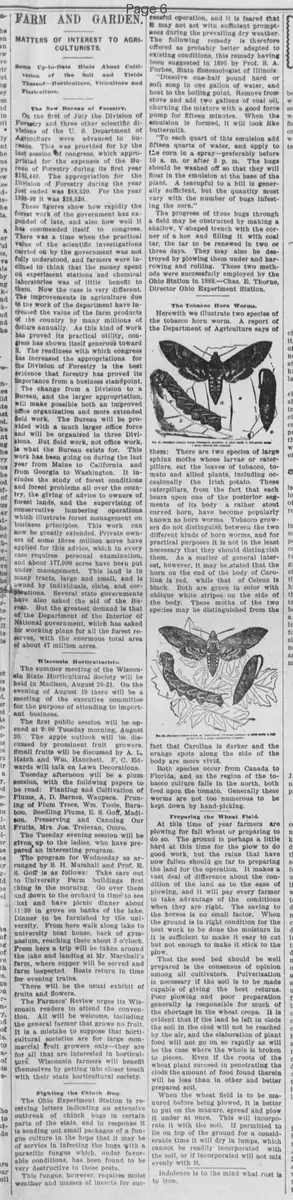
The Ohio Experiment Station is receiving letters indicating an extensive outbreak of chinch bugs in certain parts of the state, and in response it is sending out small packages of a fungus culture in the hope that it may be of service in infecting the bugs with a parasitic fungus which, under favorable conditions, has been found to be very destructive to these pests.
This fungus, however, requires moist weather and masses of insects for successful operation, and it is feared that it may not act with sufficient promptness during the prevailing dry weather. The following remedy is therefore offered as probably better adapted to existing conditions, this remedy having been suggested in 1895 by Prof. S. A. Forbes, State Entomologist of Illinois:
"Dissolve one-half pound hard or soft soap in one gallon of water, and heat to the boiling point. Remove from stove and add two gallons of coal oil, churning the mixture with a good force pump for fifteen minutes. When the emulsion is formed, it will look like buttermilk.
"To each quart of this emulsion add fifteen quarts of water, and apply to the corn in a spray—preferably before 10 a. m. or after 3 p. m. The bugs should be washed off so that they will float in the emulsion at the base of the plant. A teacupful to a hill is generally sufficient, but the quantity must vary with the number of bugs infesting the corn."
The progress of these bugs through a field may be obstructed by making a shallow, V-shaped trench with the corner of a hoe and filling it with coal tar, the tar to be renewed in two or three days. They may also be destroyed by plowing them under and harrowing and rolling. These two methods were successfully employed by the Ohio Station in 1888.—Chas. E. Thorne, Director Ohio Experiment Station.
The Ohio Experiment Station is receiving letters indicating an extensive outbreak of chinch bugs in certain parts of the state, and in response it is sending out small packages of a fungus culture in the hope that it may be of service in infecting the bugs with a parasitic fungus which, under favorable conditions, has been found to be very destructive to these pests.
This fungus, however, requires moist weather and masses of insects for successful operation, and it is feared that it may not act with sufficient promptness during the prevailing dry weather. The following remedy is therefore offered as probably better adapted to existing conditions, this remedy having been suggested in 1895 by Prof. S. A. Forbes, State Entomologist of Illinois:
"Dissolve one-half pound hard or soft soap in one gallon of water, and heat to the boiling point. Remove from stove and add two gallons of coal oil, churning the mixture with a good force pump for fifteen minutes. When the emulsion is formed, it will look like buttermilk.
"To each quart of this emulsion add fifteen quarts of water, and apply to the corn in a spray—preferably before 10 a. m. or after 3 p. m. The bugs should be washed off so that they will float in the emulsion at the base of the plant. A teacupful to a hill is generally sufficient, but the quantity must vary with the number of bugs infesting the corn."
The progress of these bugs through a field may be obstructed by making a shallow, V-shaped trench with the corner of a hoe and filling it with coal tar, the tar to be renewed in two or three days. They may also be destroyed by plowing them under and harrowing and rolling. These two methods were successfully employed by the Ohio Station in 1888.—Chas. E. Thorne, Director Ohio Experiment Station.
What sub-type of article is it?
Agricultural Advice
Pest Control
What keywords are associated?
Chinch Bugs
Fungus Culture
Soap Emulsion
Coal Oil Spray
Tar Trench
Plowing Under
What entities or persons were involved?
Prof. S. A. Forbes
Chas. E. Thorne
Where did it happen?
Ohio
Story Details
Key Persons
Prof. S. A. Forbes
Chas. E. Thorne
Location
Ohio
Event Date
1895
Story Details
The Ohio Experiment Station addresses chinch bug outbreak by sending fungus culture and recommending a soap-coal oil emulsion spray, a tar trench barrier, and plowing under the bugs, based on prior methods from 1888 and 1895.