Thank you for visiting SNEWPapers!
Sign up free
The National Intelligencer And Washington Advertiser
Washington, District Of Columbia
What is this article about?
A pamphlet in England, attributed to Lord Holland, discusses the new Cabinet's views on foreign policy, particularly advocating for neutral rights of the United States in trade with France during the ongoing war, critiquing the Rule of 1756 and arguing against restricting American involvement in French colonial trade.
Merged-components note: Merged two foreign_news components that continue the excerpt from the pamphlet on international relations and neutral trade.
Clippings
1 of 2
OCR Quality
Full Text
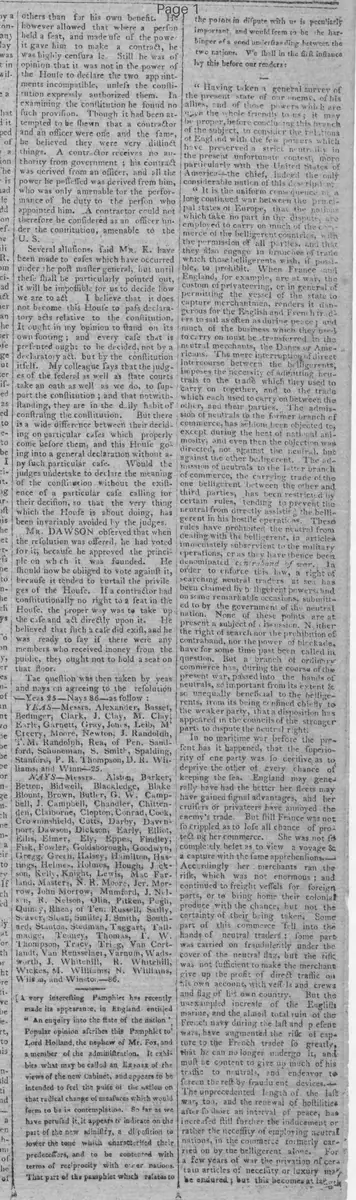
That part of this pamphlet which relates to the points in dispute with us is peculiarly important, and would seem to be the harbinger of a good understanding between the two nations. We shall in the first instance lay this before our readers:
"Having taken a general survey of the present state of our enemy, of his allies, and of those powers which are waiting the whole friendly to us; it may be proper, before concluding this branch of the subject, to consider the relations of England with the few powers which have preserved a strict neutrality in the present unfortunate contest, more particularly with the United States of America—the chief, indeed the only considerable nation of this description.
"It is the uniform consequence of a long continued war between the principal states of Europe, that the nations which take no part in the dispute, are employed to carry on much of the commerce of the belligerent countries, with the permission of all parties, and that they also engage in branches of trade which those belligerents wish, if possible, to prohibit. When France and England, for example, are at war, the custom of privateering, or in general of permitting the vessel of the state to capture merchantmen, renders it dangerous for the English and French traders to sail as often as during peace; and much of the business which they are used to carry on must be transferred to the neutral merchants, the Danes or Americans. The mere interruption of direct intercourse between the belligerents, imposes the necessity of admitting neutrals to the trade which they used to carry on together, and to the trade which each used to carry on between the other, and their colonies. The admission of neutrals to the former branch of commerce, has seldom been objected to, except during the heat of national animosity, and even then the objection was directed, not against the neutral, but against the other belligerent. The admission of neutrals to the latter branch of commerce, the carrying trade of the one belligerent between the other and third parties, has been restricted by certain rules, tending to prevent the neutral from directly assisting the belligerent in his hostile operations. These rules have prohibited the neutral from dealing with the belligerent, in articles immediately subservient to the military operations, or as they have thence been denominated contraband of war. In order to enforce this law, a right of searching neutral traders at sea has been claimed by belligerent powers and, on some remarkable occasions, submitted to by the government of the neutral nation. None of these points are at present a subject of discussion. Neither the right of search nor the prohibition of contraband, nor the power of blockade, have for some time past been called in question. But a branch of ordinary commerce has, during the course of the present war, passed into the hands of neutrals, so important from its extent & so unequally beneficial to the belligerents, from its being confined chiefly to the weaker party, that a disposition has appeared in the councils of the stronger party to dispute the neutral right.
In no maritime war before the present has it happened, that the superiority of one party was so decisive as to deprive the other of every chance of keeping the sea. England may generally have had the better her fleets may have gained signal advantages, and her cruisers or privateers have annoyed the enemy's trade. But still France was not so crippled as to lose all chance of protecting her commerce. She was not so completely blockaded as to view a voyage & a capture with the same apprehensions. Accordingly her merchants ran the risk, which was not enormous; and continued to freight vessels for foreign ports, or to bring home their colonial produce with the chance, but not the certainty of their being taken. Some part of this commerce fell into the hands of neutral traders: some parts was carried on fraudulently under the cover of the neutral flag, but the risk was not sufficient to make the merchant give up the profit of direct traffic on his own account, with vessels and crews and flag of his own country. But the unexampled increase of the English marine, and the almost total ruin of the French navy during the last and present wars, have augmented the risk of capture to the French trader so greatly, that he can no longer undergo it, and must be content to give up much of his traffic to neutrals, and endeavor to screen the rest by fraudulent devices. The unprecedented length of the last war, too, and the renewal of hostilities after so short an interval of peace, has increased still further the inducement or rather the necessity of employing neutral nations, in the commerce formerly carried on by the belligerent alone. For a few years of war the privation of certain articles of necessity or luxury may be endured; but this becomes at last both inconvenient and distressing."
intolerable. and centuries every restraint which either government or the opposing interest of traders can create. Those traders themselves, too, when a war has lasted long, gradually shift their capital into new channels, and withdraw more and more from the hazardous speculations in which, during a short period of hostility, they might be contented or compelled to continue.—
The lines of employment which they thus leave, become, in consequence, open to neutrals, who now carry on the various branches of foreign trade, from which they were formerly excluded. Thus it happened from the combined effects of our astonishing naval superiority, and the unprecedented length of the war, that almost all the foreign commerce of France, and a large proportion even of the coasting trade, have fallen into the hands of neutral nations, and particularly of the Americans, who have the greatest facilities of maritime carriage, and the most extensive commercial system. Among other branches of the French commerce now engrossed by American traders, with the permission of both governments, is that of the colonies. As their trade, during peace, was subject to the strict rules of the navigation law, common to all the maritime powers of Europe, a peculiar objection has been taken to its being suddenly laid open by the enemy to neutrals during war, or the evident purpose of screening it from our just hostility. And this interference of the Americans, in order to aid such a scheme, has been supposed inconsistent with the relations of neutrality which their nation professes to maintain.
"It is in vain the supporters of the belligerent rights contend, that England conquers the French marine, nay, reduces it almost to annihilation. Her ships of war may be captured, but the commerce of France is safe. She may declare war when she pleases; and without a ship that can make head to our weakest cruiser, she has a sure method of at once protecting her whole trade more effectually than if she had the entire command of the seas. She has but to suspend her navigation law, to admit the Americans into her colonial and coasting trade, and to get out no vessel under French colors. The English cruisers may domineer over the sea, and yet they are unable to touch a ton of her trade. She has millions floating on her vessels of neutral nations, which no enemy can reach. She reaps the whole benefits of war with the security of peace.
The rule, it is contended, which should guide us in this quarrel, as the fairest measure of justice to all parties, is, that neutrals can only take part during war, in such branches of commerce as the domestic regulations of the belligerent allowed them to partake in during peace.
This doctrine was recognised, we are told, in the war of 1756, which has never since been disputed, though England has frequently departed from its rigour by voluntary concessions. Its policy is as obvious as its justice, say the enemies of the neutral claims. Were the present principle of unlimited neutral trade to be recognised, England might give over ever pretending to naval power, abandon the hope of curbing French commerce, and despair of gaining anything by a continuance even of the justest war. Should the support of our maritime rights lead to a rupture with the neutrals, which, however, is said to be most improbable, we can lose little by such an addition to the number of our enemies, in comparison of the vast detriment which we now sustain, from those neutrals tying up our hands against all the enemies we have to contend with. Better, say they, have America as well as France hostile, and exposed to our fair attacks, than France openly hostile, and America covertly protecting her from every effort of our enmity. This will give us a chance of speedily terminating the war, or at least secure the opportunity of rendering it both safe and lucrative.
Such is the main body of the argument, in favor of the justice as well as the policy of our reviving the rule of the war of 1756. The chief point at issue is the application of that rule to the colonial trade of the enemy; and, without at all entering into the question of right, we shall proceed to offer a few simple considerations, which may tend to shew that the view of the case, in point of policy, taken by the supporters of the above doctrine, is by no means a correct one, and that the importance of the whole matter at issue in the dispute has been enormously exaggerated. The following observations proceed upon the further admission, that the facts stated by the advocates of belligerent rights are accurately given, and also that wherever a neutral flag is assumed as a cover to the ship and cargo of a belligerent power, such evident a fraud is excepted from the argument. The points to be maintained are, that whatever right England may have to prevent the interference of America in the French colonial trade during war, no material advantage could be gained from the enforcement of such a prohibition; that the real difference between the former and the present method of carrying French colonial produce, and supplying the French colonies, is extremely trifling in its ultimate consequences; and that other reasons, of a very positive nature enjoin a departure from such claims in the present situation of affairs.
To prevent a supply of colonial produce from reaching France, if not directly, at least by a roundabout importation, exceeds the power of the British navy, numerous and victorious as it is. Unless we can surround every port of the French coast with ships, and the land frontiers also with troops; and unless we are still further resolved to prohibit neutral nations from trading with France in their own merchandize, or in merchandize of our colonies, the French people must continue to be supplied with sugar and coffee, whether we are at war with them or not. If we prevent those articles from being carried directly to France from her colonies, a small increase of the price will enable neutrals to import them into their own countries, and then re-export them to France. If we maintain that the mere importation and re-exportation, though accompanied with re-landing of cargoes and payment of duties, is still a collusive transaction, and must be prohibited, as a continuation of the original voyage; then a further increase of price enables the same produce to reach France in different vessels, while the vessels that imported it take other freights. We in fact only oblige the neutrals to have two sets of vessels, one employed between the French colonies and America, the other between America and France.
The total gain of England upon these prohibitory operations, is the causing Frenchmen to drink their coffee some sous a pound dearer, which in a most pitiful advantage to us; and creating inconvenience to America, which is no advantage at all.
But suppose we go a step further, and prevent the Americans from exporting the French colony produce at all, upon plea that this trade was not open to them during peace; let us consider what consequences will follow. One of three things must happen if such a prohibition is rigorously enforced; either the French will be compelled to carry their produce in their own ships—or the English will be allowed to purchase it, and then sell to neutrals in Europe, who will carry it to France—or the produce will be condemned to remain in the colonies. If the French venture at first to freight their own vessels with the produce, the British cruisers will infallibly take them, or at least the risk of capture, which made the French throw open this trade to neutrals, will continue to be so enormous, that neither the planter nor the merchant can afford it. This expedient will therefore speedily be abandoned. If the English traders are allowed to purchase and carry the produce, it may be remarked, that such a proceeding, such an intercourse with the enemy, would be contrary to all the general rules of war, and would be a compromise of our character for the gain of trade. But, for all what great national end would be gained by such a commerce? The French would pay somewhat higher for the produce than if neutrals carried it; and a few English merchants would gain a certain commission upon the sale of it. The capital required to carry on this new and suddenly created branch of trade, would leave other branches, in which it had formerly been employed; and those branches would be filled by the capital of neutral nations. At a peace, a new change would be necessary, the capital must partly shift back again, and must in part be thrown out of employment altogether. Such changes are rather upon the whole hurtful than beneficial in a general view. Lastly, if the produce of the French colonies is prevented from being exported, it must rot there, and the colonies must be ruined, the supplies of provisions must fail: the work of the plantations be suspended; the negroes revolt, and the whole be involved in ruin. Besides the cruelty of such a plan besides its total repugnance to the practice of civilized warfare, which never attacks private property, except at sea; the evils of this system would be shared by ourselves not only from the loss of customers, which we should feel when so much wealth & industry was destroyed in the country of our nearest neighbors, but also from the incalculable danger of having scenes of rebellion and confusion in the immediate vicinity of our finest colonies. The plan therefore of preventing all exportation of French colonial produce, though the only consistent one to those who attack neutral rights, and the point to which all their support of the rule of the war of 1756, necessarily leads them, is clearly objectionable on the most established principles, both of policy and justice.
There is, moreover, a very essential distinction to be made, between the ordinary branches of trade and that commerce which is employed in transporting the produce of the colonies to the mother country; which is rather the remittance of their rents to the great body of non-resident proprietors than the exchange of colonial for European commodities. If Guadaloupe or Cuba were countries unconnected with France and Spain, except by the intercourse of traffic: if no further relation subsisted between them, than that the West Indian territories produced commodities, which the European nations required, and must either purchase directly, or procure by a roundabout commerce—then it might be of some importance according to the views with which a maritime war is now carried on, for England to harass this branch of Spanish and French trade, and to profit by taking it into her own hands.
The people of Cuba and Guadaloupe would then be paid for their produce by English merchants, and France and Spain would be obliged to buy them circuitously from England. But this is by no means the nature of the navigation between those islands and Europe. The proprietors of the colonies reside almost entirely in the mother countries. The carriage of West Indian produce is not on account of merchants who are to sell it again after having bought it in the colony, but on account of absent landholders, who have no other way of receiving their rents but by having the produce of their estates brought over to them. They live not at their farm, but at the market: and their income is transmitted in goods, which they there dispose of.
Now, by intercepting this communication, what would England effect? She cannot intend to stop it altogether, to prevent the colonial agents from sending any of their revenue to the proprietors, or to intercept it on the way. This would be a kind of warfare quite contrary to the spirit of modern customs: it would be more hurtful to individuals than the entire capture of the colonies where their estates lie, for in that case conquerors never interfere with private property, and only carry the rents of the planter round for them by a channel somewhat more circuitous. England, then, by interfering in the remittance of those rents, without capturing the enemy's colonies, can only mean to trade with the planters, to purchase the produce, and bring it home, where it will be sold again, and reach at last the consumer in the enemy's country, while the agents or the proprietors remit their rents, not in kind, but in money or bills. The same effect will be produced, if instead of buying the produce, we only cause it to be consigned to English merchants, who, for a certain commission, sell it, and account to the planter or his agents.
In either case, the colonial proprietor loses absolutely nothing. His produce is carried by the English, instead of French or American merchants; the freight cannot be much greater; the commission will probably be less; he is paid by bills upon London or Liverpool, instead of Bordeaux or Nantz, or New-York: and a few mercantile houses in England gain a profit upon the consignment instead of the same number of French or American houses.
Surely it is neither for the gain of these individuals, nor for the sake of effecting such a change as this upon the wealth of French colonial proprietors, that we are to insist on the exclusion of neutrals from the colony trade of our enemies. We injure the enemy sufficiently by forcing those neutrals to carry the produce round by their own ports, instead of allowing it to be transported directly from the colony to the mother country, as during peace. This may raise the price of the goods to the consumer in the enemy's country: to the planter, who is most interested in the traffic, we can do no injury whatever, unless we can take the colonies where his estate lies, and there choose to violate the rights of individual proprietors; or until we discover a measure of compelling people to ship cargoes in vessels which are absolutely certain of being captured.
(TO BE CONTINUED.)
What sub-type of article is it?
What keywords are associated?
What entities or persons were involved?
Where did it happen?
Foreign News Details
Primary Location
England
Key Persons
Outcome
the pamphlet argues for recognizing neutral rights to foster better anglo-american relations and critiques restrictions on us trade with french colonies, suggesting no material advantage to britain from enforcement and potential for good understanding between nations.
Event Details
A pamphlet titled 'An enquiry into the state of the nation,' attributed to Lord Holland, outlines the new British Cabinet's foreign policy views, emphasizing reciprocity with other nations and addressing disputes with the United States over neutral trade rights during the war with France. It discusses the historical context of neutral commerce, the Rule of 1756, and argues that restricting American involvement in French colonial trade offers little benefit to Britain and could harm relations.