Thank you for visiting SNEWPapers!
Sign up free
Editorial
January 26, 1947
Atlanta Daily World
Atlanta, Fulton County, Georgia
What is this article about?
The editorial praises Prof. J. R. Wingfield's 27-year tenure at Alabama's Mt. Meigs Juvenile Reform School for successfully rehabilitating Negro youth without chain-gangs, citing him as a model, and contrasts it critically with the inadequate, chain-using Fulton County, Georgia reform school, urging Negro personnel there.
Clipping
OCR Quality
98%
Excellent
Full Text
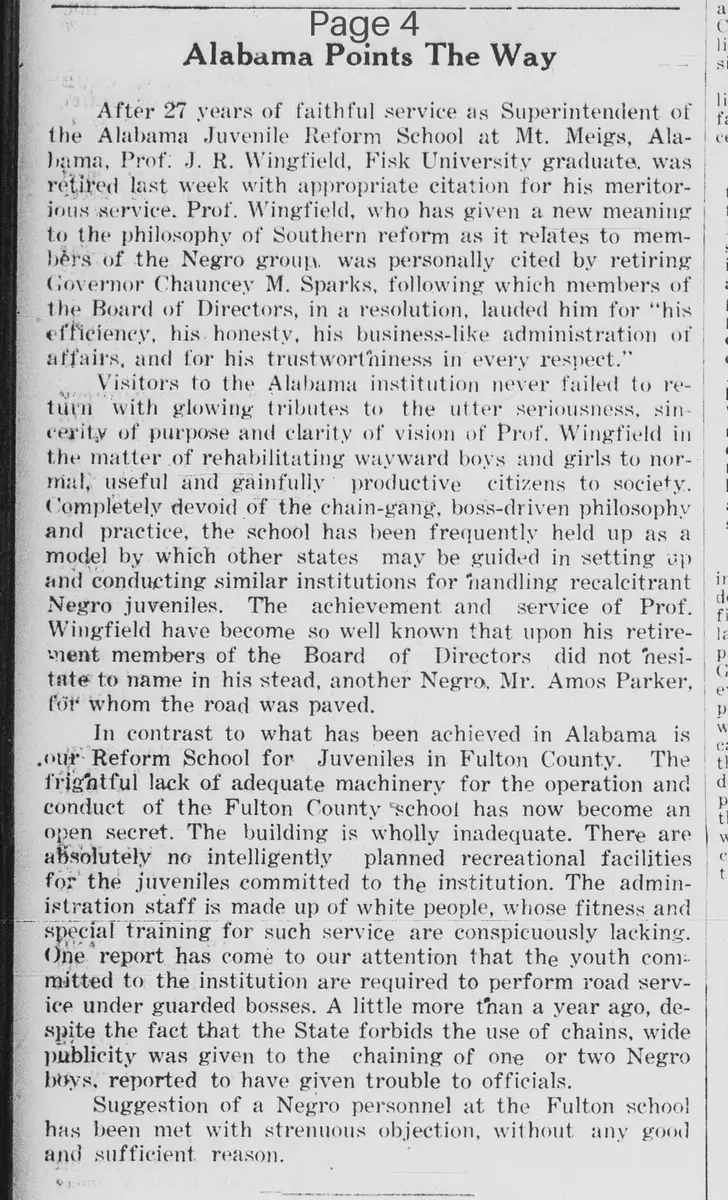
Alabama Points The Way
After 27 years of faithful service as Superintendent of the Alabama Juvenile Reform School at Mt. Meigs, Alabama, Prof. J. R. Wingfield, Fisk University graduate, was retired last week with appropriate citation for his meritorious service. Prof. Wingfield, who has given a new meaning to the philosophy of Southern reform as it relates to members of the Negro group, was personally cited by retiring Governor Chauncey M. Sparks, following which members of the Board of Directors, in a resolution, lauded him for "his efficiency, his honesty, his business-like administration of affairs, and for his trustworthiness in every respect."
Visitors to the Alabama institution never failed to return with glowing tributes to the utter seriousness, sincerity of purpose and clarity of vision of Prof. Wingfield in the matter of rehabilitating wayward boys and girls to normal, useful and gainfully productive citizens to society.
Completely devoid of the chain-gang, boss-driven philosophy and practice, the school has been frequently held up as a model by which other states may be guided in setting up and conducting similar institutions for handling recalcitrant Negro juveniles. The achievement and service of Prof. Wingfield have become so well known that upon his retirement members of the Board of Directors did not hesitate to name in his stead, another Negro, Mr. Amos Parker, for whom the road was paved.
In contrast to what has been achieved in Alabama is our Reform School for Juveniles in Fulton County. The frightful lack of adequate machinery for the operation and conduct of the Fulton County school has now become an open secret. The building is wholly inadequate. There are absolutely no intelligently planned recreational facilities for the juveniles committed to the institution. The administration staff is made up of white people, whose fitness and special training for such service are conspicuously lacking.
One report has come to our attention that the youth committed to the institution are required to perform road service under guarded bosses. A little more than a year ago, despite the fact that the State forbids the use of chains, wide publicity was given to the chaining of one or two Negro boys, reported to have given trouble to officials.
Suggestion of a Negro personnel at the Fulton school has been met with strenuous objection, without any good and sufficient reason.
After 27 years of faithful service as Superintendent of the Alabama Juvenile Reform School at Mt. Meigs, Alabama, Prof. J. R. Wingfield, Fisk University graduate, was retired last week with appropriate citation for his meritorious service. Prof. Wingfield, who has given a new meaning to the philosophy of Southern reform as it relates to members of the Negro group, was personally cited by retiring Governor Chauncey M. Sparks, following which members of the Board of Directors, in a resolution, lauded him for "his efficiency, his honesty, his business-like administration of affairs, and for his trustworthiness in every respect."
Visitors to the Alabama institution never failed to return with glowing tributes to the utter seriousness, sincerity of purpose and clarity of vision of Prof. Wingfield in the matter of rehabilitating wayward boys and girls to normal, useful and gainfully productive citizens to society.
Completely devoid of the chain-gang, boss-driven philosophy and practice, the school has been frequently held up as a model by which other states may be guided in setting up and conducting similar institutions for handling recalcitrant Negro juveniles. The achievement and service of Prof. Wingfield have become so well known that upon his retirement members of the Board of Directors did not hesitate to name in his stead, another Negro, Mr. Amos Parker, for whom the road was paved.
In contrast to what has been achieved in Alabama is our Reform School for Juveniles in Fulton County. The frightful lack of adequate machinery for the operation and conduct of the Fulton County school has now become an open secret. The building is wholly inadequate. There are absolutely no intelligently planned recreational facilities for the juveniles committed to the institution. The administration staff is made up of white people, whose fitness and special training for such service are conspicuously lacking.
One report has come to our attention that the youth committed to the institution are required to perform road service under guarded bosses. A little more than a year ago, despite the fact that the State forbids the use of chains, wide publicity was given to the chaining of one or two Negro boys, reported to have given trouble to officials.
Suggestion of a Negro personnel at the Fulton school has been met with strenuous objection, without any good and sufficient reason.
What sub-type of article is it?
Social Reform
Crime Or Punishment
What keywords are associated?
Juvenile Reform
Negro Administrators
Chain Gang Opposition
Alabama Model
Fulton County Criticism
Racial Rehabilitation
What entities or persons were involved?
Prof. J. R. Wingfield
Governor Chauncey M. Sparks
Mr. Amos Parker
Alabama Juvenile Reform School At Mt. Meigs
Fulton County Reform School For Juveniles
Board Of Directors
Editorial Details
Primary Topic
Alabama Juvenile Reform Model Vs. Fulton County Failures
Stance / Tone
Praiseworthy Of Alabama's Approach, Critical Of Fulton County's Inadequacies
Key Figures
Prof. J. R. Wingfield
Governor Chauncey M. Sparks
Mr. Amos Parker
Alabama Juvenile Reform School At Mt. Meigs
Fulton County Reform School For Juveniles
Board Of Directors
Key Arguments
Wingfield's 27 Years Of Meritorious Service Rehabilitating Negro Youth
Alabama School As Model Without Chain Gangs
Fulton County School Lacks Adequate Facilities And Trained Staff
Reports Of Chaining And Road Service In Fulton Despite State Bans
Objection To Negro Personnel In Fulton Without Reason