Thank you for visiting SNEWPapers!
Sign up free
Letter to Editor
September 14, 1769
The Virginia Gazette
Richmond, Williamsburg, Richmond County, Virginia
What is this article about?
A colonist describes the devastating effects of a recent hurricane on Virginia's tobacco and corn crops, homes, and mills, emphasizing total destruction of the year's labor and food supplies. Urges the Assembly to address tobacco levy prices and considers grain export restrictions amid widespread suffering.
Clipping
OCR Quality
95%
Excellent
Full Text
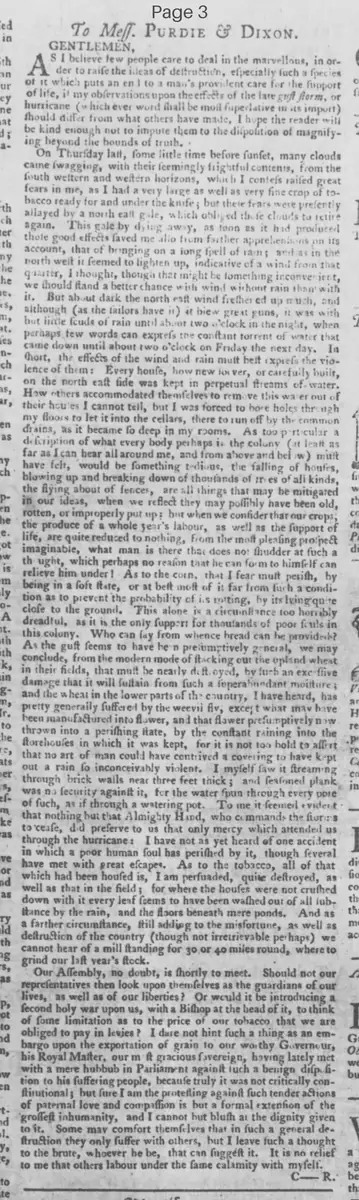
To Messrs. Purdie & Dixon.
GENTLEMEN,
As I believe few people care to deal in the marvellous, in order to raise the ideas of destruction, especially such a species of it which puts an end to a man's provident care for the support of life, it my observations upon the effects of the late gust storm, or hurricane (which ever word shall be most superlative in its import) should differ from what others have made, I hope the reader will be kind enough not to impute them to the disposition of magnifying beyond the bounds of truth.
On Thursday last, some little time before sunset, many clouds came swaggering, with their seemingly frightful contents, from the southwestern and western horizons, which I confess raised great fears in me, as I had a very large as well as very fine crop of tobacco ready for and under the knife; but these fears were presently allayed by a northeast gale, which obliged these clouds to retire again. This gale by dying away, as soon as it had produced those good effects saved me also from farther apprehensions, as on its account, that of bringing on a long spell of rain; and as in the northwest it seemed to lighten up, indicative of a wind from that quarter, I thought, though that might be something inconvenient, we should stand a better chance with wind without rain than with it. But about dark the northeast wind freshened up much, and although (as the sailors have it) it blew great guns, it was with but little floods of rain until about two o'clock in the night, when perhaps few words can express the constant torrent of water that came down until about two o'clock on Friday the next day. In short, the effects of the wind and rain must best express the violence of them: Every house, how new, old, or carefully built, on the northeast side was kept in perpetual streams of water. How others accommodated themselves to remove this water out of their houses I cannot tell, but I was forced to bore holes through my floors to let it into the cellars, there to run off by the common drains, as it became so deep in my rooms. As too particular a description of what every body perhaps in the colony (at least as far as I can hear all around me, and from above and below) must have felt, would be something tedious, the falling of houses, blowing up and breaking down of thousands of trees of all kinds, the flying about of fences, are all things that may be mitigated in our ideas, when we reflect they may possibly have been old, rotten, or improperly put up: but when we consider that our crops, the produce of a whole year's labour, as well as the support of life, are quite reduced to nothing, from the most pleasing prospects imaginable, what man is there that does not shudder at such a thought, which perhaps no reason that he can form to himself can relieve him under! As to the corn, that I fear must perish, by being in a soft state, or at best most of it far from such a condition as to prevent the probability of its moulding, by its lying quite close to the ground. This alone is a circumstance too horribly dreadful, as it is the only support for thousands of poor souls in this colony. Who can say from whence bread can be provided?
As the gust seems to have been presumptively general, we may conclude, from the modern mode of stacking our the upland wheat in their fields, that must be nearly destroyed, by such an excessive damage that it will sustain from such an operabundant moisture and the wheat in the lower parts of the country, I have heard, has pretty generally suffered by the weevil fly, except what may have been manufactured into flour, and that flour presumptively now thrown into a perishing state, by the constant raining into the storehouses in which it was kept. for it is not too bold to assert that no art of man could have contrived a covering to have kept out a rain so inconceivably violent. I myself saw it streaming through brick walls near three feet thick; and seasoned plank was no security against it, for the water run through every pore of such, as if through a watering pot. To me it seemed evident that nothing but that Almighty Hand, who commands the storms to cease, did preserve to us that only mercy which attended us through the hurricane: I have not as yet heard of one accident in which a poor human soul has perished by it, though several have met with great escapes. As to the tobacco, all of that which had been housed is, I am persuaded, quite destroyed, as well as that in the field; for where the houses were not crushed down with it every leaf seems to have been washed out of all substance by the rain, and the floors beneath were ponds. And as a farther circumstance, still adding to the misfortune, as well as destruction of the country (though not irretrievable perhaps) we cannot hear of a mill standing for 30 or 40 miles round, where to grind our last year's stock.
Our Assembly, no doubt, is shortly to meet. Should not our representatives then look upon themselves as the guardians of our lives, as well as of our liberties? Or would it be introducing a second holy war upon us, with a Bishop at the head of it, to think of some limitation as to the price of our tobacco that we are obliged to pay in levies? I dare not hint such a thing as an embargo upon the exportation of grain to our worthy Governor, his Royal Master, our most gracious sovereign, having lately met with a mere hubbub in Parliament against such a benign disposition to his suffering people, because truly it was not critically constitutional; but sure I am the protesting against such tender actions of paternal love and compassion is but a formal extension of the greatest inhumanity, and I cannot but blush at the dignity given to it. Some may comfort themselves that in such a general destruction they only suffer with others, but I leave such a thought to the brute, whoever he be, that can suggest it. It is no relief to me that others labour under the same calamity with myself.
CR.
GENTLEMEN,
As I believe few people care to deal in the marvellous, in order to raise the ideas of destruction, especially such a species of it which puts an end to a man's provident care for the support of life, it my observations upon the effects of the late gust storm, or hurricane (which ever word shall be most superlative in its import) should differ from what others have made, I hope the reader will be kind enough not to impute them to the disposition of magnifying beyond the bounds of truth.
On Thursday last, some little time before sunset, many clouds came swaggering, with their seemingly frightful contents, from the southwestern and western horizons, which I confess raised great fears in me, as I had a very large as well as very fine crop of tobacco ready for and under the knife; but these fears were presently allayed by a northeast gale, which obliged these clouds to retire again. This gale by dying away, as soon as it had produced those good effects saved me also from farther apprehensions, as on its account, that of bringing on a long spell of rain; and as in the northwest it seemed to lighten up, indicative of a wind from that quarter, I thought, though that might be something inconvenient, we should stand a better chance with wind without rain than with it. But about dark the northeast wind freshened up much, and although (as the sailors have it) it blew great guns, it was with but little floods of rain until about two o'clock in the night, when perhaps few words can express the constant torrent of water that came down until about two o'clock on Friday the next day. In short, the effects of the wind and rain must best express the violence of them: Every house, how new, old, or carefully built, on the northeast side was kept in perpetual streams of water. How others accommodated themselves to remove this water out of their houses I cannot tell, but I was forced to bore holes through my floors to let it into the cellars, there to run off by the common drains, as it became so deep in my rooms. As too particular a description of what every body perhaps in the colony (at least as far as I can hear all around me, and from above and below) must have felt, would be something tedious, the falling of houses, blowing up and breaking down of thousands of trees of all kinds, the flying about of fences, are all things that may be mitigated in our ideas, when we reflect they may possibly have been old, rotten, or improperly put up: but when we consider that our crops, the produce of a whole year's labour, as well as the support of life, are quite reduced to nothing, from the most pleasing prospects imaginable, what man is there that does not shudder at such a thought, which perhaps no reason that he can form to himself can relieve him under! As to the corn, that I fear must perish, by being in a soft state, or at best most of it far from such a condition as to prevent the probability of its moulding, by its lying quite close to the ground. This alone is a circumstance too horribly dreadful, as it is the only support for thousands of poor souls in this colony. Who can say from whence bread can be provided?
As the gust seems to have been presumptively general, we may conclude, from the modern mode of stacking our the upland wheat in their fields, that must be nearly destroyed, by such an excessive damage that it will sustain from such an operabundant moisture and the wheat in the lower parts of the country, I have heard, has pretty generally suffered by the weevil fly, except what may have been manufactured into flour, and that flour presumptively now thrown into a perishing state, by the constant raining into the storehouses in which it was kept. for it is not too bold to assert that no art of man could have contrived a covering to have kept out a rain so inconceivably violent. I myself saw it streaming through brick walls near three feet thick; and seasoned plank was no security against it, for the water run through every pore of such, as if through a watering pot. To me it seemed evident that nothing but that Almighty Hand, who commands the storms to cease, did preserve to us that only mercy which attended us through the hurricane: I have not as yet heard of one accident in which a poor human soul has perished by it, though several have met with great escapes. As to the tobacco, all of that which had been housed is, I am persuaded, quite destroyed, as well as that in the field; for where the houses were not crushed down with it every leaf seems to have been washed out of all substance by the rain, and the floors beneath were ponds. And as a farther circumstance, still adding to the misfortune, as well as destruction of the country (though not irretrievable perhaps) we cannot hear of a mill standing for 30 or 40 miles round, where to grind our last year's stock.
Our Assembly, no doubt, is shortly to meet. Should not our representatives then look upon themselves as the guardians of our lives, as well as of our liberties? Or would it be introducing a second holy war upon us, with a Bishop at the head of it, to think of some limitation as to the price of our tobacco that we are obliged to pay in levies? I dare not hint such a thing as an embargo upon the exportation of grain to our worthy Governor, his Royal Master, our most gracious sovereign, having lately met with a mere hubbub in Parliament against such a benign disposition to his suffering people, because truly it was not critically constitutional; but sure I am the protesting against such tender actions of paternal love and compassion is but a formal extension of the greatest inhumanity, and I cannot but blush at the dignity given to it. Some may comfort themselves that in such a general destruction they only suffer with others, but I leave such a thought to the brute, whoever he be, that can suggest it. It is no relief to me that others labour under the same calamity with myself.
CR.
What sub-type of article is it?
Informative
Reflective
Persuasive
What themes does it cover?
Agriculture
Economic Policy
Politics
What keywords are associated?
Hurricane Damage
Tobacco Crop Destruction
Corn Perish
Colonial Assembly
Tobacco Levies
Grain Export
Virginia Colony
What entities or persons were involved?
Cr.
Messrs. Purdie & Dixon
Letter to Editor Details
Author
Cr.
Recipient
Messrs. Purdie & Dixon
Main Argument
the recent hurricane has destroyed crops like tobacco and corn, threatening famine in the colony; the assembly should consider limiting tobacco prices for levies and restricting grain exports to aid the suffering population.
Notable Details
No Human Deaths Reported Despite Destruction
Water Penetrated Brick Walls And Seasoned Plank
Mills Destroyed For 30 40 Miles
References To Almighty Hand Preserving Lives
Critique Of Constitutional Objections To Export Embargoes