Thank you for visiting SNEWPapers!
Sign up free
Norfolk Gazette And Publick Ledger
Norfolk, Virginia
What is this article about?
In East Florida, patriot forces under Col. Ludovick Ashley captured Amelia Island from Spanish commandant Don Justo Lopez on March 16, 1812, with aid from US Commodore Campbell's gunboats. The island was then surrendered to US Riflemen under Gen. Matthews, establishing American control amid revolutionary unrest.
Clipping
OCR Quality
Full Text
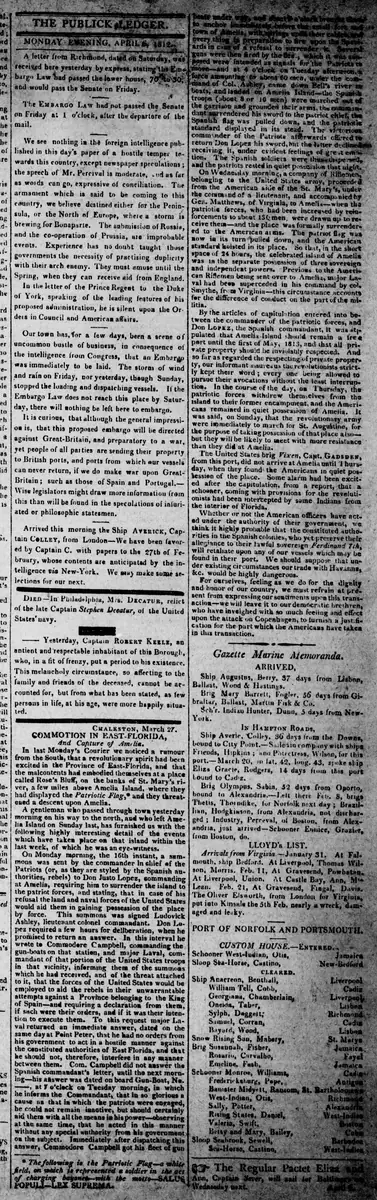
COMMOTION IN EAST-FLORIDA,
And Capture of Amelia.
In last Monday's Courier we noticed a rumour from the South, that a revolutionary spirit had been excited in the Province of East-Florida, and that the malcontents had embodied themselves at a place called Rose's Bluff, on the banks of St. Mary's river, a few miles above Amelia Island, where they had displayed the Patriotic Flag, and they threatened a descent upon Amelia.
A gentleman who passed through town yesterday morning on his way to the north, and who left Amelia Island on Sunday last, has furnished us with the following highly interesting detail of the events which have taken place on that island within the last week, of which he was an eye-witness.
On Monday morning, the 16th instant, a summons was sent by the commander in chief of the Patriots (or, as they are styled by the Spanish authorities, rebels) to Don Justo Lopez, commanding at Amelia, requiring him to surrender the island to the patriot forces, and stating, that in case of his refusal the land and naval forces of the United States would aid them in gaining possession of the place by force. This summons was signed Ludovick Ashley, lieutenant colonel commandant. Don Lopez required a few hours for deliberation, when he promised to return an answer. In this interval he wrote to Commodore Campbell, commanding the gun-boats on that station, and major Laval, commandant of that portion of the United States troops in that vicinity, informing them of the summons which he had received, and of the threat attached to it, that the forces of the United States would be employed to aid the rebels in their unwarrantable attempts against a Province belonging to the King of Spain—and requiring a declaration from them, if such were their orders, and if it was their intention to execute them. To this request major Laval returned an immediate answer, dated on the same day at Point Peter, that he had no orders from his government to act in a hostile manner against the constituted authorities of East Florida, and that he should not, therefore, interfere in any manner between them. Com. Campbell did not answer the Spanish commandant's letter, until the next morning—his answer was dated on board Gun-Boat, No. __, at 1 o'clock on Tuesday morning, in which he informs the Commandant, that in so glorious a cause as that in which the patriots were engaged, he could not remain inactive, but should certainly aid them with all the means in his power—observing at the same time, that he acted in this manner without any special authority from his government, on the subject. Immediately after dispatching this answer, Commodore Campbell got his fleet of gun boats under way, and anchored immediately before the town of Amelia, with springs upon their cables, ready to bring their broadsides to bear upon the Spaniards in case of a refusal to surrender. Several guns were then fired by the fleet, which it was supposed were intended as signal for the Patriots to move and at 4 o'clock on Tuesday afternoon a force amounting to about 60 men, under the command of Col. Ashley came down Bell's river in boats, and landed on Amelia Island—the Spanish troops (about 8 or 10 men) were marched out of the garrison and grounded their arms, the commandant surrendered his sword to the patriot chief the Spanish flag was pulled down, and the patriotic standard displayed in its stead,
The victorious commander of the Patriots afterwards offered to return Don Lopez his sword, but the latter declined receiving it, under evident feelings of great emotion. The Spanish soldiers were thus scrapped and the patriots rested in quiet possession that night.
On Wednesday morning, a company of Riflemen, belonging to the United States army, proceeded from the American side of the St. Mary, under the command of a lieutenant, and accompanied by Gen. Matthews, of Virginia, to Amelia—when the patriotic forces, who had been increased by reinforcements to about 150 men, were drawn up to receive them—and the place was formally surrendered to the American arms. The patriot flag was now in its turn pulled down, and the American standard hoisted in its place. So that, in the short space of 24 hours, the celebrated island of Amelia was in the separate possession of three sovereign and independent powers. Previous to the American Riflemen being sent over to Amelia, major Laval had been superceded in his command by col. Smythe, from Virginia—this circumstance accounts for the difference of conduct on the part of the militia.
By the articles of capitulation entered into between the commander of the patriotic forces, and Don Lopez, the Spanish commandant, it was stipulated that Amelia-Island should remain a free port until the first of May, 1813, and that all private property should be inviolably respected. And so far as regarded the respecting of private property, our informant assures us the revolutionists strictly kept their word; every one being allowed to pursue their avocations without the least interruption. In the course of the day, on Thursday, the patriotic forces withdrew themselves from the island to their former encampment, and the Americans remained in quiet possession of Amelia. It was said, on Sunday, that the revolutionary army were immediately to march for St. Augustine, for the purpose of taking possession of that place also—but they will be likely to meet with more resistance than they did at Amelia.
The United States brig Vixen, Capt. Gadsden, from this port, did not arrive at Amelia until Thursday, when they found the Americans in quiet possession of the place. Some alarm had been excited after the capitulation, from a report, that a schooner, coming with provisions for the revolutionists had been intercepted by some Indians from the interior of Florida..
Whether or not the American officers have acted under the authority of their government, we think it highly probable that the constituted authorities in the Spanish colonies, who yet preserve their allegiance to their lawful sovereign Ferdinand 7th, will retaliate upon any of our vessels which may be found in their port. We should suppose that under existing circumstances our trade with Havanna, &c. would be highly dangerous.
For ourselves, feeling as we do for the dignity and honor of our country, we must refrain at present from expressing our sentiments upon this transaction—we will leave it to our democratic brethren, who have inveighed with so much feeling and effect upon the attack on Copenhagen, to furnish a justification for the part which the Americans have taken in this transaction.
The following is the Patriotic Flag—a white field, on which is represented a soldier in the act of charging bayonet—with the motto—SALUS POPULI SUPREMA LEX.
What sub-type of article is it?
What keywords are associated?
What entities or persons were involved?
Where did it happen?
Domestic News Details
Primary Location
Amelia Island, East Florida
Event Date
March 16, 1812
Key Persons
Outcome
peaceful surrender with no casualties reported; amelia island became a free port until may 1, 1813; private property respected; americans took possession; patriots planned advance on st. augustine.
Event Details
Patriot forces summoned Spanish commandant Don Justo Lopez to surrender Amelia Island on March 16; US Commodore Campbell aided with gunboats despite lacking orders; 60 patriots landed and captured the island without resistance; next day, US Riflemen under Gen. Matthews formally took control from patriots.