Thank you for visiting SNEWPapers!
Sign up free
Indian Chieftain
Vinita, Craig County, Oklahoma
What is this article about?
The British South Africa Company, led by Cecil Rhodes, faces financial collapse, with shares sold at premiums to British royalty and aristocracy. Speculation suggests Dr. Jameson's raid on Transvaal was to force charter forfeiture, shifting blame to the government and protecting royal investors from scandal.
Clipping
OCR Quality
Full Text
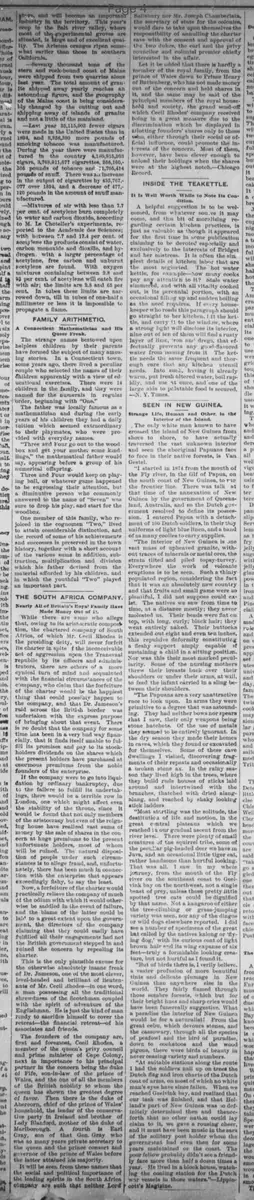
Nearly All of Britain's Royal Family Have Made Money Out of It.
While there are some who allege that, owing to its aristocratic composition, the chartered company of South Africa, of which Mr. Cecil Rhodes is the presiding deity, will never forfeit its charter in spite of the inconceivable act of aggression upon the Transvaal republic by its officers and administrators, there are others of a more cynical turn of mind and acquainted with the financial circumstances of the company, who claim that the forfeiture of the charter would be the happiest thing that could possibly happen to the company, and that Dr. Jameson's raid across the British border was undertaken with the express purpose of bringing about that event. There is no doubt that the company for some time has been in a very bad way financially, that it finds itself unable to fulfill its promises and pay to its stockholders dividends on the shares which the present holders have purchased at enormous premiums from the noble founders of the enterprise.
If the company were to go into liquidation by ordinary bankruptcy, due to the failure to fulfill its undertakings, there would be a terrible row in London, one which might affect even the stability of the throne, since it would be found that not only members of the aristocracy but even of the reigning house have realized vast sums of money by the sale of shares in the concern at huge premiums to the present unfortunate holders, most of whom will be ruined. The natural disposition of people under such circumstances is to allege fraud, and, unfortunately, there has been much in connection with the enterprise that appears exceedingly fishy, to say the least.
Now, a forfeiture of the charter would practically relieve the company of much of the odium with which it would otherwise be saddled in the event of failure, and the blame of the latter could be laid to a great extent upon the government, the directors of the company claiming that they could easily have fulfilled all their engagements had not the British government stepped in and ruined the concern by repealing its charter.
This is the only plausible excuse for the otherwise absolutely insane freak of Dr. Jameson, one of the most clever, level-headed and brilliant of lieutenants of Mr. Cecil Rhodes- in one word a man possessing all the traditional shrewdness of the Scotchman coupled with the spirit of adventure of the Englishman. He is just the kind of man ready to sacrifice himself to cover the retreat- the financial retreat- of his associates and friends.
The founders of the company are, first and foremost, Cecil Rhodes, a member of the queen's privy council and prime minister of Cape Colony, next in importance to his principal partner in the concern being the duke of Fife, son-in-law of the prince of Wales, and the one of all the members of the British nobility to whom the queen has shown the greatest degree of favor. Then there is the duke of Abercorn, chief of the prince of Wales' household, the leader of the conservative party in Ireland and brother of Lady Blandford, mother of the duke of Marlborough. A fourth is Earl Gray, son of that Gen. Gray who was so many years private secretary to the queen and the prince consort and governor of the prince of Wales before the latter attained his majority.
It will be seen from these names that the social and political importance of the leading spirits in the South Africa company are such that neither Lord Salisbury nor Mr. Joseph Chamberlain the secretary of state for the colonies would dare to take upon themselves the responsibility of annulling the charter save with the consent and approval of the two dukes, the earl and the privy councilor and colonial premier chiefly interested in the affair.
Let it be added that there is hardly a member of the royal family, from the prince of Wales down to Prince Henry of Battenberg, who has not made money out of the concern and held shares in it, and the same may be said of the principal members of the royal household and society, the grand send-off which Cecil Rhodes' company received being in a great measure due to the discrimination which he displayed in allotting founders' shares only to those who, either through their social or official influence, could promote the interests of the concern. Most of them, however, have been clever enough to unload their holdings when the shares were at the highest notch. Chicago Record.
What sub-type of article is it?
What keywords are associated?
What entities or persons were involved?
Where did it happen?
Foreign News Details
Primary Location
South Africa
Key Persons
Outcome
potential forfeiture of company charter to avoid financial scandal and ruin for shareholders; blame shifted to british government.
Event Details
The British South Africa Company, founded by Cecil Rhodes and British nobility including Duke of Fife, Duke of Abercorn, and Earl Gray, is in financial distress and unable to pay dividends. Speculation claims Dr. Jameson's raid on Transvaal was intended to provoke charter revocation, protecting royal and aristocratic investors from fraud allegations by attributing failure to government intervention.