Thank you for visiting SNEWPapers!
Sign up free
Norfolk Gazette And Publick Ledger
Norfolk, Virginia
What is this article about?
A former Portuguese diplomat argues that French General Bessieres's move to Zamora poses no threat of invasion into Portugal via the rugged Tralos Montes province, due to its impassable terrain, mountains, and rivers that would render cavalry and artillery useless and doom the army to starvation and defeat. Written from Turnham Green, Aug. 7, 1808.
Clipping
OCR Quality
Full Text
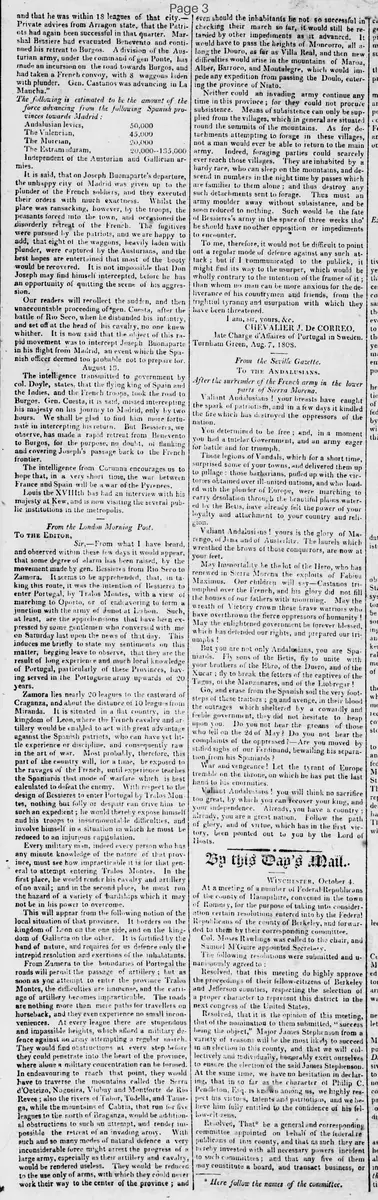
To the Editor,
Sir,--From what I have heard and observed within these few days it would appear, that some degree of alarm has been raised, by the movement made by gen. Bessieres from Rio Seco to Zamora. It seems to be apprehended, that, in taking this route, it was the intention of Bessieres to enter Portugal, by Tralos Montes, with a view of marching to Oporto, or of endeavoring to form a junction with the army of Junot at Lisbon. Such, at least, are the apprehensions that have been expressed by some gentlemen who conversed with me on Saturday last upon the news of that day. This induces me briefly to state my sentiments on this matter; begging leave to observe, that they are the result of long experience and much local knowledge of Portugal, particularly of these Provinces, having served in the Portuguese army upwards of 20 years.
Zamora lies nearly 20 leagues to the eastward of Braganza, and about the distance of 10 leagues from Miranda. It is situated in a flat country, in the kingdom of Leon, where the French cavalry and artillery would be enabled to act with great advantage against the Spanish patriots, who can have yet little experience or discipline, and consequently raw in the art of war. Most probably, therefore, this part of the country will, for a time, be exposed to the ravages of the French, until experience teaches the Spaniards that mode of warfare which is best calculated to defeat the enemy. With respect to the design of Bessieres to enter Portugal by Tralos Montes, nothing but folly or despair can drive him to such an expedient; he would thereby expose himself and his troops to insurmountable difficulties, and involve himself in a situation in which he must be reduced to an injurious capitulation.
Every military man, indeed every person who has any minute knowledge of the nature of that province, must see how impracticable it is for that general to attempt entering Tralos Montes. In the first place, he would render his cavalry and artillery of no avail; and in the second place, he must run the hazard of a variety of hardships which it may not be in his power to overcome.
This will appear from the following notion of the local situation of that province. It borders on the kingdom of Leon on the one side, and on the kingdom of Gallicia on the other. It is fortified by the hand of nature, and requires for its defence only the intrepid resolution and exertions of the inhabitants. From Zamora to the boundaries of Portugal the roads will permit the passage of artillery; but as soon as you attempt to enter the province Tralos Montes, the difficulties are immense, and the carriage of artillery becomes impracticable. The roads are nothing more than mere paths for travellers on horseback, and they even experience no small inconveniences. At every league there are stupendous and impassable heights, which afford a military defence against an army attempting a regular march. They would find obstructions at every step before they could penetrate into the heart of the province, where alone a military concentration can be formed. In endeavouring to reach that point, they would have to traverse the mountains called the Serra d'Oeste, Nogueira, Vinbay and Montforte de Rio Reve ; also the rivers of Tabor, Tudella, and Tamega, while the mountains of Cabria, that run for five leagues to the north of Braganza, would be additional obstructions to such an attempt, and render impossible the retreat of an invading army. With such and so many modes of natural defence a very inconsiderable force might arrest the progress of a large army, especially as their artillery and cavalry, would be rendered useless. They would be reduced to the use only of arms, with which they could never work their way to the center of the province ; and even should the inhabitants be not so successful in checking their march so far, it would still be retarded by other impediments as it advanced. It would have to pass the heights of Moncorro, all along the Douro, as far as Villa Real, and then new difficulties would arise in the mountains of Maroa, Alber, Barroco, and Montalegre, which would impede any expedition from passing the Douro, entering the province of Niato.
Neither could an invading army continue any time in this province; for they could not procure subsistence. Means of subsistence can only be supplied from the villages, which in general are situated round the summits of the mountains. As for detachments attempting to forage in these villages, not a man would ever be able to return to the main army. Indeed, foraging parties could scarcely ever reach those villages. They are inhabited by a hardy race, who can sleep on the mountains, and descend in numbers in the night time by passes which are familiar to them alone; and thus destroy any such detachments sent to forage. Thus must an army moulder away without subsistence, and be soon reduced to nothing. Such would be the fate of Bessieres's army in the space of three weeks tho' he should have no other opposition or impediments to encounter.
To me, therefore, it would not be difficult to point out a regular mode of defence against any such attack ; but if I communicated to the publick, it might find its way to the usurper, which would be wholly contrary to the intention of the framer of it ; than whom no man can be more anxious for the deliverance of his countrymen and friends, from the frightful tyranny and usurpation with which they have been threatened.
I am, sir, yours, &c.
CHEVALIER J. De CORREO,
late Charge d'Affaires of Portugal in Sweden.
Turnham Green, Aug.7, 1808.
What sub-type of article is it?
What themes does it cover?
What keywords are associated?
What entities or persons were involved?
Letter to Editor Details
Author
Chevalier J. De Correo, Late Charge D'affaires Of Portugal In Sweden
Recipient
The Editor
Main Argument
the movement of general bessieres from rio seco to zamora does not indicate an intention to invade portugal via tralos montes, as the province's mountainous terrain, impassable roads, and natural defenses would make such an attempt impracticable and disastrous for the french forces.
Notable Details