Thank you for visiting SNEWPapers!
Sign up free
The Liberator
Boston, Suffolk County, Massachusetts
What is this article about?
Editorial from the New Englander expresses regret over the Massachusetts Supreme Court's decision granting local school boards authority to maintain separate schools for colored children, arguing it denies equal rights and causes unnecessary agitation. Notes successful integration in other Massachusetts cities like Salem, New Bedford, and Lowell.
Clipping
OCR Quality
Full Text
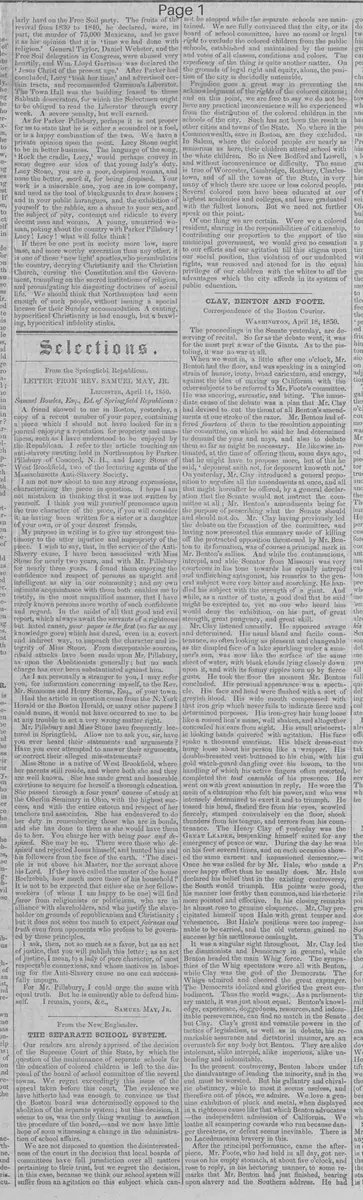
THE SEPARATE SCHOOL SYSTEM.
Our readers are already apprised of the decision of the Supreme Court of this State, by which the question of the maintenance of separate schools for the education of colored children is left to the disposal of the board of school committee of the several towns. We regret exceedingly this issue of the appeal taken before this court. The evidence we have hitherto had was enough to convince us that the Boston board was determinedly opposed to the abolition of the separate system; but this decision, it seems to us, was the only thing wanting to sanction the procedure of the board,—and we now have little hope of soon witnessing a change in the administration of school affairs.
We are not disposed to question the disinterestedness of the court in the decision that local boards of committees have full jurisdiction over all matters pertaining to their trust, but we regret the decision. in this case, because we think our school system will suffer from an agitation on this subject which cannot be stopped while the separate schools are maintained. We are fully convinced that the city, or its board of school committee, have no moral or legal right to exclude the colored children from the public schools, established and maintained by the means and votes of all classes, conditions and colors. The expediency of the thing is quite another matter. On the grounds of legal right and equity, alone, the position of the city is decidedly untenable.
Prejudice goes a great way in preventing the acknowledgment of the rights of the colored citizens; and on this point, we are free to say we do not believe any practical inconvenience will be experienced from the distribution of the colored children in the schools of the city. Such has not been the result in other cities and towns of the State. No where in the Commonwealth, save in Boston, are they excluded. In Salem, where the colored people are nearly as numerous as here, their children attend school with the white children. So in New Bedford and Lowell, and without inconvenience or difficulty. The same is true of Worcester, Cambridge, Roxbury, Charlestown, and of all the towns of the State, in very many of which there are more or less colored people. Several colored men have been educated at our highest academies and colleges, and have graduated with the fullest honors. But we need not further speak on this point.
Of one thing we are certain. Were we a colored resident, sharing in the responsibilities of citizenship, contributing our proportion to the support of the municipal government, we would give no cessation to our efforts and our agitation till this stigma upon our social position, this violation of our undoubted rights, was removed and atoned for in the equal privilege of our children with the whites to all the advantages which the city affords in its system of public education.
What sub-type of article is it?
What themes does it cover?
What keywords are associated?
Where did it happen?
Story Details
Location
Boston, Massachusetts
Story Details
The Supreme Court decision leaves separate schools for colored children to local boards, particularly opposed by Boston's board. The editorial argues this denies moral and legal rights, causes agitation, and contrasts with successful integration in other Massachusetts cities like Salem, New Bedford, Lowell, Worcester, Cambridge, Roxbury, and Charlestown. It vows continued agitation until equality in public education is achieved.