Thank you for visiting SNEWPapers!
Sign up free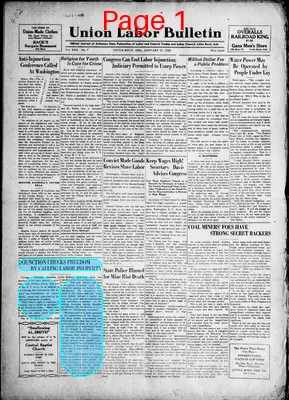
Union Labor Bulletin
Little Rock, Pulaski County, Arkansas
What is this article about?
William Green, A.F.L. president, addresses Chicago Bar Association via radio, criticizing labor injunctions that treat labor as property and restrict workers' rights to organize and strike. He references the Supreme Court-upheld Bedford injunction case, noting dissents by Justices Brandeis and Holmes.
Clipping
OCR Quality
Full Text
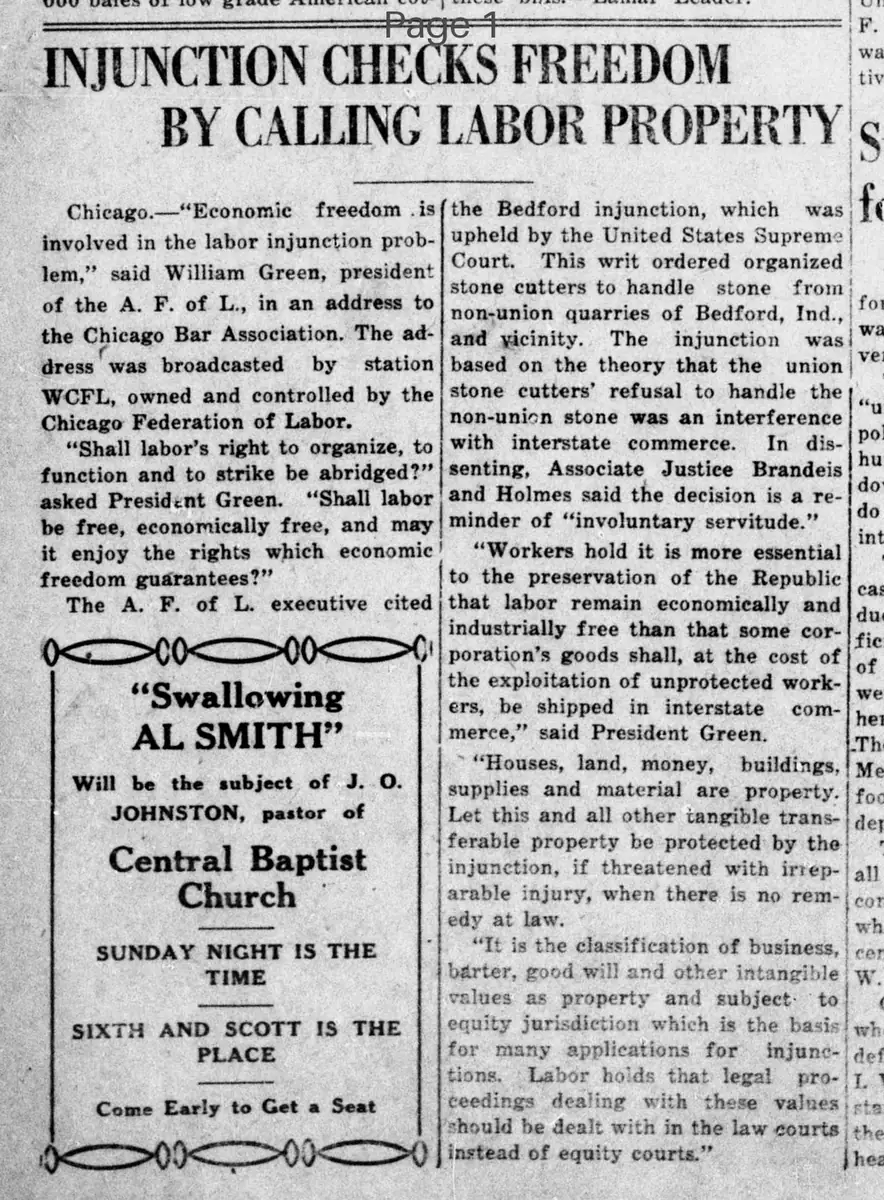
BY CALLING LABOR PROPERTY
Chicago.--"Economic freedom is involved in the labor injunction problem," said William Green, president of the A. F. of L., in an address to the Chicago Bar Association. The address was broadcasted by station WCFL, owned and controlled by the Chicago Federation of Labor.
"Shall labor's right to organize, to function and to strike be abridged?" asked President Green. "Shall labor be free, economically free, and may it enjoy the rights which economic freedom guarantees?"
The A. F. of L. executive cited the Bedford injunction, which was upheld by the United States Supreme Court. This writ ordered organized stone cutters to handle stone from non-union quarries of Bedford, Ind., and vicinity. The injunction was based on the theory that the union stone cutters' refusal to handle the non-union stone was an interference with interstate commerce.
In dissenting, Associate Justice Brandeis and Holmes said the decision is a reminder of "involuntary servitude."
"Workers hold it is more essential to the preservation of the Republic that labor remain economically and industrially free than that some corporation's goods shall, at the cost of the exploitation of unprotected workers, be shipped in interstate commerce," said President Green.
"Houses, land, money, buildings, supplies and material are property. Let this and all other tangible transferable property be protected by the injunction, if threatened with irreparable injury, when there is no remedy at law.
"It is the classification of business, barter, good will and other intangible values as property and subject to equity jurisdiction which is the basis for many applications for injunctions. Labor holds that legal proceedings dealing with these values should be dealt with in the law courts instead of equity courts."
What sub-type of article is it?
What themes does it cover?
What keywords are associated?
What entities or persons were involved?
Where did it happen?
Story Details
Key Persons
Location
Chicago
Story Details
William Green delivers a radio-broadcast address to the Chicago Bar Association, arguing against labor injunctions that infringe on workers' economic freedom by classifying labor as property. He cites the Bedford injunction case, upheld by the Supreme Court, which forced union stone cutters to handle non-union stone, with dissents from Justices Brandeis and Holmes likening it to involuntary servitude. Green advocates protecting tangible property via injunctions but handling intangible business values in law courts, not equity.