Thank you for visiting SNEWPapers!
Sign up free
The Gazette
Portland, Cumberland County, Maine
What is this article about?
Extract from a German work detailing the secret Propaganda society, established in 1786 in Paris by Rochefoucault, Condorcet, and Sieyes. It promotes atheism, revolutions against rulers, and European-wide agitation via philosophical missions, with 55,000 members and a treasury of 20 million livres growing to 30 million by 1791.
Clipping
OCR Quality
Full Text
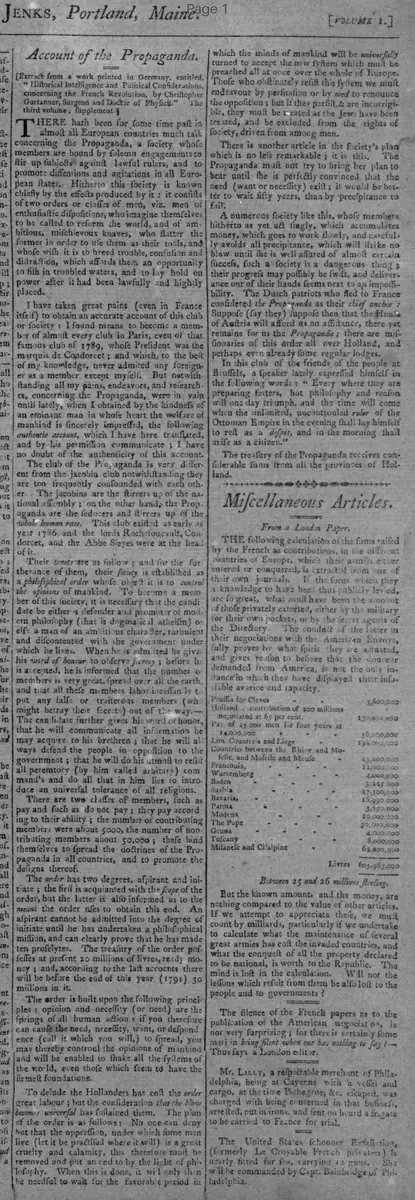
Extract from a work printed in Germany, entitled, "Historical Intelligence and Political Considerations, concerning the French Revolution, by Christopher Girtanner, Surgeon and Doctor of Physic." The third volume; supplement.
There hath been for some time past in almost all European countries much talk concerning the Propaganda, a society whose members are bound by solemn engagements to stir up subjects against lawful rulers, and to promote dissensions and agitations in all European states. Hitherto this society is known chiefly by the effects produced by it: it consists of two orders or classes of men, viz. men of enthusiastic dispositions, who imagine themselves to be called to reform the world, and of ambitious, mischievous knaves, who flatter the former in order to use them as their tools, and whose wish it is to breed trouble, confusion and distraction, which affords them an opportunity to fish in troubled waters, and to lay hold on power after it had been lawfully and rightly placed.
I have taken great pains (even in France itself) to obtain an accurate account of this club or society: I found means to become a member of almost every club in Paris, even of that famous club of 1780, whose President was the marquis de Condorcet; and which, to the best of my knowledge, never admitted any foreigner as a member except myself. But notwithstanding all my pains, endeavors, and researches, concerning the Propaganda, were in vain until lately, when I obtained by the kindness of an eminent man in whose heart the welfare of mankind is sincerely impressed, the following authentic account, which I have here translated, and by his permission communicate; I have no doubt of the authenticity of this account.
The club of the Propaganda is very different from the Jacobin club notwithstanding they are too frequently confounded with each other. The Jacobins are the stirrers up of the national assembly; on the other hand, the Propaganda are the seducers and stirrers up of the whole human race. This club existed as early as year 1786, and the lords Rochefoucault, Condorcet, and the Abbe Sieyes were at the head of it.
Their tenets are as follow; and for the furtherance of them, their society is established as a philosophical order whose object it is to control the opinions of mankind. To become a member of this society, it is necessary that the candidate be either a defender and promoter of modern philosophy (that is dogmatical atheism) or else a man of an ambitious character, turbulent and discontented with the government under which he lives. When he is admitted he gives his word of honour to observe secrecy; before he is accepted, he is informed that the number of members is very great, spread over all the earth, and that all these members labor incessantly to put any false or traitorous members (who might betray their secrets) out of the way.-- The candidate further gives his word of honor, that he will communicate all information he may acquire to his brethren; that he will always defend the people in opposition to the government; that he will do his utmost to resist all peremptory (by him called arbitrary) commands and do all that in him lies to introduce an universal tolerance of all religions.
There are two classes of members, such as pay and such as do not pay; they pay according to their ability; the number of contributing members were about 5000, the number of non-tributing members about 50,000; these bind themselves to spread the doctrines of the Propaganda in all countries, and to promote the designs thereof.
The order has two degrees, aspirant and initiate; the first is acquainted with the scope of the order, but the latter is also informed as to the means the order uses to obtain this end. An aspirant cannot be admitted into the degree of initiate until he has undertaken a philosophical mission, and can clearly prove that he has made ten proselytes. The treasury of the order possesses at present 20 millions of livres, ready money; and, according to the last accounts there will be before the end of this year (1791) 30 millions in it.
The order is built upon the following principles: opinion and necessity (or need) are the springs of all human action: if you therefore can cause the need, necessity, want, or dependence (call it which you will,) to spread, you may thereby control the opinions of mankind and will be enabled to shake all the systems of the world, even those which seem to have the firmest foundations.
To delude the Hollanders has cost the order great labour; but the consideration that the blow becomes universal has sustained them. The plan of the order is as follows: No one can deny but that the oppression, under which some men live (let it be practised where it will) is a great cruelty and calamity, this therefore must be removed and put an end to by the light of philosophy. When this is done, it will only then be needful to wait for the favorable period in [VOLUME 1.] which the minds of mankind will be universally turned to accept the new system which must be preached all at once over the whole of Europe. Those who obstinately resist this system we must endeavour by persuasion or by need to renounce the opposition; but if they persist, & are incorrigible, they must be treated as the Jews have been treated, and be excluded from the rights of society, driven from among men.
There is another article in the society's plan which is no less remarkable; it is this. The Propaganda must not try to bring her plan to bear until she is perfectly convinced that the need (want or necessity) exists; it would be better to wait fifty years, than by precipitance to fail.
A numerous society like this, whose members hitherto as yet act singly, which accumulates money, which goes to work slowly, and carefully avoids all precipitance, which will strike no blow until she is well assured of almost certain success, such a society is a dangerous thing; their progress may possibly be slow, and deliverance out of their hands seems next to an impossibility. The Dutch patriots who fled to France considered the Propaganda as their chief anchor: Suppose (say they) suppose then that the House of Austria will afford us no assistance, there yet remains for us the Propaganda; there are missionaries of this order all over Holland, and perhaps even already some regular lodges.
In this club of the friends of the people at Brussels, a speaker lately expressed himself in the following words: "Every where they are preparing fetters, but philosophy and reason will one day triumph, and the time will come when the unlimited, uncontrolled ruler of the Ottoman Empire in the evening shall lay himself to rest as a despot, and in the morning shall arise as a citizen."
The treasury of the Propaganda receives considerable sums from all the provinces of Holland.
What sub-type of article is it?
What keywords are associated?
What entities or persons were involved?
Where did it happen?
Foreign News Details
Primary Location
France
Event Date
1786 1791
Key Persons
Outcome
society comprises about 5,000 paying members and 50,000 non-paying members; treasury holds 20 million livres, expected to reach 30 million by end of 1791; aims to promote universal revolution through philosophical missions and control of opinions via induced necessity.
Event Details
The Propaganda is a secret society founded in 1786 in Paris, distinct from the Jacobins, led by Rochefoucault, Condorcet, and Sieyes. It seeks to control global opinions through promoting atheism, defending the people against governments, and inciting revolutions across Europe by creating necessities and waiting for the right moment to implement a new philosophical system. Members swear secrecy, spread doctrines, and eliminate traitors; advancement requires making ten proselytes. The society operates cautiously, accumulating funds from sources including Dutch provinces, and is viewed as a dangerous force by observers.