Thank you for visiting SNEWPapers!
Sign up free
Lancaster Daily Intelligencer
Lancaster, Lancaster County, Pennsylvania
What is this article about?
The National Association of Democratic Clubs issues an address post-1888 election, urging members to maintain organizations, advocate Jeffersonian principles, oppose Republican corruption and high tariffs, and prepare for 1892 victory through nationwide activism starting in 1890 elections.
Clipping
OCR Quality
Full Text
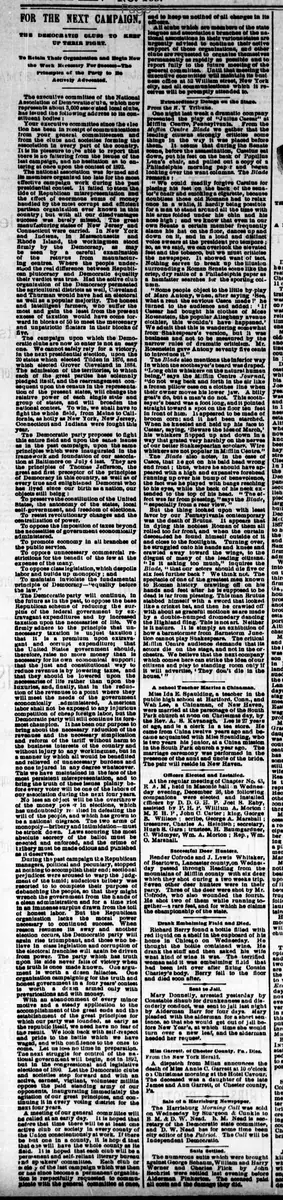
The Democratic Clubs to Keep Up Their Fight.
To Retain Their Organizations and Begin Now the Work Necessary for Success—The Principles of the Party to Be Aggressively Advocated.
The executive committee of the National Association of Democratic Clubs, which now represents about 3,000 associated local clubs, has issued the following address to its constituent bodies:
Your executive committee since the election has been in receipt of communications from your general committeemen and from the clubs and societies forming the association in every part of the country. It is our pleasure to be able to report that there is no faltering from the issues of the last campaign, and no hesitation as to entering at once upon the contest of 1892.
The national association was formed and its members organized too late for the most effective campaign work during the past presidential contest. It failed to stem the tide of Republican misrepresentation and the effect of enormous sums of money handled by the most corrupt and efficient partisan organization ever known in this country; but with all our disadvantages we barely missed. The great manufacturing states of New Jersey and Connecticut were carried. In New York and Indiana, in Massachusetts and Rhode Island, the workingmen stood firmly by the Democracy, as may be seen by a careful examination of the returns from manufacturing centres. Where the people understood the real difference between Republican plutocracy and Democratic equality their verdict was true. Had the active club organization of the Democracy permeated the agricultural districts as well, Cleveland and Thurman would have had an electoral as well as a popular majority. The honest and intelligent farmers, who suffer the most and gain the least from the present excess of taxation would have come forward in blocks of 50 to meet the mercenary and unpatriotic floaters in their block.
The campaign upon which the Democratic clubs are now to enter is not an easy one. We cannot safely rely for a victory, in the next presidential election, upon the 20 states which elected Tilden in 1876, and which elected Grover Cleveland in 1884. The admission of the territories, to which each of the great parties has solemnly pledged itself, and the rearrangement consequent upon the census in the representation of the present states, will change the relative power of each single state and group of states, and will broaden the national contest. "To win, we shall have to fight the whole field, from Maine to California, as hotly as New York, New Jersey, Connecticut and Indiana were fought this year."
The Democratic party proposes to fight this entire field and upon the same issues as in the past campaign, upon the same principles which were inaugurated in the framework and foundation of our association at Baltimore on July 4 last. They are the principles of Thomas Jefferson, the great and first preceptor of the principles of Democracy in this country, as well as of every true and enlightened Democrat who has lived since our birth as a nation, our objects still being:
To preserve the constitution of the United States, the autonomy of the states, local self-government, and freedom of elections.
To resist revolutionary changes and the centralization of power.
To oppose the imposition of taxes beyond the necessities of government economically administered.
To promote economy in all branches of the public service.
To oppose unnecessary commercial restrictions for the benefit of the few at the expense of the many.
To oppose class legislation, which despoils labor and builds up monopoly; and
To maintain inviolate the fundamental principle of Democracy—'equality before the law.'
The Democratic party will continue, in the future as in the past, to oppose the base Republican scheme of reducing the surplus of the federal government by extravagant expenditures and by increased taxation upon the necessaries of life. We firmly adhere to the principle that unnecessary taxation is unjust taxation; that it is a premium upon extravagant and corrupt expenditure; that the United States government should, therefore, raise no more money than is necessary for its own economical support; that the just and constitutional way to reduce revenue is by lowering taxes, and that they should be lowered upon the necessaries of life rather than upon the luxuries, and, finally, that in the reduction of the revenues to a point where they will meet the needs of the government economically administered, American labor shall not be exposed to any injurious competition of cheap foreign labor, but the Democratic party will still continue its foremost champion. It has been our purpose to bring about the necessary reduction of the revenues and the necessary simplification and reform of the tariff without harm to the business interests of the country and without injury to any workingman, but in a manner by which all would be benefitted and relieved of unnecessary burdens and no one injured in any degree whatsoever.
This we have maintained in the face of the most persistent misrepresentation, and to bring the truth of these issues plainly before every voter will be one of the labors of our association during the next four years. No less an object will be the overthrow of the money power in elections, which has undoubtedly resulted in defeating the will of the people, and which has grown to be a national disgrace. The two arms of monopoly—bribery and intimidation—must be struck down. Laws securing the most absolute secrecy of the ballot must be enacted and enforced, and the crime of bribery must be made odious and punished as it deserves.
During the past campaign the Republican managers, political and pecuniary, stopped at nothing to accomplish their end; sectional prejudices were aroused to warp the judgment of the timid; audacious bribery was resorted to to complete their purpose of debauching the people, so that they might wrench the government from the hands of clean administration and for a time riot in an immense surplus drawn from the toil of honest labor. But the Republican organization lacks the moral power necessary to continued success. When reason resumes its sway and another election occurs, the Democratic party will again rise triumphant, and those who believe in class legislation and corruption of the electoral franchise will again be driven from power. The party which has truth upon its side never fails of victory when the truth is once made known. One argument is worth a dozen fallacies. One organization campaigning for the truth and honest government in a four years' contest is worth a dozen armed only with prevarications and with money.
With an abandonment of every minor motive and a steady application to the accomplishment of the great ends and the establishment of the great principles for which our party was founded, as early as the republic itself, we need have no fear of the result. We look back with self-respect and pride to the battle which we have waged, and with confidence to the one to come. 'Let us lose no time in preparation. The next struggle for control of the national government will begin, not in 1892, but in the congressional and legislative elections of 1890.' Let the Democratic clubs and societies step forward and with an active, earnest, vigilant, volunteer militia oppose the paid standing army of our opponents, inaugurating immediately the agitation of our great principles, and continuing it in every voting district for the next four years.
A meeting of our general committee will be called at an early day. It is hoped that before that time there will be at least one active club or society in every county of the Union conscientiously at work. If there be but one in a county, it is hoped that that one will have the whole county as its field. It is hoped that each club will be a permanent and self-reliant literary bureau and speakers' committee. Each club or society of the last campaign which was then or has since become a permanent organization is respectfully requested to communicate with the committee.
All clubs which are members of the state leagues and associations—branches of the national association in their various states—are urgently advised to continue their active support of those organizations, and other clubs are requested to organize themselves permanently as rapidly as possible and to report fully to the future meeting of the general committee. Until that meeting the executive committee will maintain its business office at 82 William street, New York city, and all communications which it receives will be promptly attended to.
What sub-type of article is it?
What themes does it cover?
What keywords are associated?
What entities or persons were involved?
Where did it happen?
Story Details
Key Persons
Location
United States, New York City
Event Date
Post 1888 Election, For 1892
Story Details
The executive committee of the National Association of Democratic Clubs addresses members, reflecting on the narrow 1888 loss due to late organization and Republican tactics, reaffirming commitment to Democratic principles like tariff reform, equality, and anti-corruption, and calling for immediate nationwide preparation starting in 1890 elections to secure victory in 1892.