Thank you for visiting SNEWPapers!
Sign up free
Literary
January 16, 1949
Atlanta Daily World
Atlanta, Fulton County, Georgia
What is this article about?
In Chapter Forty-Six, Andrew prepares a housewarming barbecue at his newly built home in Branfield, reflecting on community contributions amid meat shortages, his personal achievements, evolving relationship with Joan, and growth of others like Carol, while anticipating the event's arrival of friends.
Clipping
OCR Quality
85%
Good
Full Text
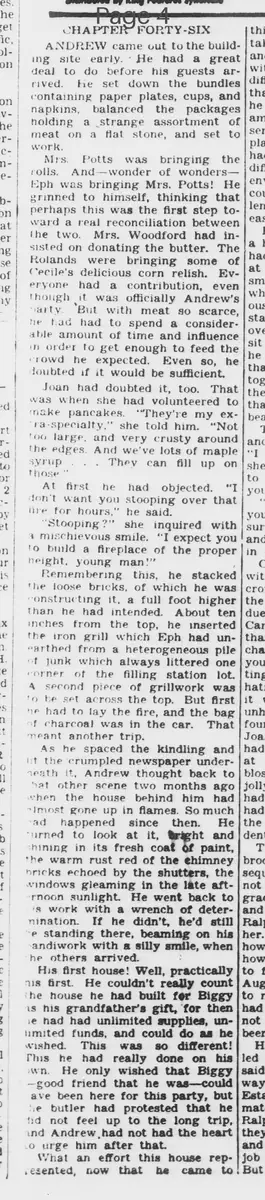
CHAPTER FORTY-SIX
ANDREW came out to the building site early. He had a great deal to do before his guests arrived.
He set down the bundles containing paper plates, cups, and napkins,
balanced the packages holding a strange assortment of meat on a flat stone, and set to work.
Mrs. Potts was bringing the rolls. And—wonder of wonders—Eph was bringing Mrs. Potts! He grinned to himself, thinking that perhaps this was the first step toward a real reconciliation between the two. Mrs. Woodford had insisted on donating the butter. The Rolands were bringing some of Cecile's delicious corn relish. Everyone had a contribution, even though it was officially Andrew's party. But with meat so scarce, he had had to spend a considerable amount of time and influence in order to get enough to feed the crowd he expected. Even so, he doubted if it would be sufficient.
Joan had doubted it, too. That was when she had volunteered to make pancakes. "They're my extra-specialty," she told him. "Not too large, and very crusty around the edges. And we've lots of maple syrup . . . They can fill up on those."
At first he had objected. "I don't want you stooping over that fire for hours," he said.
"Stooping?" she inquired with mischievous smile. "I expect you to build a fireplace of the proper height, young man!"
Remembering this, he stacked the loose bricks, of which he was constructing it, a full foot higher than he had intended. About ten inches from the top, he inserted the iron grill which Eph had unearthed from a heterogeneous pile of junk which always littered one corner of the filling station lot.
A second piece of grillwork was to be set across the top. But first he had to lay the fire, and the bag of charcoal was in the car. That meant another trip.
As he spaced the kindling and lit the crumpled newspaper underneath it, Andrew thought back to that other scene two months ago when the house behind him had almost gone up in flames. So much had happened since then. He turned to look at it, bright and shining in its fresh coat of paint, the warm rust red of the chimney bricks echoed by the shutters, the windows gleaming in the late afternoon sunlight. He went back to his work with a wrench of determination. If he didn't, he'd still be standing there, beaming on his handiwork with a silly smile, when the others arrived.
His first house! Well, practically his first. He couldn't really count the house he had built for Biggy as his grandfather's gift. For then he had had unlimited supplies, unlimited funds, and could do as he wished.
This was so different!
This he had really done on his own. He only wished that Biggy—good friend that he was—could have been here for this party, but the butler had protested that he did not feel up to the long trip, and Andrew had not had the heart to urge him after that.
What an effort this house represented, now that he came to think of it! At the time, he had taken each problem as it arose, and had gone about solving it without too much thought for the difficulties lurking ahead. Perhaps that was the best way to do things, he thought now. A moderate amount of forethought was only sensible, but no one could really plan for the future. The future had a way of turning out quite different from the way one had envisaged it, and an open mind could make the solution of problems along the way a good deal easier.
He laid on the top grill, using a huge asbestos glove which Alec had loaned him. He looked down at the monstrosity with a faint smile. How kind people were, and, when they liked you, how generous and openhanded! Eph, for instance, had insisted on bringing over some logs.
"They'll want to sit around a fire after they've eaten," he said. "Something about a fire that always brings people closer together—maybe it's a memory of the old days when they felt safer that way, and could keep the beasts off."
Then there was Mildred Sayre, and her offer to make the coffee.
"I may be sticking my neck out," she had laughed, "but I'm willing to bet I make better coffee than you do."
"Didn't your father ever tell you it isn't cricket to bet on a sure thing?" he had complained, and had taken her up on her offer in one second flat.
Carol was coming, of course, with one of the boys of the young crowd she had gone with most of the summer. Tomorrow she was due to go back to Brinkerhoff.
Carol was another reason to be thankful tonight. How she had changed from the surly, sullen young girl he had first met, sitting on her grandfather's steps, hating the world and everyone in it with the unreasoning hate of unhappy youth!
Once she had found her niche with the group Joan had introduced her to, and had learned the meaning of work at Eph's filling station, she had blossomed into a perfectly normal, jolly girl, and her smile, which had been the one feature which had attracted Andrew to her at the first, was more and more evident.
The episode with Ralph Estabrook had had no unpleasant consequences, thank heaven. She had not brooded over her fall from grace—Joan had seen to that—and once she knew the right boys, Ralph had lost his attraction for her. Ralph had not forgotten it, however.
Andrew recalled now how he had finally met him face to face on Main Street one grey August day, and Ralph had tried to make him fight. Mary Roland had been with him, and if she had not intervened, there might have been an unsavory scene.
He had allowed himself to be led away, and Andrew, who had said hardly a word, had gone his way.
Mary Roland and Ralph Estabrook! They were a well-matched pair, he decided now.
Ralph and his people were gone—they had left after Labor Day—and Mary had gone back to her job in Conway shortly thereafter.
But he had a feeling they would get together again. They each had a streak of wildness—an inner resentment against life—which made them defy the established conventions.
Of course, they bruised themselves more than they harmed the world and its accepted order.
Yet he doubted if they would realize that fact for some time.
But it was the changes in himself and Joan which most occupied Andrew's thoughts as he sat on a pile of boards and waited for his friends. They, too, had changed this summer.
His own life had widened and deepened most satisfactorily. He had become, through his own efforts, an established part of Branfield. Only this morning, he had completed negotiations with the bank for the rest of the loan which was to finance the entire development.
"We've decided," Jethro Emmons had said, "that anybody who can snatch building materials out of thin air, like you have for this one house, ought to have the chance to exercise his ingenuity on a few more."
This first house was already sold. Or as good as sold. Tomorrow morning the initial payment was to be made, and it afforded Andrew great satisfaction to know that it was to go to Maggie's nephew and wife—that couple she had told him about the first time she had waited on him at the Lodge. Her words had remained with him ever since, and it was some dim memory of them which had really determined him to make the experiment of building these inexpensive houses.
But it was not only his new confidence in himself as an architect and a business man which had constituted the change in him, Andrew realized. There was a deeper, more subtle change, which only he could know about. It was the knowledge he had found his place as a human being—as a man. He had made friends; he had earned his own living; he had found the girl he wanted to marry.
That alone gave every action, every thought, new significance.
Joan was someone to love, to spend himself on, as he had never had the chance to love or spend himself before, and it gave him immeasurable happiness simply to know that she lived in the same town.
And, he smiled to himself, rising to his feet as the Priests drove up, Joan, too, had changed. She had become so much softer, her bristly manner almost completely discarded. She had been kind, and helpful; he would have said "loving" if he had dared. Perhaps, he thought, the time had come when he should drop his hard-won casual manner and ask her again.
"I've brought the wire grills and the forks," Helen Priest said in greeting, "but I've been wondering all day where on earth you'd find anything to cook. In the meat line, I mean . . . Or have you got chicken?"
"Heaven forbid!" Alec groaned. "I'm sprouting pin feathers now, and—come the sunrise I'll begin to crow. Helen has been feeding me chicken for eighteen days straight."
"Well, it's all I could get, Alec," she said indignantly.
(To Be Continued
ANDREW came out to the building site early. He had a great deal to do before his guests arrived.
He set down the bundles containing paper plates, cups, and napkins,
balanced the packages holding a strange assortment of meat on a flat stone, and set to work.
Mrs. Potts was bringing the rolls. And—wonder of wonders—Eph was bringing Mrs. Potts! He grinned to himself, thinking that perhaps this was the first step toward a real reconciliation between the two. Mrs. Woodford had insisted on donating the butter. The Rolands were bringing some of Cecile's delicious corn relish. Everyone had a contribution, even though it was officially Andrew's party. But with meat so scarce, he had had to spend a considerable amount of time and influence in order to get enough to feed the crowd he expected. Even so, he doubted if it would be sufficient.
Joan had doubted it, too. That was when she had volunteered to make pancakes. "They're my extra-specialty," she told him. "Not too large, and very crusty around the edges. And we've lots of maple syrup . . . They can fill up on those."
At first he had objected. "I don't want you stooping over that fire for hours," he said.
"Stooping?" she inquired with mischievous smile. "I expect you to build a fireplace of the proper height, young man!"
Remembering this, he stacked the loose bricks, of which he was constructing it, a full foot higher than he had intended. About ten inches from the top, he inserted the iron grill which Eph had unearthed from a heterogeneous pile of junk which always littered one corner of the filling station lot.
A second piece of grillwork was to be set across the top. But first he had to lay the fire, and the bag of charcoal was in the car. That meant another trip.
As he spaced the kindling and lit the crumpled newspaper underneath it, Andrew thought back to that other scene two months ago when the house behind him had almost gone up in flames. So much had happened since then. He turned to look at it, bright and shining in its fresh coat of paint, the warm rust red of the chimney bricks echoed by the shutters, the windows gleaming in the late afternoon sunlight. He went back to his work with a wrench of determination. If he didn't, he'd still be standing there, beaming on his handiwork with a silly smile, when the others arrived.
His first house! Well, practically his first. He couldn't really count the house he had built for Biggy as his grandfather's gift. For then he had had unlimited supplies, unlimited funds, and could do as he wished.
This was so different!
This he had really done on his own. He only wished that Biggy—good friend that he was—could have been here for this party, but the butler had protested that he did not feel up to the long trip, and Andrew had not had the heart to urge him after that.
What an effort this house represented, now that he came to think of it! At the time, he had taken each problem as it arose, and had gone about solving it without too much thought for the difficulties lurking ahead. Perhaps that was the best way to do things, he thought now. A moderate amount of forethought was only sensible, but no one could really plan for the future. The future had a way of turning out quite different from the way one had envisaged it, and an open mind could make the solution of problems along the way a good deal easier.
He laid on the top grill, using a huge asbestos glove which Alec had loaned him. He looked down at the monstrosity with a faint smile. How kind people were, and, when they liked you, how generous and openhanded! Eph, for instance, had insisted on bringing over some logs.
"They'll want to sit around a fire after they've eaten," he said. "Something about a fire that always brings people closer together—maybe it's a memory of the old days when they felt safer that way, and could keep the beasts off."
Then there was Mildred Sayre, and her offer to make the coffee.
"I may be sticking my neck out," she had laughed, "but I'm willing to bet I make better coffee than you do."
"Didn't your father ever tell you it isn't cricket to bet on a sure thing?" he had complained, and had taken her up on her offer in one second flat.
Carol was coming, of course, with one of the boys of the young crowd she had gone with most of the summer. Tomorrow she was due to go back to Brinkerhoff.
Carol was another reason to be thankful tonight. How she had changed from the surly, sullen young girl he had first met, sitting on her grandfather's steps, hating the world and everyone in it with the unreasoning hate of unhappy youth!
Once she had found her niche with the group Joan had introduced her to, and had learned the meaning of work at Eph's filling station, she had blossomed into a perfectly normal, jolly girl, and her smile, which had been the one feature which had attracted Andrew to her at the first, was more and more evident.
The episode with Ralph Estabrook had had no unpleasant consequences, thank heaven. She had not brooded over her fall from grace—Joan had seen to that—and once she knew the right boys, Ralph had lost his attraction for her. Ralph had not forgotten it, however.
Andrew recalled now how he had finally met him face to face on Main Street one grey August day, and Ralph had tried to make him fight. Mary Roland had been with him, and if she had not intervened, there might have been an unsavory scene.
He had allowed himself to be led away, and Andrew, who had said hardly a word, had gone his way.
Mary Roland and Ralph Estabrook! They were a well-matched pair, he decided now.
Ralph and his people were gone—they had left after Labor Day—and Mary had gone back to her job in Conway shortly thereafter.
But he had a feeling they would get together again. They each had a streak of wildness—an inner resentment against life—which made them defy the established conventions.
Of course, they bruised themselves more than they harmed the world and its accepted order.
Yet he doubted if they would realize that fact for some time.
But it was the changes in himself and Joan which most occupied Andrew's thoughts as he sat on a pile of boards and waited for his friends. They, too, had changed this summer.
His own life had widened and deepened most satisfactorily. He had become, through his own efforts, an established part of Branfield. Only this morning, he had completed negotiations with the bank for the rest of the loan which was to finance the entire development.
"We've decided," Jethro Emmons had said, "that anybody who can snatch building materials out of thin air, like you have for this one house, ought to have the chance to exercise his ingenuity on a few more."
This first house was already sold. Or as good as sold. Tomorrow morning the initial payment was to be made, and it afforded Andrew great satisfaction to know that it was to go to Maggie's nephew and wife—that couple she had told him about the first time she had waited on him at the Lodge. Her words had remained with him ever since, and it was some dim memory of them which had really determined him to make the experiment of building these inexpensive houses.
But it was not only his new confidence in himself as an architect and a business man which had constituted the change in him, Andrew realized. There was a deeper, more subtle change, which only he could know about. It was the knowledge he had found his place as a human being—as a man. He had made friends; he had earned his own living; he had found the girl he wanted to marry.
That alone gave every action, every thought, new significance.
Joan was someone to love, to spend himself on, as he had never had the chance to love or spend himself before, and it gave him immeasurable happiness simply to know that she lived in the same town.
And, he smiled to himself, rising to his feet as the Priests drove up, Joan, too, had changed. She had become so much softer, her bristly manner almost completely discarded. She had been kind, and helpful; he would have said "loving" if he had dared. Perhaps, he thought, the time had come when he should drop his hard-won casual manner and ask her again.
"I've brought the wire grills and the forks," Helen Priest said in greeting, "but I've been wondering all day where on earth you'd find anything to cook. In the meat line, I mean . . . Or have you got chicken?"
"Heaven forbid!" Alec groaned. "I'm sprouting pin feathers now, and—come the sunrise I'll begin to crow. Helen has been feeding me chicken for eighteen days straight."
"Well, it's all I could get, Alec," she said indignantly.
(To Be Continued
What sub-type of article is it?
Prose Fiction
What themes does it cover?
Friendship
Love Romance
Moral Virtue
What keywords are associated?
Housewarming Party
Community Support
Personal Growth
Romance
Post War Scarcity
Branfield
Literary Details
Title
Chapter Forty Six
Key Lines
"Stooping?" She Inquired With Mischievous Smile. "I Expect You To Build A Fireplace Of The Proper Height, Young Man!"
His First House! Well, Practically His First. He Couldn't Really Count The House He Had Built For Biggy As His Grandfather's Gift. For Then He Had Had Unlimited Supplies, Unlimited Funds, And Could Do As He Wished.
This Was So Different!
The Future Had A Way Of Turning Out Quite Different From The Way One Had Envisaged It, And An Open Mind Could Make The Solution Of Problems Along The Way A Good Deal Easier.
Joan Was Someone To Love, To Spend Himself On, As He Had Never Had The Chance To Love Or Spend Himself Before, And It Gave Him Immeasurable Happiness Simply To Know That She Lived In The Same Town.