Thank you for visiting SNEWPapers!
Sign up free
Literary
July 3, 1787
The New York Packet
New York, New York County, New York
What is this article about?
In the First Punic War, Roman Consul Attilius, captured by Carthaginians, returns on parole to negotiate peace but patriotically urges Rome to reject it and continue fighting, dooming himself to execution. Despite family and public pleas, he honors his word and returns to Carthage.
Clipping
OCR Quality
98%
Excellent
Full Text
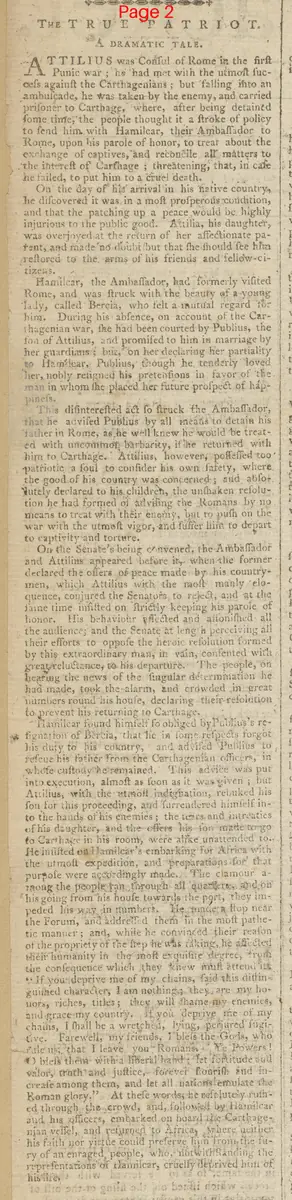
THE TRUE PATRIOT.
A DRAMATIC TALE.
TITUS was Consul of Rome in the first Punic war: he had met with the utmost successes against the Carthaginians; but falling into an ambuscade, he was taken by the enemy, and carried prisoner to Carthage, where, after being detained some time, the people thought it a stroke of policy to send him with Hamilcar, their Ambassador to Rome, upon his parole of honor, to treat about the exchange of captives, and reconcile all matters to the interest of Carthage; threatening, that, in case he failed, to put him to a cruel death.
On the day of his arrival in his native country he discovered it was in a most prosperous condition, and that the patching up a peace would be highly injurious to the public good. Attilia, his daughter, was overjoyed at the return of her affectionate parent, and made no doubt but that she should see him restored to the arms of his friends and fellow-citizens.
Hamilcar, the Ambassador, had formerly visited Rome, and was struck with the beauty of a young lady, called Bercia, who felt a mutual regard for him. During his absence, on account of the Carthaginian war, she had been courted by Publius, the son of Attilius, and promised to him in marriage by her guardians; but, on her declaring her partiality to Hamilcar, Publius, though he tenderly loved her, nobly resigned his pretensions in favor of the man in whom she placed her future prospect of happiness.
This disinterested act so struck the Ambassador, that he advised Publius by all means to detain his father in Rome, as he well knew he would be treated with uncommon barbarity, if he returned with him to Carthage. Attilius, however, possessed too patriotic a soul to consider his own safety, where the good of his country was concerned; and absolutely declared to his children, the unshaken resolution he had formed of advising the Romans by no means to treat with their enemy, but to push on the war with the utmost vigor, and suffer him to depart to captivity and torture.
On the Senate's being convened, the Ambassador and Attilius appeared before it, when the former declared the offers of peace made by his countrymen, which Attilius with the most manly eloquence, conjured the Senators to reject, and at the same time insisted on strictly keeping his parole of honor. His behaviour affected and astonished all the audience; and the Senate at length, perceiving all their efforts to oppose the heroic resolution formed by this extraordinary man, in vain, consented with great reluctance, to his departure. The people, on hearing the news of the singular determination he had made, took the alarm, and crowded in great numbers round his house, declaring their resolution to prevent his returning to Carthage.
Hamilcar found himself so obliged by Publius's resignation of Bercia, that he in some respects forgot his duty to his country, and advised Publius to rescue his father from the Carthaginian officers, in whose custody he remained. This advice was put into execution, almost as soon as it was given; but Attilius, with the utmost indignation, rebuked his son for this proceeding, and surrendered himself into the hands of his enemies; the tears and intreaties of his daughter, and the offers his son made to go to Carthage in his room, were alike unattended to.
He insisted on Hamilcar's embarking for Africa with the utmost expedition, and preparations for that purpose were accordingly made. The clamour among the people ran through all quarters, and on his going from his house towards the port, they impeded his way in numbers. He made a stop near the Forum, and addressed them in the most pathetic manner; and, while he convinced their reason of the propriety of the step he was taking, he affected their humanity in the most exquisite degree, from the consequence which they knew must attend it.
"If you deprive me of my chains," said this distinguished character, "I am nothing; they are my honors, riches, titles; they will shame my enemies, and grace my country. If you deprive me of my chains, I shall be a wretched, lying, perjured fugitive. Farewell, my friends, I bless the Gods, who rule us: that I leave you—Romans. Ye Powers! bless them with a liberal hand; Let fortitude and valor, truth and justice, forever flourish and increase among them, and let all nations emulate the Roman glory." At these words, he resolutely rushed through the crowd, and, followed by Hamilcar and his officers, embarked on board the Carthaginian vessel, and returned to Africa, where neither his faith nor virtue could preserve him from the fury of an enraged people, who, notwithstanding the representations of Hamilcar, cruelly deprived him of his life.
A DRAMATIC TALE.
TITUS was Consul of Rome in the first Punic war: he had met with the utmost successes against the Carthaginians; but falling into an ambuscade, he was taken by the enemy, and carried prisoner to Carthage, where, after being detained some time, the people thought it a stroke of policy to send him with Hamilcar, their Ambassador to Rome, upon his parole of honor, to treat about the exchange of captives, and reconcile all matters to the interest of Carthage; threatening, that, in case he failed, to put him to a cruel death.
On the day of his arrival in his native country he discovered it was in a most prosperous condition, and that the patching up a peace would be highly injurious to the public good. Attilia, his daughter, was overjoyed at the return of her affectionate parent, and made no doubt but that she should see him restored to the arms of his friends and fellow-citizens.
Hamilcar, the Ambassador, had formerly visited Rome, and was struck with the beauty of a young lady, called Bercia, who felt a mutual regard for him. During his absence, on account of the Carthaginian war, she had been courted by Publius, the son of Attilius, and promised to him in marriage by her guardians; but, on her declaring her partiality to Hamilcar, Publius, though he tenderly loved her, nobly resigned his pretensions in favor of the man in whom she placed her future prospect of happiness.
This disinterested act so struck the Ambassador, that he advised Publius by all means to detain his father in Rome, as he well knew he would be treated with uncommon barbarity, if he returned with him to Carthage. Attilius, however, possessed too patriotic a soul to consider his own safety, where the good of his country was concerned; and absolutely declared to his children, the unshaken resolution he had formed of advising the Romans by no means to treat with their enemy, but to push on the war with the utmost vigor, and suffer him to depart to captivity and torture.
On the Senate's being convened, the Ambassador and Attilius appeared before it, when the former declared the offers of peace made by his countrymen, which Attilius with the most manly eloquence, conjured the Senators to reject, and at the same time insisted on strictly keeping his parole of honor. His behaviour affected and astonished all the audience; and the Senate at length, perceiving all their efforts to oppose the heroic resolution formed by this extraordinary man, in vain, consented with great reluctance, to his departure. The people, on hearing the news of the singular determination he had made, took the alarm, and crowded in great numbers round his house, declaring their resolution to prevent his returning to Carthage.
Hamilcar found himself so obliged by Publius's resignation of Bercia, that he in some respects forgot his duty to his country, and advised Publius to rescue his father from the Carthaginian officers, in whose custody he remained. This advice was put into execution, almost as soon as it was given; but Attilius, with the utmost indignation, rebuked his son for this proceeding, and surrendered himself into the hands of his enemies; the tears and intreaties of his daughter, and the offers his son made to go to Carthage in his room, were alike unattended to.
He insisted on Hamilcar's embarking for Africa with the utmost expedition, and preparations for that purpose were accordingly made. The clamour among the people ran through all quarters, and on his going from his house towards the port, they impeded his way in numbers. He made a stop near the Forum, and addressed them in the most pathetic manner; and, while he convinced their reason of the propriety of the step he was taking, he affected their humanity in the most exquisite degree, from the consequence which they knew must attend it.
"If you deprive me of my chains," said this distinguished character, "I am nothing; they are my honors, riches, titles; they will shame my enemies, and grace my country. If you deprive me of my chains, I shall be a wretched, lying, perjured fugitive. Farewell, my friends, I bless the Gods, who rule us: that I leave you—Romans. Ye Powers! bless them with a liberal hand; Let fortitude and valor, truth and justice, forever flourish and increase among them, and let all nations emulate the Roman glory." At these words, he resolutely rushed through the crowd, and, followed by Hamilcar and his officers, embarked on board the Carthaginian vessel, and returned to Africa, where neither his faith nor virtue could preserve him from the fury of an enraged people, who, notwithstanding the representations of Hamilcar, cruelly deprived him of his life.
What sub-type of article is it?
Prose Fiction
What themes does it cover?
Patriotism
Political
Moral Virtue
What keywords are associated?
Punic War
Roman Consul
Patriotism
Parole Honor
Sacrifice
Carthage
Attilius
Hamilcar
Literary Details
Title
The True Patriot. A Dramatic Tale.
Key Lines
"If You Deprive Me Of My Chains," Said This Distinguished Character, "I Am Nothing; They Are My Honors, Riches, Titles; They Will Shame My Enemies, And Grace My Country. If You Deprive Me Of My Chains, I Shall Be A Wretched, Lying, Perjured Fugitive. Farewell, My Friends, I Bless The Gods, Who Rule Us: That I Leave You—Romans. Ye Powers! Bless Them With A Liberal Hand; Let Fortitude And Valor, Truth And Justice, Forever Flourish And Increase Among Them, And Let All Nations Emulate The Roman Glory."