Thank you for visiting SNEWPapers!
Sign up free
Daily National Intelligencer
Washington, District Of Columbia
What is this article about?
A devastating fire on November 3, 1819, destroyed half of Wilmington, North Carolina, including 300 buildings over 12 acres, causing $500,000 in losses mostly uninsured. Magistrate Hanson Kelly appealed for aid to Washington's mayor, prompting the city council to appoint ward committees to solicit donations from citizens.
Clipping
OCR Quality
Full Text
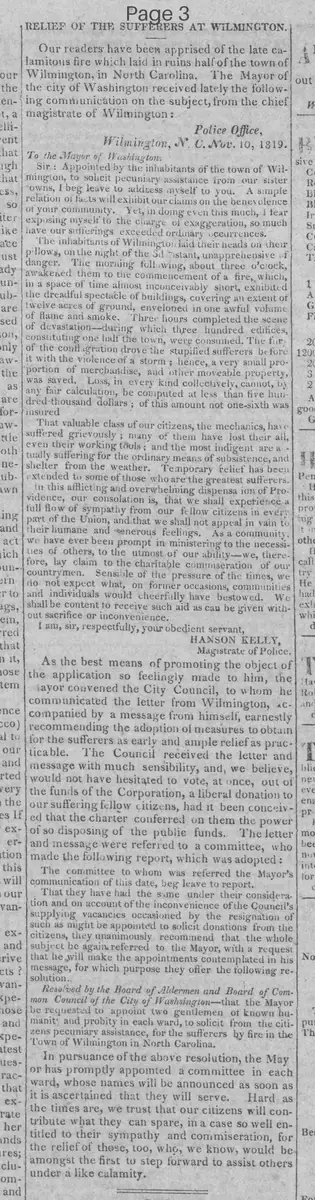
Our readers have been apprised of the late calamitous fire which laid in ruins half of the town of Wilmington, in North Carolina. The Mayor of the city of Washington received lately the following communication on the subject, from the chief magistrate of Wilmington:
Police Office,
Wilmington, N. C. Nov. 10, 1819.
To the Mayor of Washington:
Sir: Appointed by the inhabitants of the town of Wilmington, to solicit pecuniary assistance from our sister towns, I beg leave to address myself to you. A simple relation of facts will exhibit our claims on the benevolence of your community. Yet, in doing even this much, I fear exposing myself to the charge of exaggeration, so much have our sufferings exceeded ordinary occurrences.
The inhabitants of Wilmington laid their heads on their pillows, on the night of the 3d instant, unapprehensive of danger. The morning following, about three o'clock, awakened them to the commencement of a fire, which, in a space of time almost inconceivably short, exhibited the dreadful spectacle of buildings, covering an extent of twelve acres of ground, enveloped in one awful volume of flame and smoke. Three hours completed the scene of devastation—during which three hundred edifices, constituting one half the town, were consumed. The fury of the conflagration drove the stupified sufferers before it with the violence of a storm; hence, a very small proportion of merchandise, and other moveable property, was saved. Loss, in every kind collectively, cannot, by any fair calculation, be computed at less than five hundred thousand dollars; of this amount not one-sixth was insured.
That valuable class of our citizens, the mechanics, have suffered grievously; many of them have lost their all, even their working tools; and the most indigent are actually suffering for the ordinary means of subsistence, and shelter from the weather. Temporary relief has been extended to some of those who are the greatest sufferers.
In this afflicting and overwhelming dispensation of Providence, our consolation is, that we shall experience a full flow of sympathy from our fellow citizens in every part of the Union, and that we shall not appeal in vain to their humane and generous feelings. As a community, we have ever been prompt in ministering to the necessities of others, to the utmost of our ability—we, therefore, lay claim to the charitable commiseration of our countrymen. Sensible of the pressure of the times, we do not expect what, on former occasions, communities and individuals would cheerfully have bestowed. We shall be content to receive such aid as can be given without sacrifice or inconvenience.
I am, sir, respectfully, your obedient servant,
HANSON KELLY.
Magistrate of Police.
As the best means of promoting the object of the application so feelingly made to him, the Mayor convened the City Council, to whom he communicated the letter from Wilmington, accompanied by a message from himself, earnestly recommending the adoption of measures to obtain for the sufferers as early and ample relief as practicable. The Council received the letter and message with much sensibility, and, we believe, would not have hesitated to vote, at once, out of the funds of the Corporation, a liberal donation to our suffering fellow citizens, had it been conceived that the charter conferred on them the power of so disposing of the public funds. The letter and message were referred to a committee, who made the following report, which was adopted:
The committee to whom was referred the Mayor's communication of this date, beg leave to report.
That they have had the same under their consideration and on account of the inconvenience of the Council's supplying vacancies occasioned by the resignation of such as might be appointed to solicit donations from the citizens, they unanimously recommend that the whole subject be again referred to the Mayor, with a request that he will make the appointments contemplated in his message, for which purpose they offer the following resolution.
Resolved by the Board of Aldermen and Board of Common Council of the City of Washington—that the Mayor be requested to appoint two gentlemen of known humanity and probity in each ward, to solicit from the citizens pecuniary assistance, for the sufferers by fire in the Town of Wilmington in North Carolina.
In pursuance of the above resolution, the Mayor has promptly appointed a committee in each ward, whose names will be announced as soon as it is ascertained that they will serve. Hard as the times are, we trust that our citizens will contribute what they can spare, in a case so well entitled to their sympathy and commiseration, for the relief of those, too, who, we know, would be amongst the first to step forward to assist others under a like calamity.
What sub-type of article is it?
What keywords are associated?
What entities or persons were involved?
Where did it happen?
Domestic News Details
Primary Location
Wilmington, North Carolina
Event Date
November 3, 1819
Key Persons
Outcome
three hundred edifices consumed, covering twelve acres; total loss estimated at five hundred thousand dollars, with not one-sixth insured; mechanics lost tools and livelihoods; indigent suffering for subsistence and shelter; temporary relief provided to some.
Event Details
Fire started around 3 a.m. on November 3, 1819, rapidly destroying half the town in three hours; little property saved due to the storm-like fury; appeal for pecuniary assistance sent by Hanson Kelly on November 10, 1819, to Washington mayor; Washington City Council referred to committee and resolved to appoint solicitors in each ward for donations.