Thank you for visiting SNEWPapers!
Sign up free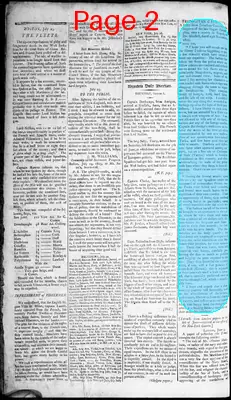
Story
August 1, 1805
Alexandria Daily Advertiser
Alexandria, Virginia
What is this article about?
Letter from Jonathan Cowdery, surgeon of the captured USS Philadelphia, detailing his captivity in Tripoli in 1804: prisoner conditions, hard labor, illnesses treated with soda and lime, Turkish medical practices for burns, and hopes for liberation.
Clipping

OCR Quality
98%
Excellent
Full Text
TRIPOLITAN CAPTIVITY.
A letter from Jonathan Cowdery, esq. surgeon of the late frigate Philadelphia, now a captive in Tripoli, to Dr. Mitchell, dated 24th November, 1804.
DEAR SIR,
"I hope you will excuse me for the liberty I take in suggesting to you a few remarks which have occurred since my captivity. The bashaw has taken me from the prison where my fellow officers are confined and ordered me to attend his sick slaves who are principally Neapolitans, negroes, and our unfortunate crew. Some of the latter I this morning saw chained to a cart loaded with stones which they were dragging through the town to repair the fortifications. They complain much of hunger, cold, hard labor, and the lash of the whip. I confess I never saw any thing that wounded my feelings equal to the sight of those poor fellows. I have liberty to walk in the town, but am attended by a Turk who is loaded with weapons of war. I am not allowed to visit any of the fortifications nor any of the foreign consuls. Captain Bainbridge's endeavors to relieve the wants of his crew are often countermanded by our new masters. Five of our countrymen have turned Turks, and five have paid their last debt to nature. Diarrhoea and dysentery have often appeared among our crew, but on a free use of Carbonate of Soda (Natron) which is found in abundance in this country, and often whitewashing the walls of the prison with lime where they sleep, it soon disappears. Our crew are now very healthy.
"During the several attacks upon this town by our squadron under the command of commodore Preble, many Turks were killed and wounded, and several men much burnt by the explosion of their own powder. I had an opportunity of seeing their method of curing burns in particular, many of which extended over the whole body. The bashaw has all of his wounded brought to an apartment in the castle where he visits them and makes them a present of ten dollars each. He then orders his surgeons and Mamelukes to dress their wounds: he often assists with his own hands. The Mamelukes are his body guards; the Marabouts are employed to expel evil spirits and make intercession with Mahomet their prophet, for their recovery. Those that were burnt, were first anointed with honey, carefully preserving the skin as much as possible and keeping the parts exposed to the air. They then sprinkled the ulcered parts, if any, with a fine powder of white-lead (Ceruse); this is repeated at short intervals until a scab is formed, that is carefully preserved until a cure is accomplished, which is remarkably soon.
"I hope and expect that in due time my country will honorably, and to the astonishment of Barbarians, and tyrants, liberate us from the chains of slavery, and restore us to our native land, that happy land the thoughts of which is a healing balm to our souls in their miserable bondage."
A letter from Jonathan Cowdery, esq. surgeon of the late frigate Philadelphia, now a captive in Tripoli, to Dr. Mitchell, dated 24th November, 1804.
DEAR SIR,
"I hope you will excuse me for the liberty I take in suggesting to you a few remarks which have occurred since my captivity. The bashaw has taken me from the prison where my fellow officers are confined and ordered me to attend his sick slaves who are principally Neapolitans, negroes, and our unfortunate crew. Some of the latter I this morning saw chained to a cart loaded with stones which they were dragging through the town to repair the fortifications. They complain much of hunger, cold, hard labor, and the lash of the whip. I confess I never saw any thing that wounded my feelings equal to the sight of those poor fellows. I have liberty to walk in the town, but am attended by a Turk who is loaded with weapons of war. I am not allowed to visit any of the fortifications nor any of the foreign consuls. Captain Bainbridge's endeavors to relieve the wants of his crew are often countermanded by our new masters. Five of our countrymen have turned Turks, and five have paid their last debt to nature. Diarrhoea and dysentery have often appeared among our crew, but on a free use of Carbonate of Soda (Natron) which is found in abundance in this country, and often whitewashing the walls of the prison with lime where they sleep, it soon disappears. Our crew are now very healthy.
"During the several attacks upon this town by our squadron under the command of commodore Preble, many Turks were killed and wounded, and several men much burnt by the explosion of their own powder. I had an opportunity of seeing their method of curing burns in particular, many of which extended over the whole body. The bashaw has all of his wounded brought to an apartment in the castle where he visits them and makes them a present of ten dollars each. He then orders his surgeons and Mamelukes to dress their wounds: he often assists with his own hands. The Mamelukes are his body guards; the Marabouts are employed to expel evil spirits and make intercession with Mahomet their prophet, for their recovery. Those that were burnt, were first anointed with honey, carefully preserving the skin as much as possible and keeping the parts exposed to the air. They then sprinkled the ulcered parts, if any, with a fine powder of white-lead (Ceruse); this is repeated at short intervals until a scab is formed, that is carefully preserved until a cure is accomplished, which is remarkably soon.
"I hope and expect that in due time my country will honorably, and to the astonishment of Barbarians, and tyrants, liberate us from the chains of slavery, and restore us to our native land, that happy land the thoughts of which is a healing balm to our souls in their miserable bondage."
What sub-type of article is it?
Biography
Historical Event
Survival
What themes does it cover?
Misfortune
Survival
Fate Providence
What keywords are associated?
Tripoli Captivity
American Prisoners
Barbary Wars
Medical Treatment
Burn Cures
Naval Attacks
What entities or persons were involved?
Jonathan Cowdery
Dr. Mitchell
Captain Bainbridge
Commodore Preble
Bashaw
Where did it happen?
Tripoli
Story Details
Key Persons
Jonathan Cowdery
Dr. Mitchell
Captain Bainbridge
Commodore Preble
Bashaw
Location
Tripoli
Event Date
24th November, 1804
Story Details
Captive American surgeon describes harsh conditions of imprisoned crew including labor and illness, effective treatments used, observations of Turkish burn remedies during naval attacks, and anticipation of honorable liberation.