Thank you for visiting SNEWPapers!
Sign up free
The Hillsborough Recorder
Hillsboro, Orange County, North Carolina
What is this article about?
The New York Tribune argues that higher tariffs have not increased prices of goods like pins, sad irons, nails, and hardware; instead, many are cheaper now than in 1841, refuting free trade claims of excessive taxation on consumers.
Clipping
OCR Quality
Full Text
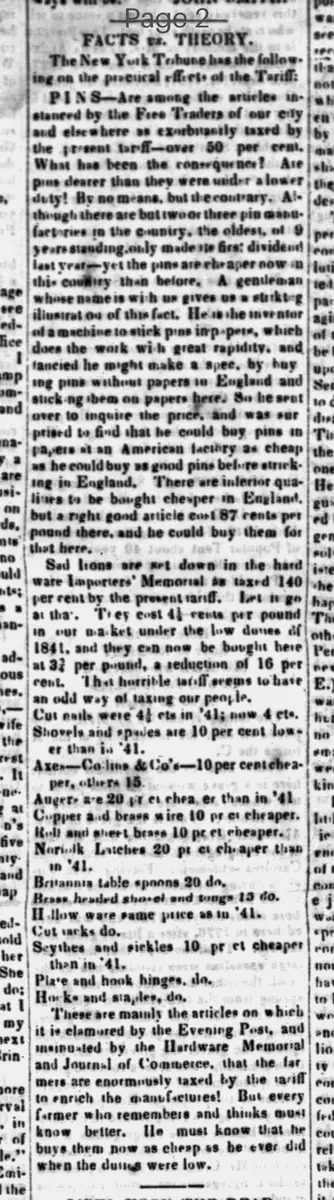
The New York Tribune has the following on the practical effect of the Tariff:
PINS-Are among the articles instanced by the Free Traders of our city and elsewhere as exorbitantly taxed by the present tariff-over 50 per cent. What has been the consequence? Are pins dearer than they were under a lower duty! By no means, but the contrary. Although there are but two or three pin manufactories in the Country, the oldest, established nine years standing, only made its first dividend last year- yet the pins are cheaper now than before. A gentleman whose name is with us gives us a striking illustration of this fact. He is the inventor of a machine to stick pins in papers, which does the work with great rapidity, and fancied he might make a spec, by buying pins without papers in England and sticking them on papers here. So he went over to inquire the price, and was surprised to find that he could buy pins on papers at an American factory as cheap as he could buy as good pins before sticking in England. There are inferior qualities to be bought cheaper in England, but a right good article cost 87 cents per pound there, and he could buy them for that here.
Sad irons are set down in the Hardware Importers' Memorial as taxed 140 per cent by the present tariff. Let it go at that. They cost 4 cents per pound in our market under the low duties of 1841, and they can now be bought here at 3½ per pound, a reduction of 16 per cent. That horrible tariff has an odd way of taxing our people.
Cut nails were 4 cts in '41; now 4 cts,
Shovels and spades are 10 per cent lower than in '41.
Axes-Collins & Co's-10 per cent cheaper, others 15
Augers are 20 per cent cheaper than in '41
Copper and brass wire 10 per cent cheaper.
Roll and sheet brass 10 per cent cheaper.
Norfolk Latches 20 per cent cheaper than in '41.
Britannia table spoons 20 do,
Brass heated shovel and tongs 13 60.
Hollow ware same price as in '41.
Cut axes do.
Scythes and sickles 10 per cent cheaper than in 41.
Plane and hook hinges, do.
Butts and staples, do.
These are many of the articles on which it is clamored by the Evening Post, and insinuated by the Hardware Memorial and Journal of Commerce, that the farmers are enormously taxed by the tariff to enrich the manufacturers! But every farmer who remembers and thinks must know better. He must know that he buys them now as cheap as he ever did when the duties were low.
What sub-type of article is it?
What keywords are associated?
What entities or persons were involved?
Where did it happen?
Domestic News Details
Primary Location
New York
Key Persons
Outcome
prices of pins, sad irons, cut nails, shovels, spades, axes, augers, copper and brass wire, roll and sheet brass, norfolk latches, britannia table spoons, brass heated shovel and tongs, hollow ware, cut axes, scythes and sickles, plane and hook hinges, butts and staples are cheaper or same as in 1841 despite higher tariffs.
Event Details
The New York Tribune discusses how higher tariffs have led to lower or stable prices for various manufactured goods compared to 1841, using examples like pins costing 87 cents per pound in England but available at same price in American factories, and sad irons reduced from 4 cents to 3½ cents per pound.