Thank you for visiting SNEWPapers!
Sign up free
Editorial
August 6, 1834
The Daily Cincinnati Republican, And Commercial Register
Cincinnati, Hamilton County, Ohio
What is this article about?
Editorial defends the 1834 Act on U.S. gold coins against Charles Hammond's critique in the Gazette, arguing the law's intent is to set a new standard with 232 grains pure gold per eagle valued at $10, not double value as claimed. Accuses Hammond of political bias and sophistry, praising the act for promoting honest currency over bank paper.
Clipping
OCR Quality
92%
Excellent
Full Text
For the Cincinnati Republican.
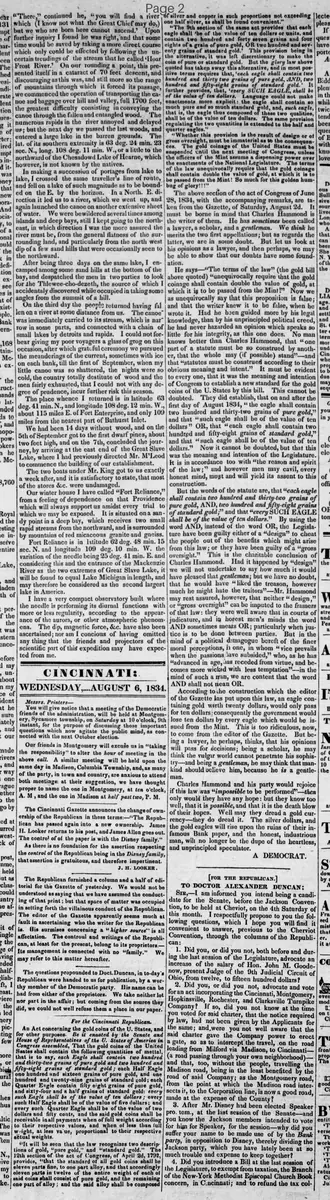
An Act concerning the gold coins of the U. States, and for other purposes. Be it enacted by the Senate and House of Representatives of the U. States of America in Congress assembled, That the gold coins of the United States shall contain the following quantities of metal, that is to say, each Eagle shall contain two hundred and thirty-two grains of pure gold and two hundred and fifty-eight grains of standard gold: each Half Eagle one hundred and sixteen grains of pure gold, and one hundred and twenty-nine grains of standard gold; each Quarter Eagle contain fifty eight grains of pure gold, and sixty-four and a half grains of standard gold: every such Eagle shall be of the value of ten dollars; every such Half Eagle shall be of the value of five dollars; and every such Quarter Eagle shall be of the value of two dollars and fifty cents, and the said gold coins shall be receivable in all payments when of full weight according to their respective values, and when of less than full weight, at less value, proportional to their respective actual weights.
It will be seen that the law recognizes two descriptions of gold, "pure gold," and "standard gold." The 12th section of the act of Congress, of April 2d, 1792, provides, "that the standard of all gold coins shall be eleven parts fine, to one part alloy, and that accordingly eleven parts in twelve of the entire weight of each of said coins shall consist of pure gold, and the remaining one part of alloy; and the said alloy shall be composed of silver and copper in such proportions not exceeding one half silver, as shall be found convenient."
"The 9th section of the same act provides that each eagle shall be of the value of ten dollars or units, and contain two hundred and forty seven grains and four eights of a grain of pure gold, OR two hundred and seventy grains of standard gold.' This provision being in the alternative, it was left discretionary to make the coin of pure or standard gold. But the glory law above quoted has taken away this alternative, and in most positive terms requires that, 'each eagle shall contain two hundred and thirty two grains of pure gold, AND, two hundred and fifty-eight grains of standard gold.' It further provides, that, 'every SUCH EAGLE, shall be of the value of ten dollars. Language could not make enactments more explicit: the eagle shall contain so much pure and so much standard gold, and, such eagle, that is the eagle thus composed of these two qualities shall be of the value of ten dollars. The same provision regulating the two quantities is extended to the half and quarter eagles.
"Whether this provision is the result of design or of gross oversight, must be immaterial as to the consequences
suspended until the next meeting of Congress, unless the officers of the Mint assume a dispensing power over the enactments of the National Legislature. The terms of the law unequivocally require that the gold coinage shall contain double the value of gold, at which it is to be passed from the Mint! So much for this golden humbug of glory!!!"
The above section of the act of Congress of June 28, 1834, with the accompanying remarks, are taken from the Gazette, of Saturday, August 2d. It must be borne in mind that Charles Hammond is the writer of them. He has sometimes been called a lawyer, a scholar, and a gentleman. We think he merits the two first appellations; but as regards the latter, we are in some doubt. But let us look at his opinions as a lawyer, and then perhaps, we may be able to show that our doubts have some foundation.
He says—"The terms of the law" (the gold bill above quoted) "unequivocally require that the gold coinage shall contain double the value of gold, at which it is to be passed from the Mint!" Now we as unequivocally say that this proposition is false; and that the writer knew it to be false, when he wrote it. Had he been guided more by his legal knowledge, than by his unprincipled political creed, he had never hazarded an opinion which speaks so little for his integrity, as this one does. No man knows better than Charles Hammond, that "one part of a statute must be so construed by another, that the whole may (if possible) stand" and that "statutes must be construed according to their obvious meaning and intent." It must be evident to every one, that it was the meaning and intention of Congress to establish a new standard for the gold coins of the U. States by this bill. This cannot be doubted. They did establish, that on and after the first day of August 1834, "the eagle shall contain two hundred and thirty-two grains of pure gold," and that "such eagle shall be of the value of ten dollars" OR, that "each eagle shall contain two hundred and fifty-eight grains of standard gold," and that "such eagle shall be of the value of ten dollars." Now it cannot be doubted, but that this was the meaning and intention of the Legislature.
It is in accordance too with "the reason and spirit of the law;" and however men may cavil, every honest mind, must and will yield its assent to this construction.
But the words of the statute are, that "each eagle shall contain two hundred and thirty-two grains of pure gold, AND, two hundred and fifty-eight grains of standard gold;" and that "every SUCH EAGLE shall be of the value of ten dollars." By using the word AND, instead of the word OR, the Legislature have been guilty either of a "design" to cheat the people out of the benefits which might arise from this law; or they have been guilty of a "gross oversight." This is the charitable conclusion of Charles Hammond. Had it happened by "design" we will not undertake to say how much it would have pleased that gentleman; but we have no doubt, that he would have "liked the treason, however much he might hate the traitors"—Mr. Hammond may rest assured, however, that neither "design," or "gross oversight" can be imputed to the framers of that law: they were well aware that in courts of judicature, and in honest men's minds the word AND sometimes means OR; particularly when justice is to be done between parties. But in the mind of a political demagogue bereft of the finer moral perceptions, in one, in whom "vice prevails when the passions have subsided," who, as he has "advanced in age, has receded from virtue, and becomes more wicked with less temptation"—in the mind of such a man, we are content that the word AND shall not mean OR.
According to the construction which the editor of the Gazette has put upon this law, an eagle containing gold worth twenty dollars, would only pass for ten dollars; consequently the government would lose ten dollars by every eagle which would be issued from the Mint. This is too ridiculous, now, to come from the editor of the Gazette. But being a lawyer, he perhaps, thinks, that his opinions will pass for decisions; being a scholar, he may think the vulgar world cannot penetrate his sophistry—and being a gentleman, he may think that mankind should believe him, because he is a gentleman.
Charles Hammond and his party would rejoice if this law was "impossible to be performed"—then only would they have any hope: but they know too well, that it is possible, and that it is the death blow of their hopes. Well may they dread a gold currency—they do dread it. The silver dollars, and the gold eagles will rise upon the ruins of their infamous Bank paper, and the honest, industrious man, will no longer be the dupe of the heartless, and unprincipled speculator.
A DEMOCRAT.
An Act concerning the gold coins of the U. States, and for other purposes. Be it enacted by the Senate and House of Representatives of the U. States of America in Congress assembled, That the gold coins of the United States shall contain the following quantities of metal, that is to say, each Eagle shall contain two hundred and thirty-two grains of pure gold and two hundred and fifty-eight grains of standard gold: each Half Eagle one hundred and sixteen grains of pure gold, and one hundred and twenty-nine grains of standard gold; each Quarter Eagle contain fifty eight grains of pure gold, and sixty-four and a half grains of standard gold: every such Eagle shall be of the value of ten dollars; every such Half Eagle shall be of the value of five dollars; and every such Quarter Eagle shall be of the value of two dollars and fifty cents, and the said gold coins shall be receivable in all payments when of full weight according to their respective values, and when of less than full weight, at less value, proportional to their respective actual weights.
It will be seen that the law recognizes two descriptions of gold, "pure gold," and "standard gold." The 12th section of the act of Congress, of April 2d, 1792, provides, "that the standard of all gold coins shall be eleven parts fine, to one part alloy, and that accordingly eleven parts in twelve of the entire weight of each of said coins shall consist of pure gold, and the remaining one part of alloy; and the said alloy shall be composed of silver and copper in such proportions not exceeding one half silver, as shall be found convenient."
"The 9th section of the same act provides that each eagle shall be of the value of ten dollars or units, and contain two hundred and forty seven grains and four eights of a grain of pure gold, OR two hundred and seventy grains of standard gold.' This provision being in the alternative, it was left discretionary to make the coin of pure or standard gold. But the glory law above quoted has taken away this alternative, and in most positive terms requires that, 'each eagle shall contain two hundred and thirty two grains of pure gold, AND, two hundred and fifty-eight grains of standard gold.' It further provides, that, 'every SUCH EAGLE, shall be of the value of ten dollars. Language could not make enactments more explicit: the eagle shall contain so much pure and so much standard gold, and, such eagle, that is the eagle thus composed of these two qualities shall be of the value of ten dollars. The same provision regulating the two quantities is extended to the half and quarter eagles.
"Whether this provision is the result of design or of gross oversight, must be immaterial as to the consequences
suspended until the next meeting of Congress, unless the officers of the Mint assume a dispensing power over the enactments of the National Legislature. The terms of the law unequivocally require that the gold coinage shall contain double the value of gold, at which it is to be passed from the Mint! So much for this golden humbug of glory!!!"
The above section of the act of Congress of June 28, 1834, with the accompanying remarks, are taken from the Gazette, of Saturday, August 2d. It must be borne in mind that Charles Hammond is the writer of them. He has sometimes been called a lawyer, a scholar, and a gentleman. We think he merits the two first appellations; but as regards the latter, we are in some doubt. But let us look at his opinions as a lawyer, and then perhaps, we may be able to show that our doubts have some foundation.
He says—"The terms of the law" (the gold bill above quoted) "unequivocally require that the gold coinage shall contain double the value of gold, at which it is to be passed from the Mint!" Now we as unequivocally say that this proposition is false; and that the writer knew it to be false, when he wrote it. Had he been guided more by his legal knowledge, than by his unprincipled political creed, he had never hazarded an opinion which speaks so little for his integrity, as this one does. No man knows better than Charles Hammond, that "one part of a statute must be so construed by another, that the whole may (if possible) stand" and that "statutes must be construed according to their obvious meaning and intent." It must be evident to every one, that it was the meaning and intention of Congress to establish a new standard for the gold coins of the U. States by this bill. This cannot be doubted. They did establish, that on and after the first day of August 1834, "the eagle shall contain two hundred and thirty-two grains of pure gold," and that "such eagle shall be of the value of ten dollars" OR, that "each eagle shall contain two hundred and fifty-eight grains of standard gold," and that "such eagle shall be of the value of ten dollars." Now it cannot be doubted, but that this was the meaning and intention of the Legislature.
It is in accordance too with "the reason and spirit of the law;" and however men may cavil, every honest mind, must and will yield its assent to this construction.
But the words of the statute are, that "each eagle shall contain two hundred and thirty-two grains of pure gold, AND, two hundred and fifty-eight grains of standard gold;" and that "every SUCH EAGLE shall be of the value of ten dollars." By using the word AND, instead of the word OR, the Legislature have been guilty either of a "design" to cheat the people out of the benefits which might arise from this law; or they have been guilty of a "gross oversight." This is the charitable conclusion of Charles Hammond. Had it happened by "design" we will not undertake to say how much it would have pleased that gentleman; but we have no doubt, that he would have "liked the treason, however much he might hate the traitors"—Mr. Hammond may rest assured, however, that neither "design," or "gross oversight" can be imputed to the framers of that law: they were well aware that in courts of judicature, and in honest men's minds the word AND sometimes means OR; particularly when justice is to be done between parties. But in the mind of a political demagogue bereft of the finer moral perceptions, in one, in whom "vice prevails when the passions have subsided," who, as he has "advanced in age, has receded from virtue, and becomes more wicked with less temptation"—in the mind of such a man, we are content that the word AND shall not mean OR.
According to the construction which the editor of the Gazette has put upon this law, an eagle containing gold worth twenty dollars, would only pass for ten dollars; consequently the government would lose ten dollars by every eagle which would be issued from the Mint. This is too ridiculous, now, to come from the editor of the Gazette. But being a lawyer, he perhaps, thinks, that his opinions will pass for decisions; being a scholar, he may think the vulgar world cannot penetrate his sophistry—and being a gentleman, he may think that mankind should believe him, because he is a gentleman.
Charles Hammond and his party would rejoice if this law was "impossible to be performed"—then only would they have any hope: but they know too well, that it is possible, and that it is the death blow of their hopes. Well may they dread a gold currency—they do dread it. The silver dollars, and the gold eagles will rise upon the ruins of their infamous Bank paper, and the honest, industrious man, will no longer be the dupe of the heartless, and unprincipled speculator.
A DEMOCRAT.
What sub-type of article is it?
Economic Policy
Partisan Politics
Legal Reform
What keywords are associated?
Gold Coins
Eagle Standard
1834 Act
Charles Hammond
Currency Reform
Bank Paper
Legal Construction
Political Demagogue
What entities or persons were involved?
Charles Hammond
Congress
Officers Of The Mint
A Democrat
Editorial Details
Primary Topic
Defense Of 1834 Gold Coinage Act Against Misinterpretation
Stance / Tone
Strongly Supportive Of The Law And Critical Of Charles Hammond's Partisan Sophistry
Key Figures
Charles Hammond
Congress
Officers Of The Mint
A Democrat
Key Arguments
The Law's Use Of 'And' Instead Of 'Or' Is Not A Design Or Oversight But Can Be Construed As Alternative For Pure Or Standard Gold
Congress Intended To Establish A New Gold Standard With 232 Grains Pure Gold Per Eagle Valued At $10
Hammond's Interpretation Falsely Claims Double Gold Value, Motivated By Political Bias Against The Law
The Act Promotes Honest Gold Currency Over Bank Paper, Benefiting Industrious People
Statutes Must Be Construed By Intent And Spirit To Make The Whole Stand
Hammond's View Would Cause Government Loss Of $10 Per Eagle, Which Is Ridiculous