Thank you for visiting SNEWPapers!
Sign up free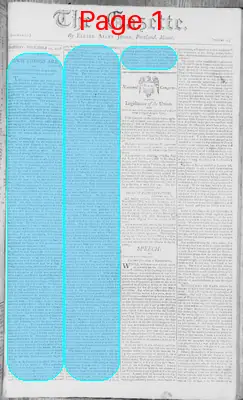
Editorial
December 24, 1798
The Gazette
Portland, Cumberland County, Maine
What is this article about?
This editorial warns of the dangers posed by Illuminati and Jacobin societies originating from the French Revolution, alleging their infiltration into American politics through figures like Genet, Jefferson, and others, leading to domestic unrest. It praises the U.S. government's benevolence and calls for war against France to counter these threats.
Clipping
OCR Quality
95%
Excellent
Full Text
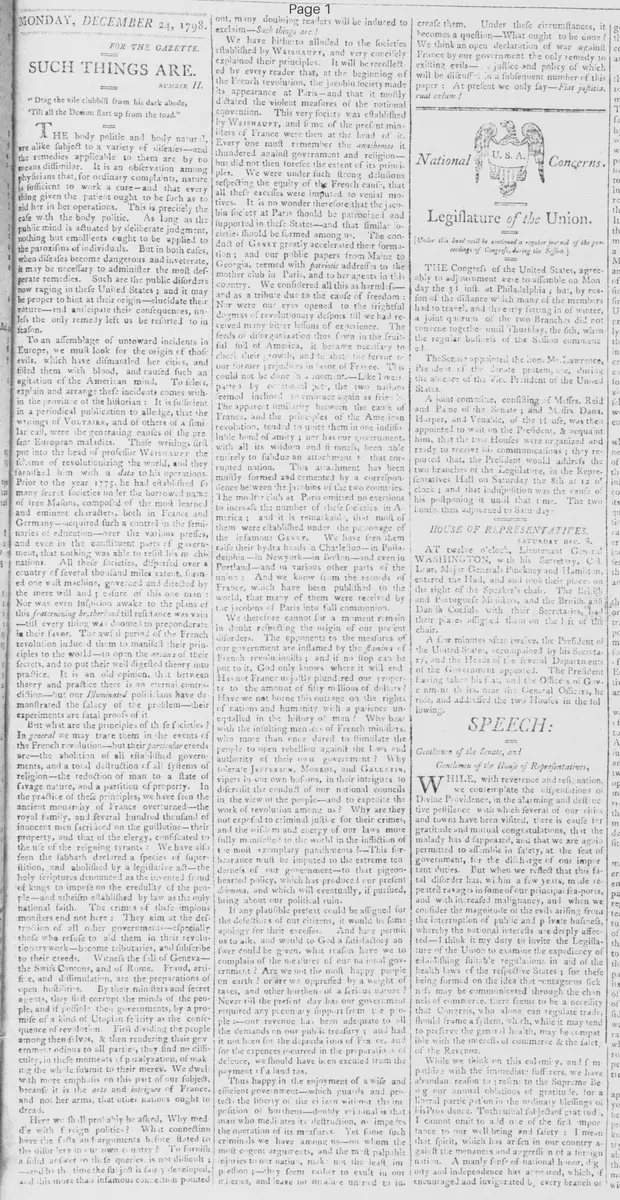
FOR THE GAZETTE.
SUCH THINGS ARE.
NUMBER II.
"Drag the vile clubbist from his dark abode,
'Till all the Demon start up from the toad."
THE body politic and body natural,
are alike subject to a variety of diseases—and
the remedies applicable to them are by no
means dissimilar. It is an observation among
physicians that, for ordinary complaints, nature
is sufficient to work a cure—and that every
thing given the patient ought to be such as to
aid her in her operations. This is precisely the
case with the body politic. As long as the
public mind is actuated by deliberate judgment,
nothing but emollients ought to be applied to
the paroxysms of individuals. But in both cases,
when diseases become dangerous and inveterate,
it may be necessary to administer the most desperate remedies. Such are the public disorders
now raging in these United States; and it may
be proper to hint at their origin—elucidate their
nature and anticipate their consequences, unless the only remedy left us be resorted to in
season.
To an assemblage of untoward incidents in
Europe, we must look for the origin of those
evils, which have dismantled her cities, and
filled them with blood, and caused such an
agitation of the American mind. To select,
explain and arrange these incidents comes within the province of the historian: It is sufficient
in a periodical publication to allege, that the
writings of Voltaire, and of others of a similar cast, were the generating causes of the present European maladies. These writings first
put into the head of professor Weishaupt the
scheme of revolutionizing the world, and they
furnished him with a data to his operations.
Prior to the year 1775, he had established so
many secret societies under the borrowed name
of free Masons, composed of the most learned
and eminent characters, both in France and
Germany—acquired such a control in the seminaries of education—over the various presses,
and even in the constituent parts of government, that nothing was able to resist his machinations. All these societies, dispersed over a
country of several thousand miles extent, formed one vast machine, governed and directed by
the mere will and pleasure of this one man:
Nor was even suspicion awake to the plans of
this fraternizing brotherhood till resistance was vain—till every thing was doomed to preponderate
in their favor. The awful period of the French
revolution induced them to manifest their principles to the world—to open the arcana of their
secrets, and to put their well digested theory into
practice. It is an old opinion, that between
theory and practice there is an eternal contradiction: but our Illuminated politicians have demonstrated the fallacy of the problem—their
experiments are fatal proofs of it.
But what are the principles of these societies?
In general we may trace them in the events of
the French revolution—but their particular creeds
are—the abolition of all established governments, and a total destruction of all systems of
religion—the reduction of man to a state of
savage nature, and a partition of property. In
the practice of these principles, we have seen the
ancient monarchy of France overturned—the
royal family, and several hundred thousand of
innocent men sacrificed on the guillotine—their
property, and that of the clergy, confiscated to
the use of the reigning tyrant: We have also
seen the sabbath declared a species of superstition, and abolished by a legislative act—the
holy scriptures denounced as the invented fraud
of kings to impose on the credulity of the people—and atheism established by law as the only
national faith. The crimes of these impious
monsters end not here: They aim at the destruction of all other governments—especially
those who refuse to aid them in their revolutionary work—become tributaries, and subscribe
to their creeds. Witness the fall of Geneva—
the Swiss Cantons, and of Rome. Fraud, artifice, and dissimulation, are the preparations of
open hostilities. By their ministers and secret
agents, they first corrupt the minds of the people, and if possible their governments, by a promise of a kind of Utopian felicity as the consequence of revolution. First dividing the people
among themselves, & then rendering their government odious to all parties, they find no difficulty in these moments of paralyzation, of making the whole submit to their mercy. We dwell
with more emphasis on this part of our subject.
because it is the arts and intrigues of France,
and not her arms, that other nations ought to
dread.
Here we shall probably be asked, Why meddle with foreign politics? What connection
have the facts and arguments before stated to
the disorders in our own country? To furnish
a solid answer to these queries is not difficult:
—and by the time the subject is fairly developed,
and its more than infamous connection pointed
out, many doubting readers will be induced to
exclaim—Such things are!
We have hitherto alluded to the societies
established by Weishaupt, and very concisely
explained their principles. It will be recollected by every reader that, at the beginning of
the French revolution, the jacobin society made
its appearance at Paris—and that it mostly
dictated the violent measures of the national
convention. This very society was established
by Weishaupt, and some of the present ministers of France were then at the head of it.
Every one must remember the anathemas it
thundered against government and religion—
but did not then foresee the extent of its principles. We were under such strong delusions
respecting the equity of the French cause, that
all these excesses were imputed to venial motives. It is no wonder therefore that the jacobin
society at Paris should be patronized and
supported in these States—and that similar societies, should be formed among us. The conduct of Genet greatly accelerated their formation; and our public papers from Maine to
Georgia, teemed with patriotic addresses to the
mother club in Paris, and to her agents in this
country. We considered all this as harmless—
and as a tribute due to the cause of freedom:
Nor were our eyes opened to the frightful
dogmas of revolutionary despots till we had received many bitter lessons of experience. The
seeds of disorganization thus sown in the fruitful soil of America, it became necessary to
check their growth, and to abate the fervor of
our former prejudices in favor of France. This
could not be done in a moment.—Like lovers,
parted by caprice, the two nations
seemed inclined to embrace again as friends.
The apparent similarity between the cause of
France, and the principles of the American
revolution, tended to unite them in one indissoluble bond of amity; nor has our government,
with all its wisdom and firmness, been able
entirely to subdue an attachment to that corrupted nation. This attachment has been
mostly formed and cemented by a correspondence between the jacobins of the two countries.
The mother club at Paris omitted no exertions
to increase the number of these societies in America; and it is remarkable, that most of
them were established under the patronage of
the infamous Genet. We have seen them
raise their hydra heads in Charleston—in Philadelphia—in New York—in Boston—and even in
Portland—and in various other parts of the
union: And we know from the records of
France, which have been published to the
world, that many of them were received by
the jacobins of Paris into full communion.
We therefore cannot for a moment remain
in doubt respecting the origin of our present
disorders. The opponents to the measures of
our government are inflamed by the same fanaticism of the French revolutionists; and if no stop can be
put to it, God only knows where it will end.
Has not France unjustly plundered our property to the amount of fifty millions of dollars?
Have we not borne this outrage on the rights
of nations and humanity with a patience unequalled in the history of man? Why bear
with the insulting menaces of French ministers,
who more than once dared to stimulate the
people to open rebellion against the laws and
authority of their own government? Why
tolerate Jefferson, Monroe, and Gallatin,
vipers in our own bosoms, in their intrigues to
discredit the conduct of our national councils
in the view of the people—and to expedite the
work of revolution among us? Why are they
not exposed to criminal justice for their crimes,
and the wisdom and energy of our laws more
fully manifested to the world in the infliction of
the most exemplary punishments?—This forbearance must be imputed to the extreme tenderness of our government—to that pigeon
hearted policy, which has produced our present
dilemma, and which will eventually, if pursued,
bring about our political ruin.
If any plausible pretext could be assigned for
the defection of our citizens, it would become
apology for their excesses. And here permit
us to ask, and would to God a satisfactory answer could be given, what reason have we to
complain of the measures of our national government? Are we not the most happy people
on earth? or are we oppressed by a weight of
taxes, and other burdens of a serious nature?
Never till the present day has our government
required any pecuniary support from the people:—our revenue has been adequate to all
the demands on our public treasury; and had
it not been for the depredations of France, and
for the expenses incurred in the preparations of
defense, we should have been excused from the
payment of a land tax.
Thus happy in the enjoyment of a wise and
efficient government—which guards and protects, the liberty of the citizen without the imposition of burdens—doubly criminal is that
man who meditates its destruction, or impedes
the operation of its measures. Yet some such
criminals we have among us—on whom the
most cogent arguments, and the most palpable
injuries to our nation, make not the least impression;—they seem rather to exult in our
miseries, and leave no medium untried to increase them. Under these circumstances, it
becomes a question—What ought to be done?
We think an open declaration of war against
France by our government the only remedy to
existing evils—justice and policy of which
will be discussed in a subsequent number of this
paper: At present we only say—Fiat justitia.
ruat caelum!
SUCH THINGS ARE.
NUMBER II.
"Drag the vile clubbist from his dark abode,
'Till all the Demon start up from the toad."
THE body politic and body natural,
are alike subject to a variety of diseases—and
the remedies applicable to them are by no
means dissimilar. It is an observation among
physicians that, for ordinary complaints, nature
is sufficient to work a cure—and that every
thing given the patient ought to be such as to
aid her in her operations. This is precisely the
case with the body politic. As long as the
public mind is actuated by deliberate judgment,
nothing but emollients ought to be applied to
the paroxysms of individuals. But in both cases,
when diseases become dangerous and inveterate,
it may be necessary to administer the most desperate remedies. Such are the public disorders
now raging in these United States; and it may
be proper to hint at their origin—elucidate their
nature and anticipate their consequences, unless the only remedy left us be resorted to in
season.
To an assemblage of untoward incidents in
Europe, we must look for the origin of those
evils, which have dismantled her cities, and
filled them with blood, and caused such an
agitation of the American mind. To select,
explain and arrange these incidents comes within the province of the historian: It is sufficient
in a periodical publication to allege, that the
writings of Voltaire, and of others of a similar cast, were the generating causes of the present European maladies. These writings first
put into the head of professor Weishaupt the
scheme of revolutionizing the world, and they
furnished him with a data to his operations.
Prior to the year 1775, he had established so
many secret societies under the borrowed name
of free Masons, composed of the most learned
and eminent characters, both in France and
Germany—acquired such a control in the seminaries of education—over the various presses,
and even in the constituent parts of government, that nothing was able to resist his machinations. All these societies, dispersed over a
country of several thousand miles extent, formed one vast machine, governed and directed by
the mere will and pleasure of this one man:
Nor was even suspicion awake to the plans of
this fraternizing brotherhood till resistance was vain—till every thing was doomed to preponderate
in their favor. The awful period of the French
revolution induced them to manifest their principles to the world—to open the arcana of their
secrets, and to put their well digested theory into
practice. It is an old opinion, that between
theory and practice there is an eternal contradiction: but our Illuminated politicians have demonstrated the fallacy of the problem—their
experiments are fatal proofs of it.
But what are the principles of these societies?
In general we may trace them in the events of
the French revolution—but their particular creeds
are—the abolition of all established governments, and a total destruction of all systems of
religion—the reduction of man to a state of
savage nature, and a partition of property. In
the practice of these principles, we have seen the
ancient monarchy of France overturned—the
royal family, and several hundred thousand of
innocent men sacrificed on the guillotine—their
property, and that of the clergy, confiscated to
the use of the reigning tyrant: We have also
seen the sabbath declared a species of superstition, and abolished by a legislative act—the
holy scriptures denounced as the invented fraud
of kings to impose on the credulity of the people—and atheism established by law as the only
national faith. The crimes of these impious
monsters end not here: They aim at the destruction of all other governments—especially
those who refuse to aid them in their revolutionary work—become tributaries, and subscribe
to their creeds. Witness the fall of Geneva—
the Swiss Cantons, and of Rome. Fraud, artifice, and dissimulation, are the preparations of
open hostilities. By their ministers and secret
agents, they first corrupt the minds of the people, and if possible their governments, by a promise of a kind of Utopian felicity as the consequence of revolution. First dividing the people
among themselves, & then rendering their government odious to all parties, they find no difficulty in these moments of paralyzation, of making the whole submit to their mercy. We dwell
with more emphasis on this part of our subject.
because it is the arts and intrigues of France,
and not her arms, that other nations ought to
dread.
Here we shall probably be asked, Why meddle with foreign politics? What connection
have the facts and arguments before stated to
the disorders in our own country? To furnish
a solid answer to these queries is not difficult:
—and by the time the subject is fairly developed,
and its more than infamous connection pointed
out, many doubting readers will be induced to
exclaim—Such things are!
We have hitherto alluded to the societies
established by Weishaupt, and very concisely
explained their principles. It will be recollected by every reader that, at the beginning of
the French revolution, the jacobin society made
its appearance at Paris—and that it mostly
dictated the violent measures of the national
convention. This very society was established
by Weishaupt, and some of the present ministers of France were then at the head of it.
Every one must remember the anathemas it
thundered against government and religion—
but did not then foresee the extent of its principles. We were under such strong delusions
respecting the equity of the French cause, that
all these excesses were imputed to venial motives. It is no wonder therefore that the jacobin
society at Paris should be patronized and
supported in these States—and that similar societies, should be formed among us. The conduct of Genet greatly accelerated their formation; and our public papers from Maine to
Georgia, teemed with patriotic addresses to the
mother club in Paris, and to her agents in this
country. We considered all this as harmless—
and as a tribute due to the cause of freedom:
Nor were our eyes opened to the frightful
dogmas of revolutionary despots till we had received many bitter lessons of experience. The
seeds of disorganization thus sown in the fruitful soil of America, it became necessary to
check their growth, and to abate the fervor of
our former prejudices in favor of France. This
could not be done in a moment.—Like lovers,
parted by caprice, the two nations
seemed inclined to embrace again as friends.
The apparent similarity between the cause of
France, and the principles of the American
revolution, tended to unite them in one indissoluble bond of amity; nor has our government,
with all its wisdom and firmness, been able
entirely to subdue an attachment to that corrupted nation. This attachment has been
mostly formed and cemented by a correspondence between the jacobins of the two countries.
The mother club at Paris omitted no exertions
to increase the number of these societies in America; and it is remarkable, that most of
them were established under the patronage of
the infamous Genet. We have seen them
raise their hydra heads in Charleston—in Philadelphia—in New York—in Boston—and even in
Portland—and in various other parts of the
union: And we know from the records of
France, which have been published to the
world, that many of them were received by
the jacobins of Paris into full communion.
We therefore cannot for a moment remain
in doubt respecting the origin of our present
disorders. The opponents to the measures of
our government are inflamed by the same fanaticism of the French revolutionists; and if no stop can be
put to it, God only knows where it will end.
Has not France unjustly plundered our property to the amount of fifty millions of dollars?
Have we not borne this outrage on the rights
of nations and humanity with a patience unequalled in the history of man? Why bear
with the insulting menaces of French ministers,
who more than once dared to stimulate the
people to open rebellion against the laws and
authority of their own government? Why
tolerate Jefferson, Monroe, and Gallatin,
vipers in our own bosoms, in their intrigues to
discredit the conduct of our national councils
in the view of the people—and to expedite the
work of revolution among us? Why are they
not exposed to criminal justice for their crimes,
and the wisdom and energy of our laws more
fully manifested to the world in the infliction of
the most exemplary punishments?—This forbearance must be imputed to the extreme tenderness of our government—to that pigeon
hearted policy, which has produced our present
dilemma, and which will eventually, if pursued,
bring about our political ruin.
If any plausible pretext could be assigned for
the defection of our citizens, it would become
apology for their excesses. And here permit
us to ask, and would to God a satisfactory answer could be given, what reason have we to
complain of the measures of our national government? Are we not the most happy people
on earth? or are we oppressed by a weight of
taxes, and other burdens of a serious nature?
Never till the present day has our government
required any pecuniary support from the people:—our revenue has been adequate to all
the demands on our public treasury; and had
it not been for the depredations of France, and
for the expenses incurred in the preparations of
defense, we should have been excused from the
payment of a land tax.
Thus happy in the enjoyment of a wise and
efficient government—which guards and protects, the liberty of the citizen without the imposition of burdens—doubly criminal is that
man who meditates its destruction, or impedes
the operation of its measures. Yet some such
criminals we have among us—on whom the
most cogent arguments, and the most palpable
injuries to our nation, make not the least impression;—they seem rather to exult in our
miseries, and leave no medium untried to increase them. Under these circumstances, it
becomes a question—What ought to be done?
We think an open declaration of war against
France by our government the only remedy to
existing evils—justice and policy of which
will be discussed in a subsequent number of this
paper: At present we only say—Fiat justitia.
ruat caelum!
What sub-type of article is it?
Foreign Affairs
Partisan Politics
Moral Or Religious
What keywords are associated?
French Revolution
Illuminati
Jacobin Societies
American Disorders
Declaration Of War
Secret Societies
Political Fanaticism
What entities or persons were involved?
Weishaupt
Voltaire
Genet
Jefferson
Monroe
Gallatin
Jacobins
Illuminati
French Ministers
Editorial Details
Primary Topic
Influence Of Illuminati And French Jacobinism On American Political Disorders
Stance / Tone
Strongly Anti Jacobin And Anti French, Pro U.S. Government, Advocating War Against France
Key Figures
Weishaupt
Voltaire
Genet
Jefferson
Monroe
Gallatin
Jacobins
Illuminati
French Ministers
Key Arguments
Writings Of Voltaire Inspired Weishaupt's Illuminati To Form Secret Societies Leading To French Revolution
Illuminati Principles Include Abolishing Governments And Religion, Reducing Society To Savagery
Jacobin Societies In America, Patronized By Genet, Threaten U.S. Stability And Are Linked To French Fanaticism
U.S. Government Is Benevolent With No Burdensome Taxes, Making Opposition Criminal
France Has Plundered U.S. Property And Incited Rebellion; Forbearance Invites Ruin
Declaration Of War Against France Is The Necessary Remedy