Thank you for visiting SNEWPapers!
Sign up free
Editorial
October 1, 1902
Fergus County Argus
Lewistown, Fergus County, Montana
What is this article about?
The Fall River Herald editorial defends President McKinley's Buffalo speech from misrepresentations by free traders and tariff revisionists, clarifying he only suggested modifying duties if protection was no longer needed, and notes strong public support for protectionism over free trade or revision.
Clipping
OCR Quality
98%
Excellent
Full Text
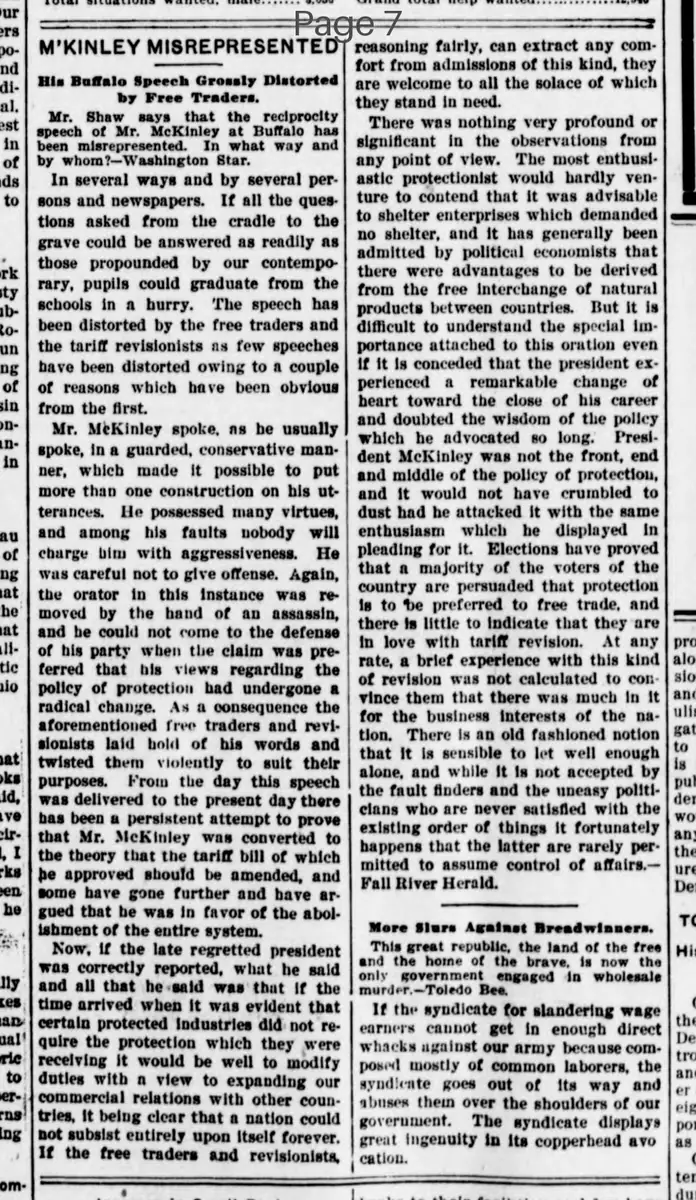
M'KINLEY MISREPRESENTED
His Buffalo Speech Grossly Distorted by Free Traders.
Mr. Shaw says that the reciprocity speech of Mr. McKinley at Buffalo has been misrepresented. In what way and by whom?-Washington Star.
In several ways and by several persons and newspapers. If all the questions asked from the cradle to the grave could be answered as readily as those propounded by our contemporary, pupils could graduate from the schools in a hurry. The speech has been distorted by the free traders and the tariff revisionists as few speeches have been distorted owing to a couple of reasons which have been obvious from the first.
Mr. McKinley spoke, as he usually spoke, in a guarded, conservative manner, which made it possible to put more than one construction on his utterances. He possessed many virtues, and among his faults nobody will charge him with aggressiveness. He was careful not to give offense. Again, the orator in this instance was removed by the hand of an assassin, and he could not come to the defense of his party when the claim was preferred that his views regarding the policy of protection had undergone a radical change. As a consequence the aforementioned free traders and revisionists laid hold of his words and twisted them violently to suit their purposes. From the day this speech was delivered to the present day there has been a persistent attempt to prove that Mr. McKinley was converted to the theory that the tariff bill of which he approved should be amended, and some have gone further and have argued that he was in favor of the abolishment of the entire system.
Now, if the late regretted president was correctly reported, what he said and all that he said was that if the time arrived when it was evident that certain protected industries did not require the protection which they were receiving it would be well to modify duties with a view to expanding our commercial relations with other countries, it being clear that a nation could not subsist entirely upon itself forever.
If the free traders and revisionists, reasoning fairly, can extract any comfort from admissions of this kind, they are welcome to all the solace of which they stand in need.
There was nothing very profound or significant in the observations from any point of view. The most enthusiastic protectionist would hardly venture to contend that it was advisable to shelter enterprises which demanded no shelter, and it has generally been admitted by political economists that there were advantages to be derived from the free interchange of natural products between countries. But it is difficult to understand the special importance attached to this oration even if it is conceded that the president experienced a remarkable change of heart toward the close of his career and doubted the wisdom of the policy which he advocated so long. President McKinley was not the front, end and middle of the policy of protection, and it would not have crumbled to dust had he attacked it with the same enthusiasm which he displayed in pleading for it. Elections have proved that a majority of the voters of the country are persuaded that protection is to be preferred to free trade, and there is little to indicate that they are in love with tariff revision. At any rate, a brief experience with this kind of revision was not calculated to convince them that there was much in it for the business interests of the nation. There is an old fashioned potion that it is sensible to let well enough alone, and while it is not accepted by the fault finders and the uneasy politicians who are never satisfied with the existing order of things it fortunately happens that the latter are rarely permitted to assume control of affairs.-Fall River Herald.
His Buffalo Speech Grossly Distorted by Free Traders.
Mr. Shaw says that the reciprocity speech of Mr. McKinley at Buffalo has been misrepresented. In what way and by whom?-Washington Star.
In several ways and by several persons and newspapers. If all the questions asked from the cradle to the grave could be answered as readily as those propounded by our contemporary, pupils could graduate from the schools in a hurry. The speech has been distorted by the free traders and the tariff revisionists as few speeches have been distorted owing to a couple of reasons which have been obvious from the first.
Mr. McKinley spoke, as he usually spoke, in a guarded, conservative manner, which made it possible to put more than one construction on his utterances. He possessed many virtues, and among his faults nobody will charge him with aggressiveness. He was careful not to give offense. Again, the orator in this instance was removed by the hand of an assassin, and he could not come to the defense of his party when the claim was preferred that his views regarding the policy of protection had undergone a radical change. As a consequence the aforementioned free traders and revisionists laid hold of his words and twisted them violently to suit their purposes. From the day this speech was delivered to the present day there has been a persistent attempt to prove that Mr. McKinley was converted to the theory that the tariff bill of which he approved should be amended, and some have gone further and have argued that he was in favor of the abolishment of the entire system.
Now, if the late regretted president was correctly reported, what he said and all that he said was that if the time arrived when it was evident that certain protected industries did not require the protection which they were receiving it would be well to modify duties with a view to expanding our commercial relations with other countries, it being clear that a nation could not subsist entirely upon itself forever.
If the free traders and revisionists, reasoning fairly, can extract any comfort from admissions of this kind, they are welcome to all the solace of which they stand in need.
There was nothing very profound or significant in the observations from any point of view. The most enthusiastic protectionist would hardly venture to contend that it was advisable to shelter enterprises which demanded no shelter, and it has generally been admitted by political economists that there were advantages to be derived from the free interchange of natural products between countries. But it is difficult to understand the special importance attached to this oration even if it is conceded that the president experienced a remarkable change of heart toward the close of his career and doubted the wisdom of the policy which he advocated so long. President McKinley was not the front, end and middle of the policy of protection, and it would not have crumbled to dust had he attacked it with the same enthusiasm which he displayed in pleading for it. Elections have proved that a majority of the voters of the country are persuaded that protection is to be preferred to free trade, and there is little to indicate that they are in love with tariff revision. At any rate, a brief experience with this kind of revision was not calculated to convince them that there was much in it for the business interests of the nation. There is an old fashioned potion that it is sensible to let well enough alone, and while it is not accepted by the fault finders and the uneasy politicians who are never satisfied with the existing order of things it fortunately happens that the latter are rarely permitted to assume control of affairs.-Fall River Herald.
What sub-type of article is it?
Economic Policy
Trade Or Commerce
Partisan Politics
What keywords are associated?
Mckinley Speech
Buffalo
Protectionism
Free Trade
Tariff Revision
Reciprocity
What entities or persons were involved?
Mckinley
Free Traders
Tariff Revisionists
Washington Star
Fall River Herald
Editorial Details
Primary Topic
Defense Of Mckinley's Protectionist Stance In Buffalo Speech
Stance / Tone
Supportive Of Protectionism And Critical Of Free Traders' Misrepresentations
Key Figures
Mckinley
Free Traders
Tariff Revisionists
Washington Star
Fall River Herald
Key Arguments
Mckinley's Speech Distorted By Free Traders Due To His Guarded Style And Assassination
He Only Advocated Modifying Duties If Protection No Longer Needed For Industries
No Radical Change In His Protectionist Views
Public Elections Show Preference For Protection Over Free Trade Or Revision
Wise To Let Well Enough Alone On Tariffs