Thank you for visiting SNEWPapers!
Sign up free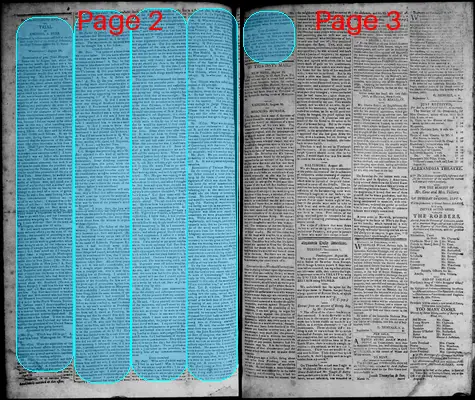
Alexandria Daily Advertiser
Alexandria, Virginia
What is this article about?
Testimonies from the Morgan family at Aaron Burr's 1807 treason trial describe his August 1806 visit to their Washington County home, where he discussed separating Western states from the Union, military capabilities, and potential expeditions, raising suspicions of treasonous plots.
Merged-components note: Merged continuation of the Aaron Burr trial story across pages 2 and 3; relabeled from domestic_news to story as it is a full narrative article.
Clippings
1 of 2
OCR Quality
Full Text
TRIAL OF COLONEL A. BURR
Continued by adjournment and held at the Capitol in the Hall of the House of Delegates, for High Treason against the United States.
Wednesday, August 19.
Examination of Gen. John Morgan.
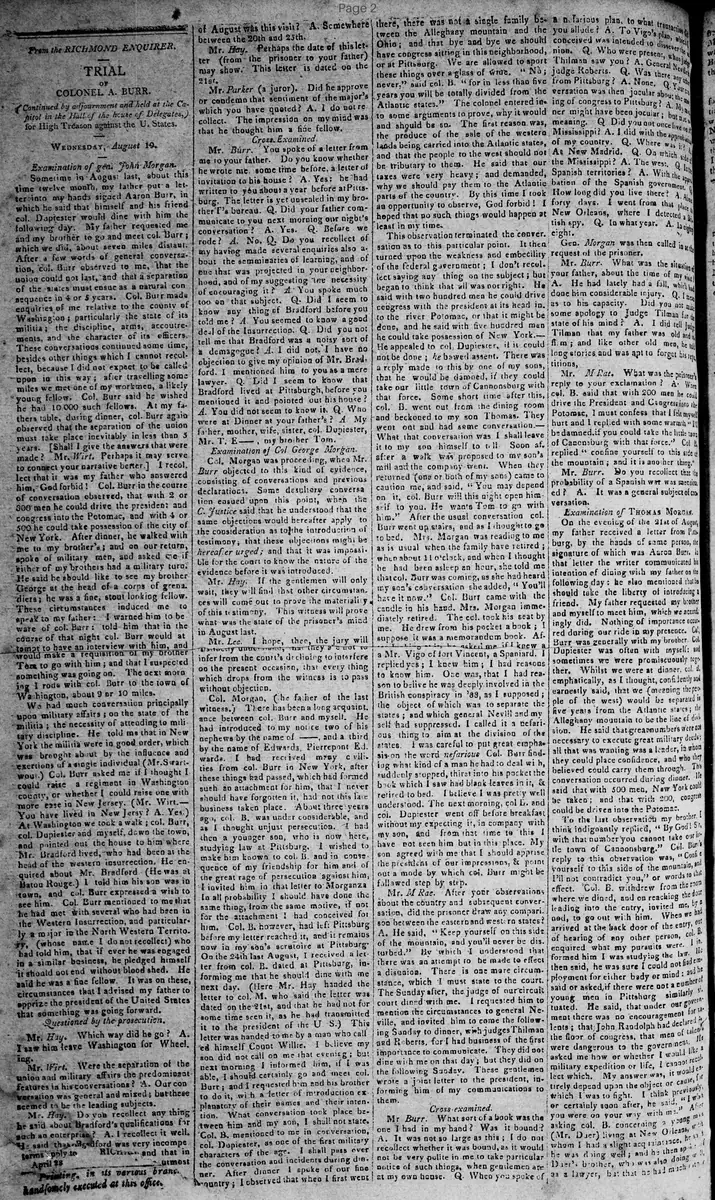
Sometime in August last, about this time twelve months, my father put a letter into my hands signed Aaron Burr, in which he said that himself and his friend Col. Dupliesier would dine with him the following day. My father requested me and my brother to go and meet Col. Burr; which we did, about seven miles distant. After a few words of general conversation, Col. Burr observed to me, that the union could not last, and that a separation of the states must ensue as a natural consequence in 4 or 5 years. Col. Burr made inquiries of me relative to the county of Washington; particularly the state of its militia; the discipline, arms, accoutrements, and the character of its officers. These conversations continued some time, besides other things which I cannot recollect, because I did not expect to be called upon in this way; after travelling some miles we met one of my workmen, a likely young fellow. Col. Burr said he wished he had 10,000 such fellows. At my father's table, during dinner, Col. Burr again observed that the separation of the union must take place inevitably in less than 5 years. Shall I give the answers that were made? Mr. Wirt. Perhaps it may serve to connect your narrative better. I recollect that it was my father who answered him, God forbid! Col. Burr in the course of conversation observed, that with 200 or 300 men he could drive the president and congress into the Potomac, and with 400 or 500 he could take possession of the city of New York. After dinner, he walked with me to my brother's; and on our return, spoke of military men, and asked me if either of my brothers had a military turn. He said he should like to see my brother George at the head of a corps of grenadiers; he was a fine, stout looking fellow. These circumstances induced me to speak to my father: I warned him to be ware of Col. Burr: told him that in the course of that night Col. Burr would attempt to have an interview with him, and would make a requisition of my brother Tom to go with him; and that I suspected something was going on. The next morning I rode with Col. Burr to the town of Washington, about 9 or 10 miles. We had much conversation principally upon military affairs; on the state of the militia; the necessity of attending to military discipline. He told me that in New York the militia were in good order, which was brought about by the influence and exertions of a single individual (Mr. Swartwout.) Col. Burr asked me if I thought I could raise a regiment in Washington county, or whether I could raise one with more ease in New Jersey. (Mr. Wirt. You have lived in New Jersey? A. Yes.) At Washington we took a walk; Col. Burr, Col. Dupliesier and myself, down the town, and pointed out the house to him where Mr. Bradford lived, who had been at the head of the western insurrection. He enquired about Mr. Bradford. (He was at Baton Rouge.) I told him his son was in town, and Col. Burr expressed a wish to see him. Col. Burr mentioned to me that he had met with several who had been in the Western Insurrection, and particularly a major in the North Western Territory, (whose name I do not recollect) who had told him, that if ever he was engaged in a similar business, he pledged himself it should not end without blood shed. He said he was a fine fellow. It was on these circumstances that I advised my father to apprise the president of the United States that something was going forward.
Questioned by the prosecution.
Mr. Hay. Which way did he go? A. I saw him leave Washington or Wheeling.
Mr. Wirt. Were the separation of the union and military affairs the predominant features in his conversations? A. Our conversation was general and mixed: but these seemed to be the leading subjects.
Mr. Hay. Do you recollect any thing he said about Bradford's qualifications for such an enterprise? A. I recollect it well. He said that Bradford was very incompetent.
of August was this visit? A. Somewhere between the 20th and 25th.
Mr. Hay. Perhaps the date of this letter (from the prisoner to your father) may show. This letter is dated on the 21st.
Mr. Parker (a juror). Did he approve or condemn that sentiment of the major which you have quoted? A. I do not recollect. The impression on my mind was that he thought him a fine fellow.
Cross Examined
Mr. Burr. You spoke of a letter from me to your father. Do you know whether he wrote me, some time before, a letter of invitation to his house? A. Yes: he had written to you about a year before at Pittsburgh. The letter is yet unopened in my brother F's bureau. Q. Did your father communicate to you next morning our night's conversation? A. Yes. Q. Before we rode? A. No. Q. Do you recollect of my having made several enquiries also about the seminaries of learning, and of one that was projected in your neighborhood, and of my suggesting the necessity of encouraging it? A. You spoke much too on that subject. Q. Did I seem to know any thing of Bradford before you told me? A. You seemed to know a good deal of the Insurrection. Q. Did you not tell me that Bradford was a noisy sort of a demagogue? A. I did not. I have no objection to give my opinion of Mr. Bradford. I mentioned him to you as a mere lawyer. Q. Did I seem to know that Bradford lived at Pittsburgh, before you mentioned it and pointed out his house? A. You did not seem to know it. Q. Who were at Dinner at your father's? A. My father, mother, wife, sister, Col. Dupliester, Mr. T. E--, my brother Tom.
Examination of Col. George Morgan
Col. Morgan was proceeding, when Mr. Burr objected to this kind of evidence, consisting of conversations and previous declarations. Some desultory conversation ensued upon this point, when the Chief Justice said that he understood that the same objections would hereafter apply to the consideration as to the introduction of testimony; that these objections might be hereafter urged; and that it was impossible for the court to know the nature of the evidence before it was introduced.
Mr. Hay, If the gentlemen will only wait, they will find that other circumstances will come out to prove the materiality of this testimony. This witness will prove what was the state of the prisoner's mind in August last.
Mr. Lee. I hope, therefore, the jury will not infer from the court's declining to interfere on the present occasion, that every thing which drops from the witness is to pass without objection.
Col. Morgan, (the father of the last witness.) There has been a long acquaintance between Col. Burr and myself. He had introduced to my notice two of his nephews by the name of Blennerhassett, and a third by the name of Edwards, Pierrepont Edwards. I had received many civilities from Col. Burr in New York, after these things had passed, which had formed such an attachment for him, that I never should have forgotten it, had not this late business taken place. About three years ago, Col. B. was under considerable, and as I thought unjust persecution. I had then a younger son, who is now here, studying law at Pittsburgh. I wished to make him known to Col. B. and in consequence of my friendship for him and of the great rage of persecution against him, I invited him in that letter to Morganza. In all probability I should have done the same thing, from the same motive, if not for the attachment I had conceived for him. Col. B. however, had left Pittsburgh before my letter reached it, and it remains now in my son's scrutoire at Pittsburgh. On the 24th last August, I received a letter from Col. B. dated at Pittsburgh, informing me that he should dine with me next day. (Here Mr. Hay handed the letter to Col. M. who said the letter was dated on the 21st, and that he had not for some time seen it, as he had transmitted it to the president of the U. S.) This letter was handed to me by a man who called himself Count Wiltre. I believe my son did not call on me that evening: but able, I should certainly go and meet Col. Burr; and I requested him and his brother to do it, with a letter of introduction explanatory of their names and their intention. What conversation took place between him and my son, I shall not state. Col. B. mentioned to me in conversation, the conversation and incidents during dinner. Col. Dupliester, as one of the first military characters of the age. I shall pass over. After dinner I spoke of our fine country: I observed that when I first went there, there was not a single family between the Allegheny mountain and the Ohio; and that bye and bye we should have congress sitting in this neighborhood, or at Pittsburgh. We are allowed to sport these things over a glass of wine, "No; never," said Col. B. "for in less than five years you will be totally divided from the Atlantic states." The colonel entered into some arguments to prove, why it would and should be so. The first reason was, the produce of the sale of the western lands being carried into the Atlantic states, and that the people to the west should not be tributary to them. He said that our taxes were very heavy; and demanded why we should pay them to the Atlantic parts of the country. By this time I took an opportunity to observe, God forbid! I hoped that no such things would happen at least in my time. This observation terminated the conversation as to this particular point. It then turned upon the weakness and imbecility of the federal government; I don't recollect saying anything on the subject; but began to think that all was not right. He said with two hundred men he could drive congress with the president at its head into the river Potomac, or that it might be done, and he said with five hundred men he could take possession of New York. He appealed to Col. Dupliester, if it could not be done; he bowed assent. There was a reply made to this by one of my sons, that he would be damned, if they could take our little town of Cannonsburg with that force. Some short time after this, Col. B. went out from the dining room and beckoned to my son Thomas. They went out and had some conversation. What that conversation was I shall leave it to my son himself to tell. Soon after a walk was proposed to my son's mill and the company went. When they returned (one or both of my sons) came to caution me, and said, "You may depend on it, Col. Burr will this night open himself to you. He wants Tom to go with him." After the usual conversation Col. Burr went up stairs, and as I thought to go to bed. Mrs. Morgan was reading to me as is usual when the family have retired; when about 11 o'clock, and when I thought he had been asleep an hour, she told me that Col. Burr was coming, as she had heard my son's conversation she added, "You'll have it now." Col. Burr came with the candle in his hand. Mrs. Morgan immediately retired. The Col. took his seat by me. He drew from his pocket a book; I suppose it was a memorandum book. After asking me if I knew a Mr. Vigo of Fort Vincent, a Spaniard. I replied yes; I knew him: I had reasons to know him. One was, that I had reason to believe he was deeply involved in the British conspiracy in '88, as I supposed; the object of which was to separate the states; and which General Neville and myself had suppressed. I called it a nefarious thing to aim at the division of the states. I was careful to put great emphasis on the word nefarious. Col. Burr having what kind of a man he had to deal with, suddenly stopped, thrust into his pocket the book which I saw had blank leaves in it, & retired to bed. I believe I was pretty well understood. The next morning, Col. B. and Col. Dupliester went off before breakfast without my expecting it, in company with my son, and from that time to this I have not seen him but in this place. My son agreed with me that I should apprise the president of our impressions, & point out a mode by which Col. Burr might be followed step by step.
Mr. McRae. After your observations about the country and subsequent conversation, did the prisoner draw any comparison between the eastern and western states? A. He said, "Keep yourself on this side of the mountain, and you'll never be disturbed." By which I understood that there was an attempt to be made to effect a disunion. There is one more circumstance, which I must state to the court. The Sunday after, the judge of our circuit court dined with me. I requested him to mention the circumstances to General Neville, and invited him to come the following Sunday to dinner, with judges Tilghman and Roberts, for I had business of the first importance to communicate. They did not dine with me on that day; but they did on the following Sunday. These gentlemen wrote a joint letter to the president, informing him of my communications to them.
Cross-examined.
Mr. Burr. What sort of a book was that one I had in my hand? Was it bound? A. It was not so large as this; I do not recollect whether it was bound, as it would not be very polite in me to take particular notice of such things, when gentlemen are at my own house. Q. When you spoke of a nefarious plan, to what transaction do you allude? A. To the one conceived was intended to dissever the union. Who were present, when Judges Tilghman saw you? A. Judge Roberts. Q. Was there any one from Pittsburgh? A. None. Q. Your speaking of congress to Pittsburgh? A. My answer might have been jocular; but not the conversation about the Mississippi? A. I did with the approbation of my country. Q. Where was it? A. At New Madrid. Q. On which side the Mississippi? A. The west. Q. In Spanish territories? A. With the approbation of the Spanish government. How long did you live there? A. About forty days. I went from that place New Orleans, where I detected a British spy. Q. In what year. A. In eighty eight. Geo. Morgan was then called in at the request of the prisoner.
Mr. Burr. What was the situation of your father, about the time of my visit? A. He had lately had a fall, which had done him considerable injury. Q. I mean as to his capacity. Did you not make some apology to Judge Tilman for the state of his mind? A. I did tell Judge Tilman that my father was old and infirm; and like other old men, he told long stories and was apt to forget his repetitions.
Mr. McRae. What was the prisoner's reply to your exclamation? A. When Col. B. said that with 200 men he could drive the President and Congress into the Potomac, I must confess that I felt myself hurt and I replied with some warmth "I be damned if you could take the little town of Cannonsburg with that force." Col. B. replied "confine yourself to this side of the mountain; and it is another thing."
Mr. Burr. Do you recollect that the probability of a Spanish war was mentioned? A. It was a general subject of conversation.
Examination of Thomas Morgan.
On the evening of the 21st of August my father received a letter from Pittsburgh, by the hands of some person, the signature of which was Aaron Burr. In that letter the writer communicated his intention of dining with my father on the following day: he also mentioned that he should take the liberty of introducing a friend. My father requested my brother and myself to meet him, which we accordingly did. Nothing of importance occurred during our ride in my presence. Col. Burr was generally with my brother. Col. Dupliester was often with myself: and sometimes we were promiscuously together. Whilst we were at dinner, Col. B. emphatically, as I thought, confidently and earnestly said, that we (meaning the people of the west) would be separated in five years from the Atlantic states; the Alleghany mountain to be the line of division. He said that great numbers were not necessary to execute great military deeds; all that was wanting was a leader, in whom they believed could carry them through. This they could place confidence, and who they conversation occurred during dinner. It said that with 500 men, New York could be taken; and that with 200, congress could be driven into the Potomac. To the last observation my brother, I think indignantly replied, "By God! Sir, with that number you cannot take our little town of Cannonsburg." Col. Burr's reply to this observation was, "Confine yourself to this side of the mountain, and I'll not contradict you, or words to that effect. Col. B. withdrew from the room where we dined, and on reaching the door leading into the entry, invited me, by a nod, to go out with him. When we had arrived at the back door of the entry, out of hearing of any other person, Col. B. enquired what my pursuits were. I informed him I was studying the law. He then said, that under our government young men in Pittsburgh similarly situated. He said, that under our government there was no encouragement for the for of congress, that men of talent John Randolph had declared were dangerous to the government. He asked me how or whether I would like a military expedition or life, I cannot recollect urely depend upon the object or cause, leet which. To high I think previously or certainly soon after, he said, "I wish you were on your way with m." After asking Col. B. concerning a young min whom I had a slight acquaintance, he f Mr. Der living at New Orleans Ds b wh 33 a lawyer, but that he had much rt 7
At the head of a military corps. Mr. Morgan then proposed to state the steps which his father had taken to defeat A. Burr's projects, when he was stopped by the court.
Q. Did you not mention to Mr. Burr... Cross Examined.
Q. Did you not complain about the neglect which your education had received? A. No. Q. Did you not complain about wasting your time? A. I recollect nothing on that subject, but your remark, that I could not surely find employment for either body or mind.
What sub-type of article is it?
What themes does it cover?
What keywords are associated?
What entities or persons were involved?
Where did it happen?
Story Details
Key Persons
Location
Washington County, Pennsylvania; Morganza; Capitol, Richmond
Event Date
1806 08 21 To 1806 08 25
Story Details
During Aaron Burr's visit to the Morgan family in August 1806, he discussed the inevitable separation of Western states from the Union, inquired about militia strength, boasted of ability to seize Washington and New York with small forces, and attempted to recruit Thomas Morgan, leading the family to suspect treason and alert the President.