Thank you for visiting SNEWPapers!
Sign up free
Gazette Of The United States
New York, New York County, New York
What is this article about?
Continuation of the U.S. Secretary of the Treasury's report on establishing a mint, critiquing arguments for a duty on imported bullion. It analyzes effects on exchange rates, trade balances, and specie flow, using France-England examples, concluding such a policy would likely harm the U.S. economy.
Clipping
OCR Quality
Full Text
CONTINUED
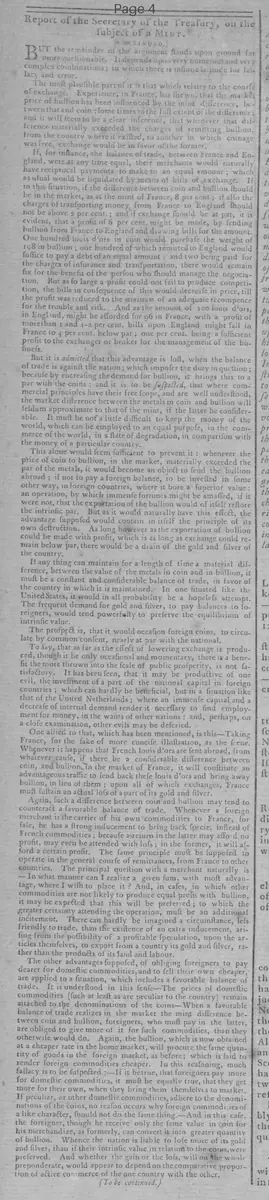
But the remainder of the argument stands upon ground far more questionable. It depends upon very numerous and very complex combinations; in which there is insane latitude for fallacy and error.
The most plausible part of it is that which relates to the course of exchange. Experience, in France, has shown, that the market price of bullion has been influenced by the mint difference, between that and coin: sometimes to the full extent of the difference; and it will seem to be a clear inference, that whenever that difference materially exceeded the charges of remitting bullion, from the country where it existed, to another in which coinage was free, exchange would be in favor of the former.
If, for instance, the balance of trade, between France and England, were at any time equal, their merchants would naturally have reciprocal payments to make to an equal amount; which as usual would be liquidated by means of bills of exchange. If in this situation, if the difference between coin and bullion should be in the market, as at the mint of France, 8 per cent; if also the charges of transporting money from France to England should not be above 2 per cent.; and if exchange should be at par, it is evident, that a profit of 6 per cent. might be made, by sending bullion from France to England and drawing bills for the amount.
One hundred louis d'ors in coin would purchase the weight of 108 in bullion; one hundred of which remitted to England would suffice to pay a debt of an equal amount: and two being paid for the charges of insurance and transportation, there would remain six for the benefit of the person who should manage the negotiation. But as so large a profit could not fail to produce competition, the bills in consequence of this would decrease in price, till the profit was reduced to the minimum of an adequate recompence for the trouble and risk. And as the amount of 100 louis d'ors, in England, might be afforded for 96 in France, with a profit of more than 1 and 1-2 per cent. bills upon England might fall in France to 4 per cent. below par; one per cent. being a sufficient profit to the exchanger or broker for the management of the business.
But it is admitted that this advantage is lost, when the balance of trade is against the nation; which imposes the duty in question; because by encreasing the demand for bullion, it brings this to a par with the coins: and it is to be suspected, that where commercial principles have their free scope, and are well understood, the market difference between the metals in coin and bullion will seldom approximate to that of the mint, if the latter be considerable. It must be not a little difficult to keep the money of the world, which can be employed to an equal purpose, in the commerce of the world, in a state of degradation, in comparison with the money of a particular country.
This alone would seem sufficient to prevent it: whenever the price of coin to bullion, in the market, materially exceeded the par of the metals, it would become an object to send the bullion abroad; if not to pay a foreign balance, to be invested in some other way, in foreign countries, where it bore a superior value: an operation, by which immense fortunes might be amassed, if it were not, that the exportation of the bullion would of itself restore the intrinsic par. But as it would naturally have this effect, the advantage supposed would contain in itself the principle of its own destruction. As long however as the exportation of bullion could be made with profit, which is as long as exchange could remain below par, there would be a drain of the gold and silver of the country.
If any thing can maintain for a length of time a material difference, between the value of the metals in coin and in bullion, it must be a constant and considerable balance of trade, in favor of the country in which it is maintained. In one situated like the United States, it would in all probability be a hopeless attempt.
The frequent demand for gold and silver, to pay balances to foreigners, would tend powerfully to preserve the equilibrium of intrinsic value.
The effect is, that it would occasion foreign coins, to circulate by common consent, nearly at par with the national.
To say, that as far as the effect of lowering exchange is produced, though it be only occasional and momentary, there is a benefit the more thrown into the scale of public prosperity, is not satisfactory. It has been seen, that it may be productive of one evil, the investment of a part of the national capital in foreign countries; which can hardly be beneficial, but in a situation like that of the United Netherlands; where an immense capital and a decrease of internal demand render it necessary to find employment for money, in the wants of other nations: and, perhaps, on a close examination, other evils may be descried.
One allied to that, which has been mentioned, is this—Taking France, for the sake of more concise illustration, as the scene.
Whenever it happens that French louis d'ors are sent abroad, from whatever cause, if there be a considerable difference between coin, and bullion, in the market of France, it will constitute an advantageous traffic to send back these louis d'ors and bring away bullion, in lieu of them; upon all of which exchanges, France must sustain an actual loss of a part of its gold and silver.
Again, such a difference between coin and bullion may tend to counteract a favorable balance of trade. Whenever a foreign merchant is the carrier of his own commodities to France, for sale, he has a strong inducement to bring back specie, instead of French commodities: because a return in the latter may afford no profit, may even be attended with loss; in the former, it will afford a certain profit. The same principle must be supposed to operate in the general course of remittances, from France to other countries. The principal question with a merchant naturally is - In what manner can I realize a given sum, with most advantage, where I wish to place it? And, in cases, in which other commodities are not likely to produce equal profit with bullion, it may be expected that this will be preferred; to which the greater certainty attending the operation, must be an additional incitement. There can hardly be imagined a circumstance, less friendly to trade, than the existence of an extra inducement, arising from the possibility of a profitable speculation, upon the articles themselves, to export from a country its gold and silver, rather than the products of its land and labour.
The other advantages supposed, of obliging foreigners to pay dearer for domestic commodities, and to sell their own cheaper, are applied to a situation, which includes a favorable balance of trade. It is understood in this sense—The prices of domestic commodities (such at least as are peculiar to the country) remain attached to the denominations of the coins—When a favorable balance of trade realizes in the market the mint difference between coin and bullion, foreigners, who must pay in the latter, are obliged to give more of it for such commodities, than they otherwise would do. Again, the bullion, which is now obtained at a cheaper rate in the home market, will procure the same quantity of goods in the foreign market, as before; which is said to render foreign commodities cheaper. In this reasoning, much fallacy is to be suspected:—If it be true, that foreigners pay more for domestic commodities, it must be equally true, that they get more for their own, when they bring them themselves to market.
If peculiar, or other domestic commodities, adhere to the denominations of the coins, no reason occurs why foreign commodities of a like character, should not do the same thing.—And in this case, the foreigner, though he receive only the same value in coin for his merchandize, as formerly, can convert it into greater quantity of bullion. Whence the nation is liable to lose more of its gold and silver, than if their intrinsic value in relation to the coins, were preserved. And whether the gain or the loss, will on the whole preponderate, would appear to depend on the comparative proportion of active commerce of the one country with the other.
(To be continued.)
What sub-type of article is it?
What keywords are associated?
What entities or persons were involved?
Where did it happen?
Story Details
Key Persons
Location
United States, France, England
Story Details
The report critiques the economic arguments for imposing a duty on imported bullion to support a mint, analyzing how mint differences between coin and bullion affect exchange rates, trade balances, and specie flows, using hypothetical France-England scenarios to argue it would disadvantage a trade-deficit nation like the United States.