Thank you for visiting SNEWPapers!
Sign up free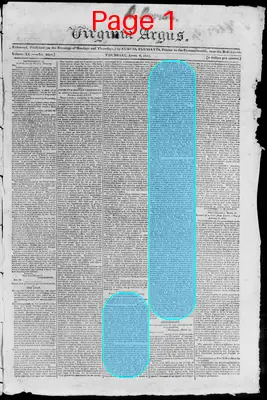
Editorial
April 8, 1813
Virginia Argus
Richmond, Virginia
What is this article about?
Editorial from The Baltimore Patriot critiques opposition actions during wartime as unpatriotic, defining true patriotism as unwavering support for the nation's rights and honor against British aggression, likely in the War of 1812 context.
Clipping
OCR Quality
95%
Excellent
Full Text
From The Baltimore Patriot
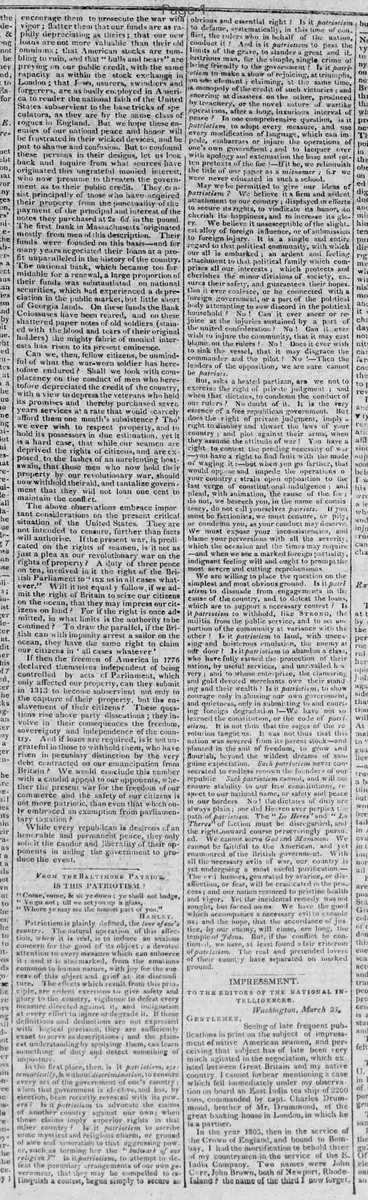
IS THIS PATRIOTISM?
"Come, come, & sit ye down: ye shall not budge,
Ye go not; till we set you up a glass,
Where ye may see the inmost part of you."
HAMLET.
Patriotism is plainly defined, the love of one's country. The natural operation of this affection, when it is real, is to induce an anxious concern for the good of its object; a devoted attention to every measure which can subserve it; and it is also marked, from the emotions common to human nature, with joy for the success of this object and grief at its discomfiture. The effects which result from this principle, are ardent exertions to give safety and glory to the country, vigilance to defeat every measure directed against it, and indignation at every effort to injure or degrade it. If these definitions and deductions are not expressed with logical precision, they are sufficiently exact to serve as descriptions; and the plainest understanding by applying them, can learn something of duty and detect something of imposture.
In the first place, then, is it patriotism, systematically, & without discrimination, to censure every act of the government of one's country: when that government is elective, and has, by election, been recently revested with its powers? Is it patriotism to advocate the claims of another country against our own; when those claims imply superior rights in that other country? Is it patriotism to ascribe some mystical and religious charm, or ground of awe and veneration to that aggressing power, such as terming her the "bulwark of our religion?" Is it patriotism, to attempt to defeat the pecuniary arrangements of our own government, that they may be compelled to relinquish a contest, begun simply to secure an obvious and essential right? Is it patriotism to defame, systematically, in this time of conflict, the rulers who in behalf of the nation, conduct it? And is it patriotism to pass the limits of the grave, to slander a great and illustrious man, for the simple, single crime of being friendly to the government? Is it patriotism to make a show of rejoicing, at triumphs, on one element; claiming, at the same time, a monopoly of the credit of such victories; and sneering at disasters on the other, produced by treachery, or the novel nature of warlike operations, after a long, luxurious interval of peace? In one comprehensive question, is it patriotism to adopt every measure, and use every modification of language, which can impede, embarrass or injure the operations of one's own government; and to lacquer over with apology and extenuation the base and rotten pretexts of the enemy, if it be, we relinquish the title of our paper as a misnomer; for we were never educated in such a school.
May we be permitted to give our ideas of patriotism? We believe it a firm and ardent attachment to our country; displayed in efforts to secure its rights, to vindicate its honor, to cherish its happiness, and to increase its glory. We believe it insusceptible of the slightest alloy of foreign influence, or of submission to foreign injury. It is a single and entire regard to that political community, with which our all is embarked: an ardent and feeling attachment to that political family which comprises all our interests; which protects and cherishes the minor divisions of society, ensures their safety, and guarantees their hopes.
Can it ever coalesce, or be connected with a foreign government, or a part of the political body attempting to sow discord in the political household? No! Can it ever sneer or rejoice at the injuries sustained by a part of the united confederation? No! Can it ever wish to injure the community, that it may cast blame on the rulers? No! Does it ever wish to sink the vessel, that it may disgrace the commander and the pilot? No! Then the leaders of the opposition, we are sure cannot be patriots.
But, asks a heated partizan, are we not to exercise the right of private judgment: and when that dictates, to condemn the conduct of our rulers? No doubt of it. It is the very essence of a free republican government. But does the right of private judgment, imply a right to disobey and thwart the laws of your country; and plot against their arms, when they assume the attitude of war? You have a right to contest the pending necessity of war—you have a right to find fault with the mode of waging it:—but when you go farther, that would oppose and impede the operations of your country; strain open opposition to the last verge of constitutional indulgence; and plead, with animation, the cause of the foe; do not, we beseech you, in the name of consistency, do not call yourselves patriots. If you must be factionists, we must censure, or pity, or condemn you, as your conduct may deserve. We must expose your inconsistencies, and blame your perversions with all the severity, which the occasion and the times may require—and when we see a marked foreign partiality, indignant feeling will and ought to prompt the most severe and cutting reprehensions.
We are willing to place the question on the simplest and most obvious ground. Is it patriotism to dissuade from engagements in the cause of the country, and to defeat the loans, which are to support a necessary contest? Is it patriotism to withhold, like Strong, the militia from the public service, and to set one portion of the community at variance with the other? Is it patriotism to laud, with unceasing and boisterous emulation, the enemy at our door? Is it patriotism to abandon a class, who have fully earned the protection of their nation, by useful services, and unrivalled bravery; and to whose enterprize, the clamoring and gold devoted merchants owe their standing and their wealth? Is it patriotism, to show courage only in abusing our own government, and quietness, only in submitting to and courting foreign degradation?—We have not so learned the constitution, or the code of patriotism. It is not thus that the sages of the revolution taught us. It was not thus that this nation was severed from its parent stock—and planted in the soil of freedom, to grow and flourish, beyond the wildest dreams of sanguine expectation. Such patriotism never consecrated to endless renown the founders of our republic. Such patriotism cannot, and will not ensure stability to our free constitutions, respect to our national name, or safety and peace in our borders. No! the dictates of duty are always plain; nor did Heaven ever perplex the path of patriotism. The 'Lo Heres' and 'Lo Theres' of faction must be disregarded, and the right onward course perseveringly pursued. We cannot serve God and Mammon. We cannot be faithful to the American, and yet enamoured of the British government. With all the necessary evils of war, our country is yet undergoing a most useful purification. The evil humors, generated by avarice, or disaffection, or fear, will be eradicated in the process; and our nation restored to pristine health and vigor. Yet the incidental remedy was not sought, but forced on us. We have the good which accompanies a necessary evil to console us; and the hope, that the accordance of justice, by our enemy, will close, ere long, the temple of Janus. But, if the conflict be continued, we have, at least found a fair criterion of patriotism. The real and pretended lovers of their country have separated on marked ground.
IS THIS PATRIOTISM?
"Come, come, & sit ye down: ye shall not budge,
Ye go not; till we set you up a glass,
Where ye may see the inmost part of you."
HAMLET.
Patriotism is plainly defined, the love of one's country. The natural operation of this affection, when it is real, is to induce an anxious concern for the good of its object; a devoted attention to every measure which can subserve it; and it is also marked, from the emotions common to human nature, with joy for the success of this object and grief at its discomfiture. The effects which result from this principle, are ardent exertions to give safety and glory to the country, vigilance to defeat every measure directed against it, and indignation at every effort to injure or degrade it. If these definitions and deductions are not expressed with logical precision, they are sufficiently exact to serve as descriptions; and the plainest understanding by applying them, can learn something of duty and detect something of imposture.
In the first place, then, is it patriotism, systematically, & without discrimination, to censure every act of the government of one's country: when that government is elective, and has, by election, been recently revested with its powers? Is it patriotism to advocate the claims of another country against our own; when those claims imply superior rights in that other country? Is it patriotism to ascribe some mystical and religious charm, or ground of awe and veneration to that aggressing power, such as terming her the "bulwark of our religion?" Is it patriotism, to attempt to defeat the pecuniary arrangements of our own government, that they may be compelled to relinquish a contest, begun simply to secure an obvious and essential right? Is it patriotism to defame, systematically, in this time of conflict, the rulers who in behalf of the nation, conduct it? And is it patriotism to pass the limits of the grave, to slander a great and illustrious man, for the simple, single crime of being friendly to the government? Is it patriotism to make a show of rejoicing, at triumphs, on one element; claiming, at the same time, a monopoly of the credit of such victories; and sneering at disasters on the other, produced by treachery, or the novel nature of warlike operations, after a long, luxurious interval of peace? In one comprehensive question, is it patriotism to adopt every measure, and use every modification of language, which can impede, embarrass or injure the operations of one's own government; and to lacquer over with apology and extenuation the base and rotten pretexts of the enemy, if it be, we relinquish the title of our paper as a misnomer; for we were never educated in such a school.
May we be permitted to give our ideas of patriotism? We believe it a firm and ardent attachment to our country; displayed in efforts to secure its rights, to vindicate its honor, to cherish its happiness, and to increase its glory. We believe it insusceptible of the slightest alloy of foreign influence, or of submission to foreign injury. It is a single and entire regard to that political community, with which our all is embarked: an ardent and feeling attachment to that political family which comprises all our interests; which protects and cherishes the minor divisions of society, ensures their safety, and guarantees their hopes.
Can it ever coalesce, or be connected with a foreign government, or a part of the political body attempting to sow discord in the political household? No! Can it ever sneer or rejoice at the injuries sustained by a part of the united confederation? No! Can it ever wish to injure the community, that it may cast blame on the rulers? No! Does it ever wish to sink the vessel, that it may disgrace the commander and the pilot? No! Then the leaders of the opposition, we are sure cannot be patriots.
But, asks a heated partizan, are we not to exercise the right of private judgment: and when that dictates, to condemn the conduct of our rulers? No doubt of it. It is the very essence of a free republican government. But does the right of private judgment, imply a right to disobey and thwart the laws of your country; and plot against their arms, when they assume the attitude of war? You have a right to contest the pending necessity of war—you have a right to find fault with the mode of waging it:—but when you go farther, that would oppose and impede the operations of your country; strain open opposition to the last verge of constitutional indulgence; and plead, with animation, the cause of the foe; do not, we beseech you, in the name of consistency, do not call yourselves patriots. If you must be factionists, we must censure, or pity, or condemn you, as your conduct may deserve. We must expose your inconsistencies, and blame your perversions with all the severity, which the occasion and the times may require—and when we see a marked foreign partiality, indignant feeling will and ought to prompt the most severe and cutting reprehensions.
We are willing to place the question on the simplest and most obvious ground. Is it patriotism to dissuade from engagements in the cause of the country, and to defeat the loans, which are to support a necessary contest? Is it patriotism to withhold, like Strong, the militia from the public service, and to set one portion of the community at variance with the other? Is it patriotism to laud, with unceasing and boisterous emulation, the enemy at our door? Is it patriotism to abandon a class, who have fully earned the protection of their nation, by useful services, and unrivalled bravery; and to whose enterprize, the clamoring and gold devoted merchants owe their standing and their wealth? Is it patriotism, to show courage only in abusing our own government, and quietness, only in submitting to and courting foreign degradation?—We have not so learned the constitution, or the code of patriotism. It is not thus that the sages of the revolution taught us. It was not thus that this nation was severed from its parent stock—and planted in the soil of freedom, to grow and flourish, beyond the wildest dreams of sanguine expectation. Such patriotism never consecrated to endless renown the founders of our republic. Such patriotism cannot, and will not ensure stability to our free constitutions, respect to our national name, or safety and peace in our borders. No! the dictates of duty are always plain; nor did Heaven ever perplex the path of patriotism. The 'Lo Heres' and 'Lo Theres' of faction must be disregarded, and the right onward course perseveringly pursued. We cannot serve God and Mammon. We cannot be faithful to the American, and yet enamoured of the British government. With all the necessary evils of war, our country is yet undergoing a most useful purification. The evil humors, generated by avarice, or disaffection, or fear, will be eradicated in the process; and our nation restored to pristine health and vigor. Yet the incidental remedy was not sought, but forced on us. We have the good which accompanies a necessary evil to console us; and the hope, that the accordance of justice, by our enemy, will close, ere long, the temple of Janus. But, if the conflict be continued, we have, at least found a fair criterion of patriotism. The real and pretended lovers of their country have separated on marked ground.
What sub-type of article is it?
War Or Peace
Partisan Politics
Moral Or Religious
What keywords are associated?
Patriotism Definition
War Opposition
British Aggression
Government Support
Factionalism
National Honor
Militia Withholding
What entities or persons were involved?
British Government
Opposition Leaders
Strong
Merchants
Founders Of The Republic
Editorial Details
Primary Topic
Critique Of Opposition As Unpatriotic During War With Britain
Stance / Tone
Strongly Pro Government And Anti Opposition, Exhorting True Patriotism
Key Figures
British Government
Opposition Leaders
Strong
Merchants
Founders Of The Republic
Key Arguments
Patriotism Requires Support For Government's War Efforts, Not Systematic Criticism
Advocating Foreign Claims Against Own Country Is Unpatriotic
Defeating Government Loans And Withholding Militia Impedes National Defense
True Patriotism Rejects Foreign Influence And Focuses On National Honor
Opposition's Actions Sow Discord And Aid The Enemy
Private Judgment Allows Criticism But Not Obstruction Of War
War Purifies The Nation By Exposing True Patriots