Thank you for visiting SNEWPapers!
Sign up free
Wisconsin Tribune
Mineral Point, Iowa County, Wisconsin
What is this article about?
Franklin Pierce's 1853 inaugural address in Washington outlines his sense of duty as president, reflects on U.S. history and strength, pledges peaceful expansion and foreign policy, domestic integrity, constitutional adherence, and unwavering support for the Union and 1850 Compromise on slavery, under divine providence.
Clipping
OCR Quality
Full Text
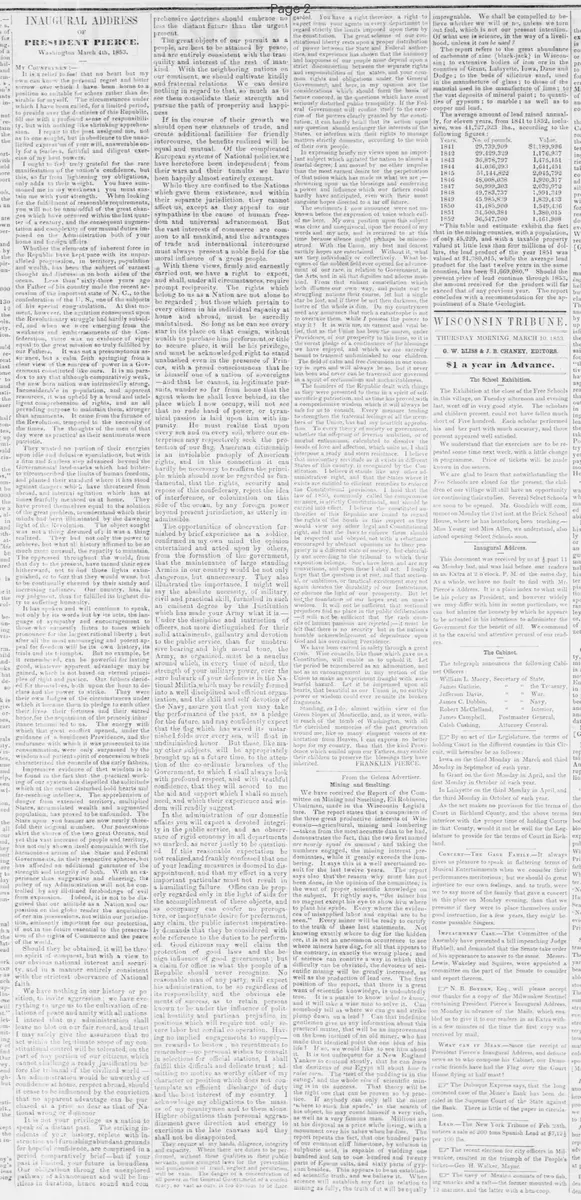
OF
PRESIDENT PIERCE.
Washington March 4th, 1853.
My Countrymen:-
It is a relief to feel that no heart but my own can know the personal regret and bitter sorrow over which I have been borne to a position so suitable for others rather than desirable for myself. The circumstances under which I have been called, for a limited period, to preside over the destinies of this Republic, fill me with a profound sense of responsibility, but with nothing like shrinking apprehension. I repair to the post assigned me, not as to one sought, but in obedience to the unsolicited expression of your will, answerable only for a fearless, faithful and diligent exercise of my best powers.
I ought to feel truly grateful for the rare manifestation of the nation's confidence, but this, so far from lightening my obligations, only adds to their weight. You have summoned me in my weakness; you must sustain me with your strength. When looking for the fulfillment of reasonable requirements, you will not be unmindful of the great changes which have occurred within the last quarter of a century, and the consequent augmentation and complexity of our mutual duties imposed on the Administration both of your home and foreign affairs.
Whether the elements of inherent force in the Republic have kept pace with its unparalleled progression in territory, population and wealth, has been the subject of earnest thought and discussion on both sides of the ocean. Less than sixty-three years ago the Father of his country made the recent accession of that important state of N. C., to the confederation of the U. S., one of the subjects of his special congratulation. At that moment, however, the agitation consequent upon the Revolutionary struggle had hardly subsided, and when we were emerging from the weakness and embarrassments of the Confederation, there was no evidence of vigor equal to the great mission so truly fulfilled by our Fathers. It was not a presumptuous assurance, but a calm faith springing from a clear view of the sources of power in a Government constituted like ours. It is no paradox to say that although comparatively weak, the new born nation was intrinsically strong. Inconsiderable in population, and apparent resources, it was upheld by a broad and intelligent comprehension of rights, and an all pervading purpose to maintain them, stronger than armaments. It came from the furnace of the Revolution, tempered to the necessity of the times. The thoughts of the men of that day were as practical as their sentiments were patriotic.
They wasted no portion of their energies upon idle and delusive speculations, but with a firm and fearless step advanced beyond the Governmental land-marks which had hitherto circumscribed the limits of human freedom, and planted their standard where it has stood against dangers which have threatened from abroad, and internal agitation which has at times fearfully menaced us at home. They have proved themselves equal to the solution of the great problem, to understand which their minds had been illuminated by the dawning light of the Revolution. The object sought was not a thing dreamed of; it was a thing realized. They had not only the power to achieve, but what all history affirmed to be so much more unusual, the capacity to maintain. The oppressed throughout the world, from that day to the present, have turned their eyes hitherward, not to find those lights extinguished, or to fear that they would wane, but to be continually cheered by their steady and increasing radiance. Our country, has, in my judgment, thus far fulfilled its highest duty to suffering humanity. It has spoken and will continue to speak, not only by its words but by its acts, the language of sympathy and encouragement to those who earnestly listen to tones which pronounce for the largest rational liberty; but after all the most encouraging and potent appeal for freedom will be its own history, its trials and its triumphs. But no example, be it remembered, can be powerful for lasting good, whatever apparent advantage may be gained, which is not based on eternal principles of right and justice. Our fathers decided for themselves, both upon the hour to declare and the power to strike. They were their own Judges of the circumstances under which it became them to pledge to each other their lives their fortunes and their sacred honor, for the acquisition of the princely inheritance transmitted to us. The energy with which that great conflict opened, under the guidance of a beneficent Providence, and the endurance with which it was prosecuted to its consummation, were only surpassed by the wisdom and patient spirit of concession which characterized the councils of the early fathers. Impressive evidence of that wisdom is to be found in the fact that the practical working of our system has dispelled the solicitude which at the outset disturbed bold hearts and far-reaching intellects. The apprehension of danger from extended territory, multiplied States, accumulated wealth and augmented population, has proved to be unfounded. The Stars upon yon banner are now nearly three-fold their original number. Our possessions skirt the shores of the two great Oceans, and yet this vast increase of people and territory has not only shown itself compatible with the harmonious action of the State and Federal Governments, in their respective spheres, but has afforded an additional guarantee of the strength and integrity of both. With an experience thus suggestive and cheering, the policy of my Administration will not be controlled by any ill-timed forebodings of evil from expansion. Indeed, it is not to be disguised that our attitude as a Nation and our position on the globe render the acquisition of certain possessions, not within our jurisdiction, eminently important for our protection, if not in the future essential to the preservation of the rights of Commerce and the peace of the world.
Should they be obtained, it will be through no spirit of conquest, but with a view to our obvious national interest and security, and in a manner entirely consistent with the strictest observance of National faith.
We have nothing in our history or position, to invite aggression; we have everything to urge us to the cultivation of relations of peace and amity with all nations. I intend that my administration shall leave no blot on our fair record, and trust I may safely give the assurance that no act within the legitimate scope of my constitutional control will be tolerated, on the part of any portion of our citizens, which cannot challenge a ready justification before the tribunal of the civilized world -
An administration would be unworthy of confidence at home, respect abroad, should it cease to be influenced by the conviction that no apparent advantage can be purchased at a price so dear as that of National wrong or dishonor.
It is not your privilege as a nation to speak of a distant past. The striking incidents of your history, replete with instruction and furnishing abundant grounds for hopeful confidence, are comprised in a period comparatively brief-but if your past is limited, your future is boundless. Our obligations through the unexplored pathway of advancement and will be limitless in duration, hence sound and comprehensive doctrines should embrace no less the distant future than the urgent present.
The great objects of our pursuit as a people, are best to be attained by peace, and are entirely consistent with the tranquility and interest of the rest of mankind. With the neighboring nations on our continent, we should cultivate kindly and fraternal relations. We can desire nothing in regard to that, so much as to see them consolidate their strength and pursue the path of prosperity and happiness. If in the course of their growth we should open new channels of trade, and create additional facilities for friendly intercourse, the benefits realized will be equal and mutual. Of the complicated European systems of National policies we have heretofore been independent; from their wars and their tumults we have been happily almost entirely exempt. While they are confined to the Nations which gave them existence, and within their separate jurisdiction, they cannot affect us, except as they appeal to our sympathies in the cause of human freedom and universal advancement. But the vast interests of commerce are common to all mankind, and the advantages of trade and international intercourse must always present a noble field for the moral influence of a great people. With these views, firmly and earnestly carried out, we have a right to expect, and shall, under all circumstances, require prompt reciprocity. The rights which belong to us as a Nation are not alone to be regarded; but those which pertain to every citizen in his individual capacity at home and abroad, must be sacredly maintained. So long as he can see every star in its place on that ensign, without wealth to purchase him preferment, or title to secure place, it will be his privilege, and must be acknowledged right to stand unabashed even in the presence of Princes, with a proud consciousness that he is himself one of a nation of sovereigns -and that he cannot, in legitimate pursuits, wander so far from home that the agent whom he shall leave behind, in the place which I now occupy, will not see that no rude hand of power, or tyrannical passion is laid upon him with impunity. He must realize that upon every sea and on every soil, where our enterprises may respectively seek the protection of our flag, American citizenship is an inviolable panoply of American rights, and in this connection it can hardly be necessary to reaffirm the principle which should now be regarded as fundamental, that the rights, security and repose of this confederacy, reject the idea of interference, or colonization on this side of the ocean, by any foreign power beyond present jurisdiction, as utterly inadmissible.
The opportunities of observation furnished by brief experience as a soldier confirmed in my own mind the opinion entertained and acted upon by others, from the formation of the government that the maintenance of large standing Armies in our country would be not only dangerous, but unnecessary. They also illustrated the importance, I might well say the absolute necessity, of military civil and practical skill, furnished in such an eminent degree by the Institution which has made your Army what it is.-
Under the discipline and instruction of officers, not more distinguished for their solid attainments, gallantry and devotion to the public service, than for unobtrusive bearing and high moral tone, the Army, as organized, must be a nucleus around which, in every time of need, the strength of your military power, ever the sure bulwark of your defence is in the National Militia, which may be readily formed into a well disciplined and efficient organization, and the skill and self devotion of the Navy, assure you that you may take the performance of the past, as a pledge for the future, and may confidently expect that the flag which has waved its untarnished folds over every sea, will float in undiminished honor. But these, like many other subjects, will be appropriately brought up at a future time, to the attention of the co-ordinate branches of the Government, to which I shall always look with profound respect, and with truthful confidence, that they will accord to me the aid and support which I shall so much need, and which their experience and wisdom will readily suggest.
In the administration of our domestic affairs you will expect a devoted integrity in the public service, and an observance of rigid economy in all departments so marked, as never justly to be questioned. If this reasonable expectation be not realized, and frankly confessed that one of your leading measures is doomed to disappointment, and that my effort in a very important particular must not result in a humiliating failure. Office can be properly regarded only in the light of aids for the accomplishment of these objects, and as occupancy can confer no prerogative, or importunate desire for preferment, any claim, the public interest imperatively demands that they be considered with sole reference to the duties to be performed. Good citizens may well claim the protection of good laws and the benign influence of good government; but a claim for office is what the people of a Republic should never recognize. No reasonable man of any party, will expect his administration, to be so regardless of its responsibility, and the obvious elements of success, as to retain persons known to be under the influence of political hostility and partisan prejudice, in positions which will require not only severe labor but cordial co-operation. Having no implied engagements to supply-no rewards to bestow, no resentments to remember-no personal wishes to consult in selections for official stations, I shall fulfill this difficult and delicate trust: admitting no motive as worthy either of my character or position which does not contemplate an efficient discharge of duty and the best interest of my country.
I acknowledge my obligations to the masses of my countrymen and to them alone. Higher obligations than personal aggrandizement gave direction and energy to exertions in the late canvass and they shall not be disappointed. They require at my hands, diligence, integrity and capacity. Where there are duties to be performed, without these qualities in their public servants, more stringent laws for the prevention and punishment of fraud, neglect and peculation, will be vain. The danger of a concentration of all power in the General Government of a confederacy so vast as ours is too obvious to be disregarded. You have a right therefore to expect from your agents in every department to regard strictly the limits imposed upon them by the constitution. The great scheme of our constitutional liberty rests upon a proper distribution of power between the State and Federal authorities, and experience has shown that the harmony and happiness of our people must depend upon a strict disconnection between the separate rights and responsibilities of the states, and your common rights and obligations under the General Government; and here, in my opinion are the considerations which should form the basis of future concord, in the questions which have most seriously disturbed public tranquility. If the Federal Government will confine itself to the exercise of the powers clearly granted by the constitution, it can hardly befall that its action upon any question should endanger the interests of the States, or interfere with their rights to manage matters strictly domestic, according to the wish of their own people.
In expressing briefly my views upon an important subject which agitated the nation to almost a fearful degree, I am moved by no other impulse than the most earnest desire for the perpetuation of that union which has made us what we are, -showering upon us the blessings and conferring a power and influence which our fathers could hardly have anticipated, even with their most sanguine hopes directed to a far off future.
The sentiments I now announce were not unknown before the expression of voice which called me here. My own position upon this subject was clear and unequivocal, upon the record of my words and my acts, and is recurred to at this time because silence might perhaps be misconstrued. With the Union, my best and dearest earthly hopes are entertained. Without it, what are they individually or collectively. What becomes of the noblest field ever opened for advancement of our race, in relation to Government, in the Arts, and in all that dignifies and adorns mankind. From that radiant constellation which both illumes our own way, and points out to struggling nations their course, let but a single star be lost, and if there be not then darkness, the lustre of the whole is dim. Do my countrymen need any assurance that such a catastrophe is not to overtake them, while I possess the power to stay it? It is with me, an earnest and vital belief, that as the Union has been the source, under Providence, of our prosperity to this time, so it is the surest pledge of a continuance of the blessings we have enjoyed, and which we are sacredly bound to transmit undiminished to our children. The field of calm and free discussion in our country is open and will always be so, but it never has been and never can be traversed nor governed in a spirit of sectionalism and uncharitableness. The founders of the Republic dealt with things as they were presented to them in a spirit of self sacrificing patriotism, and as time has proved, with a comprehensive wisdom which it will always be safe for us to consult. Every measure tending to strengthen the fraternal feelings of all the members of the Union, has had my heartfelt approbation. To every theory of society or government, whether the offspring of feverish ambition, or of morbid enthusiasm, calculated to dissolve the bonds of love and affection, which unite us, I shall interpose a ready and stern resistance. I believe that involuntary servitude as it exists in different States of this country, is recognized by the Constitution. I believe it stands like any other administrative right, and that the States where it exists are entitled to efficient remedies to enforce the Constitutional provisions. I hold that the law of 1850, commonly called the compromise measure, is strictly Constitutional, and should be carried into effect. I believe the constituted authorities of this Republic are bound to regard the rights of the South in this respect as they would view any other legal and Constitutional right, and that the laws to enforce them should be respected and obeyed, not with a reluctance encouraged by abstract opinions as to their propriety in a different state of society, but cheerfully and according to the tribunal to which their exposition belongs. Such have been, and are my convictions, and upon these I shall act. I fondly hope that the question is at rest, and that sectional, or ambitious, or fanatical excitement may not again threaten the durability of our Institutions, or obscure the light of our prosperity. But let not the foundation of our hopes rest on man's wisdom. It will not be sufficient that sectional prejudices find no place in the public deliberations --it will not be sufficient that the rash councils of human passions are rejected:-it must be felt that there is no security but in the nation's humble acknowledgement of dependence upon God and his over-ruling Providence. We have been carried in safety through a great crisis. Wise councils, like those which gave us a Constitution, will enable us to uphold it. Let the period be remembered as an admonition, and not as an encouragement in any section of the Union to make an experiment fraught with such fearful hazard. Let it be impressed upon all hearts, that beautiful as our Union is, no earthly power or wisdom could ever re-unite its broken fragments. Standing, as I do, almost within view of the Green Slopes of Monticello, and, as it were, within reach of the tomb of Washington, with all the cherished memories of the past generation around me, like so many eloquent voices of exhortation from Heaven, I can express no better hope for my country, than that the kind Providence which smiled upon our Fathers, may enable their children to preserve the blessings they have inherited.
FRANKLIN PIERCE
Inaugural Address.
This document was received by us at past 11 on Monday last, and was laid before our readers in an Extra at 2 o'clock, P. M. of the same day.
As a whole, we have no fault to find with Mr. Pierce's Address. It is a plain index to what will be his policy as President, and however widely we may differ with him in some particulars, we can but admire the honesty by which he appears to be actuated in his intentions to administer the Government for the benefit of all. We commend it to the careful and attentive perusal of our readers.
What sub-type of article is it?
What themes does it cover?
What keywords are associated?
What entities or persons were involved?
Where did it happen?
Story Details
Key Persons
Location
Washington
Event Date
March 4th, 1853
Story Details
Franklin Pierce delivers his inaugural address, expressing personal reluctance yet sense of responsibility in assuming the presidency, gratitude for national confidence, reflection on the nation's historical strength and expansion, commitment to peaceful foreign relations and protection of American rights abroad, opposition to large standing armies, emphasis on integrity and economy in domestic administration, strict adherence to constitutional limits, and firm support for the Union, the Compromise of 1850, and enforcement of laws regarding slavery in the states where it exists, invoking divine providence for the nation's preservation.