Thank you for visiting SNEWPapers!
Sign up free
Story
February 1, 1809
The National Intelligencer And Washington Advertiser
Washington, District Of Columbia
What is this article about?
In a congressional debate on December 8, Mr. Nelson counters Mr. Key's eloquent opposition to the embargo, defending it as a precautionary and coercive measure to safeguard U.S. independence and commerce against British and French blockades and licenses, prioritizing liberty over profit.
Clipping
OCR Quality
70%
Good
Full Text
DEBATE ON FOREIGN RELATIONS
[CONTINUED]
December 8.
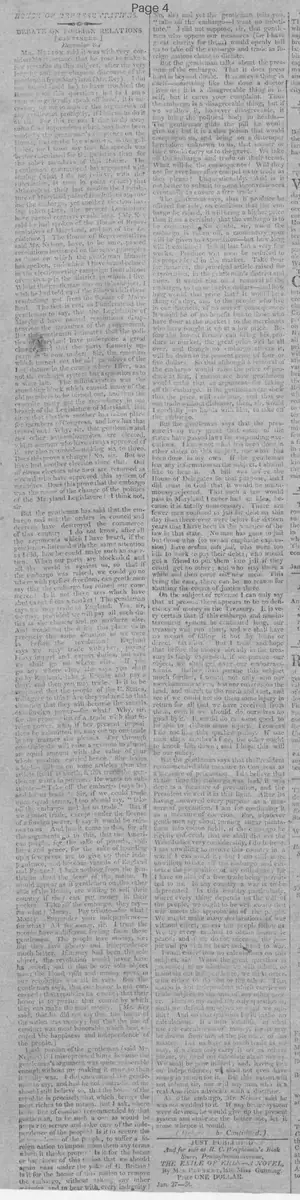
Mr. Nelson said it was with very considerable reluctance that he rose to make a few remarks on this subject, after the very lengthy and very eloquent discourse of the gentleman from Maryland (Mr. Key). I did not intend (said he) to have troubled the House upon this question; but as I am a man who generally speak off hand, it is necessary for me to answer the arguments of any gentleman promptly, if I intend to do it at all. For this reason I rise to do away some false impressions which may have been made by the gentleman's eloquence on the House, made not by design, in the gallery better calculated for the galleries than for the sober members of this House. The gentleman commenced his argument with submission, it is true in point of fact that stating (what I do not believe, with Mr. although at their last session the Legislature of Maryland passed resolutions approving the embargo, yet another election having taken place, the present Legislature have passed contrary resolutions. [Mr. Key said he had spoken of the House of Representatives of Maryland, and not of the Legislature.] The House of Representatives said Mr. Nelson, have, to be sure, passed resolutions bottomed on the same principles as those on which the gentleman himself has spoken, and which I have heard echoed in the electioneering campaign from almost every stump in the district in which I live. Whilst the gentleman was on this subject, I wish he had told us of the fillup which these men. The fact is not, as I understood the gentleman to say, that the Legislature of Maryland have passed resolutions disapproving the measures of the government. But the gentleman intimates that the politics of Maryland have undergone a great change, and that the party formerly uppermost is now under. Sir, the question which turned out the old members of the Legislature in the county where I live, was not the embargo system but a question as to a state law. The militia system was the stumbling block which caused many of the old members to be turned out, and thus the opposite party got the ascendancy in one branch of the Legislature of Maryland. But since that election another has taken place for members of Congress, and how has that turned out? Why, sir, that gentleman and I are also returned—making six to three. Whilst dis men who have always approved of trade other anti-embargoites are elected, have had another election since that. Out Nocs this prove a change? No, sir. But we elected who have approved this system of measures. Does this prove that the embargo was the cause of the change of the politics of the Maryland Legislature? I think not, sir embargo and not the orders in council and decrees have destroyed the commerce of this country. I do not know, after all the arguments which I have heard, if the gentleman listened with the same attention as I did, how he could make such an assertion. When our ports are blockaded and all the world is against us, so that if the embargo was raised, we could go nowhere with perfect freedom, can gentlemen say that the embargo has ruined our commerce? Is it not these acts which have shut us out from a market? The gentleman say we may trade to England. Yes, sir, we may, provided we will pay all such duties as she chooses and go nowhere else. And would not the doing this place us in precisely the same situation as we were in before the revolution? England says we may trade with her, paying heavy import and export duties, but says we shall go nowhere else. If you go by Zealand, take a license and pay a duty, and then you may trade. Is it to be supposed that the people of the U. States. will agree to this? Are they reduced to that situation that they will become the vassals of foreign power—for what? Why, sir, for the prosecution of a trade with that foreign power, who, if her present impositions be submitted to, may cut up our trade in any manner she pleases. For through an equal amount with the value of your whole produce carried hence. She levies a tribute on some articles than the article itself is worth, & this trade the gentleman wants to pursue. He wants no submission—let us trade. Sir, if we could trade suijude—Take off the embargo (says he) upon equal terms, I too should say, "take off the embargo and let us trade." But if we cannot trade, except under the license of a foreign power, I say it would be ruinous to us. And has it come to this, for all the arguments so to this, that the American people, for the sake of pounds, shillings and pence, for the sake of hoarding up a few pence are to give up their independence, and become vassals of England and France I hear nothing from the gentleman about the honor of the nation. It would appear as if gentlemen on the other side of the House, are willing to sell their country if they can put money in their pocket. Take off the embargo, they cry—for what? Money. Pay tribute—for what? Money Surrender your independence—for what? All for money, sir. I trust the people have a different feeling from these gentlemen. The people love money, sir; But they love liberty and independence much better. If money had been the sole object, the revolution would never have happened; and if that be our sole object now, the blood spilt and money spent in our revolution was all in vain. But the gentleman says, that our honor is not concerned; that republics have none; that their honor is to pursue that course by which they can make the most money. [Mr. Key said, that he did not say that the honor of the nation was money; but that the line of conduct was most honorable which best secured the happiness and independence of the people.] I ask pardon of the gentleman (said Mr. Nelson) if I misrepresented him: because the gentleman's argument was quite vulnerable enough without my making it more so than it really was. I did understand the gentleman to say, and had he not contradicted me should still believe so, that the honor of the republic is precisely that which brings the most riches to the nation. But I ask, where is the line of conduct recommended by that gentleman, to be such a one as would be proper to secure and take care of the independence of the people? Is it to secure the independence of the people, to suffer a foreign nation to impose upon them any terms which it thinks proper Is it for the honor or happiness of this nation that we should again pass under the yoke of G. Britain? Is it for the honor of this nation to remove the embargo, without taking any other measure and to bear with every indignity?
No, sir; and yet the gentleman tells you, "take off the embargo—I want no substitute." I did not suppose, sir, that gentlemen who oppose our measures (for I have great charity for them would openly tell us to take off the embargo and trade as foreign nations choose to dictate. But the gentleman talks about the pressure of the embargo. That it does press hard is beyond doubt. It is an evil thing in itself—something like the dose a doctor gives us; it is a disagreeable thing in itself, but it cures your complaint. Thus the embargo is a disagreeable thing, but if we swallow it, however disagreeable, it may bring the political body to health.— The gentleman gilds the pill he would give us; but it is a slow poison that would creep upon us, and bring on a distemper heretofore unknown to us, that sooner or later would carry us to the grave. We take off the embargo and trade on their terms. What will be the consequence? Will they not for ever hereafter compel us to trade as they please? Unquestionably. And is it not better to submit to some inconveniences eventually to ensure a free trade? The gentleman says, that if produce be offered for sale, on condition that the embargo be raised, it will bring a higher price than if on a certainty that the embargo is to be continued. No doubt, sir, when the embargo is taken off, a momentary spur will be given to exportation—but how long will it continue? It will last but a very few weeks, Produce will soon be reduced to its proper level in the market. Take flour for instance, the principal article raised for exportation, in the gentleman's district and mine. It would rise on a removal of the embargo, to ten or twelve dollars—and how long would that price last? It would be a thing of a day, and to the people who live in our districts, of no sort of consequence. It would be of no benefit but to those who have flour at the market; to the merchants who have bought it up at a low price. Before the honest farmer can bring his produce to market, the great price will be all over, and though no embargo affects it, will go down to its present price of four or five dollars So that although a removal of the embargo would raise the price of produce at first, I cannot see how gentlemen would make that an argument for taking off the embargo. If the gentleman can show that the price will continue, and that we can trade without dishonor, then, sir, would I cordially join hands with him, to take off the embargo. But the gentleman says that the pressure is so very great that some of the states have passed laws for suspending executions. I know not what has been done in other states on this subject, nor what has been done in my own. If the gentleman has any information on the subject, I should like to hear it. A bill was before the House of Delegates for that purpose, but I do trust in God that it would be unanimously rejected. That such a law would pass in Maryland I never had an idea, because it is totally unnecessary. There are fewer men confined in jail for debt on this day than there ever were before for sixteen years that I have been in the practice of the law in that state. No man has gone to jail but those who (to use an emphatic expression) have broken into jail, who were too idle to work or pay their debts; who would get a friend to put them into jail if they could get no other; and who stay there a while and then come out new men. This being the case, there can be no reason for shutting the courts of justice there On the subject of revenue I can only say that at present there appears to be no deficiency of money in the Treasury. It is very certain that if this embargo and non-intercourse system be continued long, our treasury will run short, and we shall have no means of filling it but by loans or direct taxation. But I trust and hope that before the money already in the treasury is fairly expended, if we pursue our object, we shall get over our embarrassments. Rather than pursue this subject much further, I would not only arm our merchantmen at sea, but our citizens on the land, and march to the north and east, and see if we could not do them some injury in return for all that we have received from them, even if we should do ourselves no good by it. It would do me some good to be able to do them some injury. I confess I do not like this quaker policy. If one man slaps the other's face, the other ought to knock him down; and I hope this will be our policy. But the gentleman says that the President recommended this measure to Congress as a measure of precaution. I do believe that at the time the embargo was laid, it was done as a measure of precaution, and the President viewed it in that light. After its having answered every purpose as a measure of precaution, I am for continuing it as a measure of coercion. For, whatever gentlemen say about turning sugar plantations into cotton fields, if the embargo be rigidly enforced, that we shall distress the West-Indies very considerably, I do believe. I am unwilling to involve this country in a war if I can avoid it; but I am still more unwilling to take off the embargo and embrace the proposition of my colleague; for I have no idea of a free trade being permitted to us. In any country a war is to be deprecated. In this country particularly, where every thing depends on the will of the people, we ought to be well aware that war meets the approbation of the people. We might make many declarations of war without effect, unless the people follow us We try every method to obtain honorable peace; and if we do not succeed, the people will go with us heart and hand to war. I shall enter into no calculations on this subject, sir. When the great question is presented to us whether we will submit or maintain our independence, we must determine either to do one or the other. That nation is not independent which carries on trade subject to the will of any other power. Then, to my mind the only question is, shall we defend ourselves or shall we submit? And on that question I will make no calculations. If a man submits, of what use are calculations of money, for it may be drawn from him at the pleasure of his master Let us have as much trade as we may, if we can only carry it on as others please, we need not calculate about money. We shall be poor indeed; and, having lost our independence, we shall not even have money in ruin for it. But this nation will not submit sir, nor will any man who is a real American advocate such a doctrine. As to the embargo, Mr. Nelson said he was not wedded to it. If any better system were devised, he would give up the present system and embrace the better one, let it come whence it would.
[CONTINUED]
December 8.
Mr. Nelson said it was with very considerable reluctance that he rose to make a few remarks on this subject, after the very lengthy and very eloquent discourse of the gentleman from Maryland (Mr. Key). I did not intend (said he) to have troubled the House upon this question; but as I am a man who generally speak off hand, it is necessary for me to answer the arguments of any gentleman promptly, if I intend to do it at all. For this reason I rise to do away some false impressions which may have been made by the gentleman's eloquence on the House, made not by design, in the gallery better calculated for the galleries than for the sober members of this House. The gentleman commenced his argument with submission, it is true in point of fact that stating (what I do not believe, with Mr. although at their last session the Legislature of Maryland passed resolutions approving the embargo, yet another election having taken place, the present Legislature have passed contrary resolutions. [Mr. Key said he had spoken of the House of Representatives of Maryland, and not of the Legislature.] The House of Representatives said Mr. Nelson, have, to be sure, passed resolutions bottomed on the same principles as those on which the gentleman himself has spoken, and which I have heard echoed in the electioneering campaign from almost every stump in the district in which I live. Whilst the gentleman was on this subject, I wish he had told us of the fillup which these men. The fact is not, as I understood the gentleman to say, that the Legislature of Maryland have passed resolutions disapproving the measures of the government. But the gentleman intimates that the politics of Maryland have undergone a great change, and that the party formerly uppermost is now under. Sir, the question which turned out the old members of the Legislature in the county where I live, was not the embargo system but a question as to a state law. The militia system was the stumbling block which caused many of the old members to be turned out, and thus the opposite party got the ascendancy in one branch of the Legislature of Maryland. But since that election another has taken place for members of Congress, and how has that turned out? Why, sir, that gentleman and I are also returned—making six to three. Whilst dis men who have always approved of trade other anti-embargoites are elected, have had another election since that. Out Nocs this prove a change? No, sir. But we elected who have approved this system of measures. Does this prove that the embargo was the cause of the change of the politics of the Maryland Legislature? I think not, sir embargo and not the orders in council and decrees have destroyed the commerce of this country. I do not know, after all the arguments which I have heard, if the gentleman listened with the same attention as I did, how he could make such an assertion. When our ports are blockaded and all the world is against us, so that if the embargo was raised, we could go nowhere with perfect freedom, can gentlemen say that the embargo has ruined our commerce? Is it not these acts which have shut us out from a market? The gentleman say we may trade to England. Yes, sir, we may, provided we will pay all such duties as she chooses and go nowhere else. And would not the doing this place us in precisely the same situation as we were in before the revolution? England says we may trade with her, paying heavy import and export duties, but says we shall go nowhere else. If you go by Zealand, take a license and pay a duty, and then you may trade. Is it to be supposed that the people of the U. States. will agree to this? Are they reduced to that situation that they will become the vassals of foreign power—for what? Why, sir, for the prosecution of a trade with that foreign power, who, if her present impositions be submitted to, may cut up our trade in any manner she pleases. For through an equal amount with the value of your whole produce carried hence. She levies a tribute on some articles than the article itself is worth, & this trade the gentleman wants to pursue. He wants no submission—let us trade. Sir, if we could trade suijude—Take off the embargo (says he) upon equal terms, I too should say, "take off the embargo and let us trade." But if we cannot trade, except under the license of a foreign power, I say it would be ruinous to us. And has it come to this, for all the arguments so to this, that the American people, for the sake of pounds, shillings and pence, for the sake of hoarding up a few pence are to give up their independence, and become vassals of England and France I hear nothing from the gentleman about the honor of the nation. It would appear as if gentlemen on the other side of the House, are willing to sell their country if they can put money in their pocket. Take off the embargo, they cry—for what? Money. Pay tribute—for what? Money Surrender your independence—for what? All for money, sir. I trust the people have a different feeling from these gentlemen. The people love money, sir; But they love liberty and independence much better. If money had been the sole object, the revolution would never have happened; and if that be our sole object now, the blood spilt and money spent in our revolution was all in vain. But the gentleman says, that our honor is not concerned; that republics have none; that their honor is to pursue that course by which they can make the most money. [Mr. Key said, that he did not say that the honor of the nation was money; but that the line of conduct was most honorable which best secured the happiness and independence of the people.] I ask pardon of the gentleman (said Mr. Nelson) if I misrepresented him: because the gentleman's argument was quite vulnerable enough without my making it more so than it really was. I did understand the gentleman to say, and had he not contradicted me should still believe so, that the honor of the republic is precisely that which brings the most riches to the nation. But I ask, where is the line of conduct recommended by that gentleman, to be such a one as would be proper to secure and take care of the independence of the people? Is it to secure the independence of the people, to suffer a foreign nation to impose upon them any terms which it thinks proper Is it for the honor or happiness of this nation that we should again pass under the yoke of G. Britain? Is it for the honor of this nation to remove the embargo, without taking any other measure and to bear with every indignity?
No, sir; and yet the gentleman tells you, "take off the embargo—I want no substitute." I did not suppose, sir, that gentlemen who oppose our measures (for I have great charity for them would openly tell us to take off the embargo and trade as foreign nations choose to dictate. But the gentleman talks about the pressure of the embargo. That it does press hard is beyond doubt. It is an evil thing in itself—something like the dose a doctor gives us; it is a disagreeable thing in itself, but it cures your complaint. Thus the embargo is a disagreeable thing, but if we swallow it, however disagreeable, it may bring the political body to health.— The gentleman gilds the pill he would give us; but it is a slow poison that would creep upon us, and bring on a distemper heretofore unknown to us, that sooner or later would carry us to the grave. We take off the embargo and trade on their terms. What will be the consequence? Will they not for ever hereafter compel us to trade as they please? Unquestionably. And is it not better to submit to some inconveniences eventually to ensure a free trade? The gentleman says, that if produce be offered for sale, on condition that the embargo be raised, it will bring a higher price than if on a certainty that the embargo is to be continued. No doubt, sir, when the embargo is taken off, a momentary spur will be given to exportation—but how long will it continue? It will last but a very few weeks, Produce will soon be reduced to its proper level in the market. Take flour for instance, the principal article raised for exportation, in the gentleman's district and mine. It would rise on a removal of the embargo, to ten or twelve dollars—and how long would that price last? It would be a thing of a day, and to the people who live in our districts, of no sort of consequence. It would be of no benefit but to those who have flour at the market; to the merchants who have bought it up at a low price. Before the honest farmer can bring his produce to market, the great price will be all over, and though no embargo affects it, will go down to its present price of four or five dollars So that although a removal of the embargo would raise the price of produce at first, I cannot see how gentlemen would make that an argument for taking off the embargo. If the gentleman can show that the price will continue, and that we can trade without dishonor, then, sir, would I cordially join hands with him, to take off the embargo. But the gentleman says that the pressure is so very great that some of the states have passed laws for suspending executions. I know not what has been done in other states on this subject, nor what has been done in my own. If the gentleman has any information on the subject, I should like to hear it. A bill was before the House of Delegates for that purpose, but I do trust in God that it would be unanimously rejected. That such a law would pass in Maryland I never had an idea, because it is totally unnecessary. There are fewer men confined in jail for debt on this day than there ever were before for sixteen years that I have been in the practice of the law in that state. No man has gone to jail but those who (to use an emphatic expression) have broken into jail, who were too idle to work or pay their debts; who would get a friend to put them into jail if they could get no other; and who stay there a while and then come out new men. This being the case, there can be no reason for shutting the courts of justice there On the subject of revenue I can only say that at present there appears to be no deficiency of money in the Treasury. It is very certain that if this embargo and non-intercourse system be continued long, our treasury will run short, and we shall have no means of filling it but by loans or direct taxation. But I trust and hope that before the money already in the treasury is fairly expended, if we pursue our object, we shall get over our embarrassments. Rather than pursue this subject much further, I would not only arm our merchantmen at sea, but our citizens on the land, and march to the north and east, and see if we could not do them some injury in return for all that we have received from them, even if we should do ourselves no good by it. It would do me some good to be able to do them some injury. I confess I do not like this quaker policy. If one man slaps the other's face, the other ought to knock him down; and I hope this will be our policy. But the gentleman says that the President recommended this measure to Congress as a measure of precaution. I do believe that at the time the embargo was laid, it was done as a measure of precaution, and the President viewed it in that light. After its having answered every purpose as a measure of precaution, I am for continuing it as a measure of coercion. For, whatever gentlemen say about turning sugar plantations into cotton fields, if the embargo be rigidly enforced, that we shall distress the West-Indies very considerably, I do believe. I am unwilling to involve this country in a war if I can avoid it; but I am still more unwilling to take off the embargo and embrace the proposition of my colleague; for I have no idea of a free trade being permitted to us. In any country a war is to be deprecated. In this country particularly, where every thing depends on the will of the people, we ought to be well aware that war meets the approbation of the people. We might make many declarations of war without effect, unless the people follow us We try every method to obtain honorable peace; and if we do not succeed, the people will go with us heart and hand to war. I shall enter into no calculations on this subject, sir. When the great question is presented to us whether we will submit or maintain our independence, we must determine either to do one or the other. That nation is not independent which carries on trade subject to the will of any other power. Then, to my mind the only question is, shall we defend ourselves or shall we submit? And on that question I will make no calculations. If a man submits, of what use are calculations of money, for it may be drawn from him at the pleasure of his master Let us have as much trade as we may, if we can only carry it on as others please, we need not calculate about money. We shall be poor indeed; and, having lost our independence, we shall not even have money in ruin for it. But this nation will not submit sir, nor will any man who is a real American advocate such a doctrine. As to the embargo, Mr. Nelson said he was not wedded to it. If any better system were devised, he would give up the present system and embrace the better one, let it come whence it would.
What sub-type of article is it?
Historical Event
What themes does it cover?
Bravery Heroism
Justice
Survival
What keywords are associated?
Embargo
Foreign Relations
National Independence
Trade Restrictions
Maryland Legislature
What entities or persons were involved?
Mr. Nelson
Mr. Key
Where did it happen?
House Of Representatives
Story Details
Key Persons
Mr. Nelson
Mr. Key
Location
House Of Representatives
Event Date
December 8.
Story Details
Mr. Nelson responds to Mr. Key's speech, defending the embargo policy as necessary to protect American commerce and independence from British and French impositions, arguing against submission for monetary gain and emphasizing national honor.