Thank you for visiting SNEWPapers!
Sign up free
Richmond Enquirer
Richmond, Richmond County, Virginia
What is this article about?
In 1835, U.S. Representative Campbell P. White resigns from New York's Third Congressional District after six years of service, citing family duties and private concerns. He praises his faithful support for Democratic principles and President Jackson's administration, including key bills on Indian affairs, tariffs, banking, and currency.
Clipping
OCR Quality
Full Text
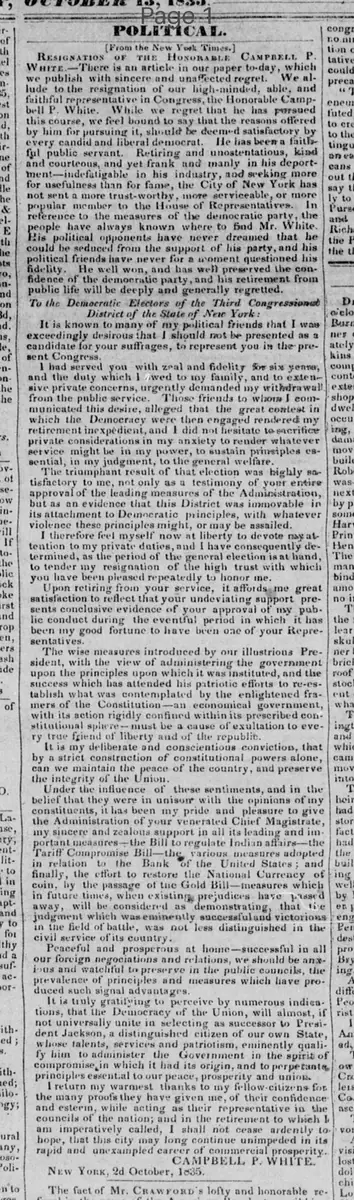
[From the New York Times.]
RESIGNATION of The HONORABLE CAMPBELL P. WHITE.—There is an article in our paper to-day, which we publish with sincere and unaffected regret. We allude to the resignation of our high-minded, able, and faithful representative in Congress, the Honorable Campbell P. White. While we regret that he has pursued this course, we feel bound to say that the reasons offered by him for pursuing it, should be deemed satisfactory by every candid and liberal democrat. He has been a faithful public servant. Retiring and unostentatious, kind and courteous, and yet frank and manly in his deportment—indefatigable in his industry, and seeking more for usefulness than for fame, the City of New York has not sent a more trust-worthy, more serviceable, or more popular member to the House of Representatives. In reference to the measures of the democratic party, the people have always known where to find Mr. White. His political opponents have never dreamed that he could be seduced from the support of his party, and his political friends have never for a moment questioned his fidelity. He well won, and has well preserved the confidence of the democratic party, and his retirement from public life will be deeply and generally regretted.
To the Democratic Electors of the Third Congressional District of the State of New York:
It is known to many of my political friends that I was exceedingly desirous that I should not be presented as a candidate for your suffrages, to represent you in the present Congress.
I had served you with zeal and fidelity for six years, and the duty which I owed to my family, and to extensive private concerns, urgently demanded my withdrawal from the public service. Those friends to whom I communicated this desire, alleged that the great contest in which the Democracy were then engaged rendered my retirement inexpedient, and I did not hesitate to sacrifice private considerations in my anxiety to render whatever service might be in my power, to sustain principles essential, in my judgment, to the general welfare.
The triumphant result of that election was highly satisfactory to me, not only as a testimony of your entire approval of the leading measures of the Administration, but as an evidence that this District was immovable in its attachment to Democratic principles, with whatever violence these principles might, or may be assailed.
I therefore feel myself now at liberty to devote my attention to my private duties, and I have consequently determined, as the period of the general election is at hand, to tender my resignation of the high trust with which you have been pleased repeatedly to honor me.
Upon retiring from your service, it affords me great satisfaction to reflect that your undeviating support presents conclusive evidence of your approval of my public conduct during the eventful period in which it has been my good fortune to have been one of your Representatives.
The wise measures introduced by our illustrious President, with the view of administering the government upon the principles upon which it was instituted, and the success which has attended his patriotic efforts to re-establish what was contemplated by the enlightened framers of the Constitution—an economical government, with its action rigidly confined within its prescribed constitutional sphere—must be a cause of exultation to every true friend of liberty and of the republic.
It is my deliberate and conscientious conviction, that by a strict construction of constitutional powers alone, can we maintain the peace of the country, and preserve the integrity of the Union.
Under the influence of these sentiments, and in the belief that they were in unison with the opinions of my constituents, it has been my pride and pleasure to give the Administration of your venerated Chief Magistrate, my sincere and zealous support in all its leading and important measures—the Bill to regulate Indian affairs—the Tariff Compromise Bill—the various measures adopted in relation to the Bank of the United States; and finally, the effort to restore the National Currency of coin, by the passage of the Gold Bill—measures which in future times, when existing prejudices have passed away, will be considered as demonstrating, that the judgment which was eminently successful and victorious in the field of battle, was not less distinguished in the civil service of its country.
Peaceful and prosperous at home—successful in all our foreign negotiations and relations, we should be anxious and watchful to preserve in the public councils, the prevalence of principles and measures which have produced such signal advantages.
It is truly gratifying to perceive by numerous indications, that the Democracy of the Union, will almost, if not universally unite in selecting as successor to President Jackson, a distinguished citizen of our own State, whose talents, services and patriotism, eminently qualify him to administer the Government in the spirit of compromise in which it had its origin, and to perpetuate principles essential to our peace, prosperity and union—
I return my warmest thanks to my fellow-citizens for the many proofs they have given me, of their confidence and esteem, while acting as their representative in the councils of the nation; and in the retirement to which I am imperatively called, I shall not cease ardently to hope, that this city may long continue unimpeded in its rapid and unexampled career of commercial prosperity.
CAMPBELL P. WHITE.
New York, 2d October, 1835.
What sub-type of article is it?
What themes does it cover?
What keywords are associated?
What entities or persons were involved?
Where did it happen?
Story Details
Key Persons
Location
Third Congressional District Of The State Of New York
Event Date
1835 10 02
Story Details
Campbell P. White announces his resignation from Congress after six years of zealous service to Democratic principles and President Jackson's administration, including support for key bills on Indian affairs, tariffs, banking, and the Gold Bill, due to duties to family and private concerns.