Thank you for visiting SNEWPapers!
Sign up free
The Daily Madisonian
Washington, District Of Columbia
What is this article about?
Article from Richmond Whig publishes an 1843 private letter by Ohio's Judge John McLean criticizing partisan politics' corruption of the presidency and government, advocating virtuous leadership like Jefferson and Monroe, and declining personal political ambitions except on honorable terms.
Clipping
OCR Quality
Full Text
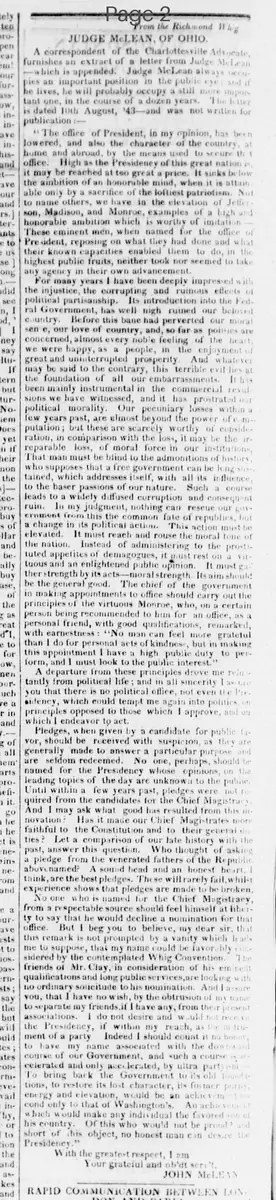
JUDGE McLEAN, OF OHIO.
A correspondent of the Charlottesville Advocate furnishes an extract of a letter from Judge McLean—which is appended. Judge McLean always occupies an important position in the public eye and as he lives, he will probably occupy a still more important one, in the course of a dozen years. The letter is dated 10th August, '43—and was not written for publication:-
"The office of President, in my opinion, has been lowered, and also the character of the country, at home and abroad, by the means used to secure the office. High as the Presidency of this great nation is, it may be reached at too great a price. It sinks below the ambition of an honorable mind, when it is attainable only by a sacrifice of the loftiest patriotism. Not to name others, we have in the elevation of Jefferson, Madison, and Monroe, examples of a high and honorable ambition which is worthy of imitation. These eminent men, when named for the office of President, reposing on what they had done and what their known capacities enabled them to do, in the highest public trusts, neither took nor seemed to take any agency in their own advancement.
For many years I have been deeply impressed with the injustice, the corrupting and ruinous effects of political partisanship. Its introduction into the Federal Government, has well nigh ruined our beloved country. Before this bane had perverted our moral sense, our love of country, and, so far as politics are concerned, almost every noble feeling of the heart, we were happy, as a people, in the enjoyment of great and uninterrupted prosperity. And what may be said to the contrary, this terrible evil lies at the foundation of all our embarrassments. It has been mainly instrumental in the commercial revulsions we have witnessed, and it has prostrated political morality. Our pecuniary losses within a few years past, are almost beyond the power of computation; but these are scarcely worthy of consideration, in comparison with the loss, it may be the irreparable loss, of moral force in our institutions. That man must be blind to the admonitions of history who supposes that a free government can be long sustained, which addresses itself, with all its influence to the baser passions of our nature. Such a course leads to a widely diffused corruption and consequent ruin. In my judgment, nothing can rescue our government from this the common fate of republics, but a change in its political action. This action must be elevated. It must reach and rouse the moral tone of the nation. Instead of administering to the prostitute appetites of demagogues, it must rest on a virtuous and an enlightened public opinion. It must gather strength by its acts—moral strength. Its aim should be the general good. The chief of the government in making appointments to office should carry out the principles of the virtuous Monroe, who, on a certain person being recommended to him for an office, as a personal friend, with good qualifications, remarked, with earnestness: "No man can feel more grateful than I do for personal acts of kindness, but in making this appointment I have a high public duty to perform, and I must look to the public interest."
A departure from these principles drove me reluctantly from political life; and in all sincerity I assure you that there is no political office, not even the Presidency, which could tempt me again into politics on principles opposed to those which I approve, and which I endeavor to act.
Pledges, when given by a candidate for public favor, should be received with suspicion, as they are generally made to answer a particular purpose and are seldom redeemed. No one, perhaps, should be named for the Presidency whose opinions, on the leading topics of the day are unknown to the public. Until within a few years past, pledges were not required from the candidates for the Chief Magistracy. And I may ask what good has resulted from this innovation? Has it made our Chief Magistrates more faithful to the Constitution and to their general duties? Let a comparison of our late history with the past, answer this question. Who thought of asking a pledge from the venerated fathers of the Republic abovenamed? A sound head and an honest heart, I think, are the best pledges. These will rarely fail, whilst experience shows that pledges are made to be broken.
No one who is named for the Chief Magistracy, from a respectable source should feel himself at liberty to say that he would decline a nomination for that office. But I beg you to believe, my dear sir, that this remark is not prompted by a vanity which flatters me to suppose, that my name could be favorably considered by the contemplated Whig Convention. The friends of Mr. Clay, in consideration of his entire qualifications and long public services, are looking with no ordinary solicitude to his nomination. And I assure you, that I have no wish, by the obtrusion of my name to separate my friends, if I have any, from their just associations. I do not desire and would not accept the Presidency, if within my reach, as the instrument of a party. Indeed I should count it no honor to have my name associated with the disgraceful course of our Government, and such a course accelerated and only accelerated, by ultra parties.
To bring back the Government to its old positions, to restore its lost character, its former high energy and elevation, would be an achievement second only to that of Washington's. An achievement which would make any individual the favored instrument of his country. Of this who would not be proud? Short of his object, no honest man can desire the Presidency.
With the greatest respect, I am
Your grateful and ob'dt ser,
JOHN McLEAN
What sub-type of article is it?
What themes does it cover?
What keywords are associated?
What entities or persons were involved?
Story Details
Key Persons
Event Date
1843 08 10
Story Details
Judge McLean critiques the degradation of the presidency through partisan politics, praises past leaders like Jefferson, Madison, and Monroe for honorable pursuits, laments the corrupting effects of partisanship on the nation, and expresses reluctance to re-enter politics except on principled terms, while supporting Clay's nomination.