Thank you for visiting SNEWPapers!
Sign up free
Lynchburg Virginian
Lynchburg, Virginia
What is this article about?
Committee chaired by Henry A. Wise adopts resolution praising his conduct and vindicating him from slanders. A proposed report with misrepresentations against him is withdrawn after Gen. Campbell's strong objection and threat of confrontation.
Clipping
OCR Quality
Full Text
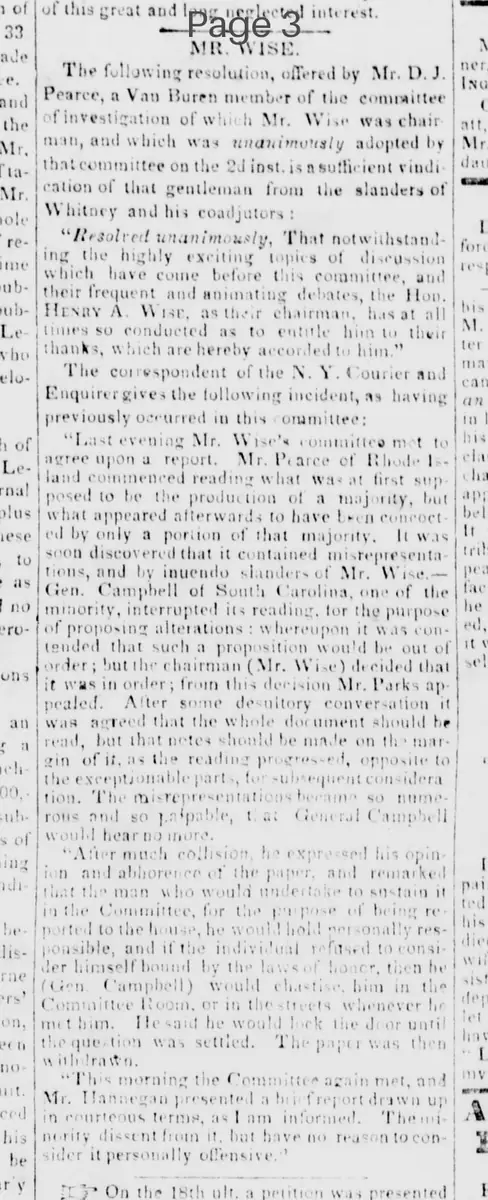
The following resolution, offered by Mr. D. J. Pearce, a Van Buren member of the committee of investigation of which Mr. Wise was chairman, and which was unanimously adopted by that committee on the 2d inst. is a sufficient vindication of that gentleman from the slanders of Whitney and his coadjutors:
"Resolved unanimously. That notwithstanding the highly exciting topics of discussion which have come before this committee, and their frequent and animating debates, the Hon. Henry A. Wise, as their chairman, has at all times so conducted as to entitle him to their thanks, which are hereby accorded to him."
The correspondent of the N. Y. Courier and Enquirer gives the following incident, as having previously occurred in this committee:
"Last evening Mr. Wise's committee met to agree upon a report. Mr. Pearce of Rhod. Island commenced reading what was at first supposed to be the production of a majority, but what appeared afterwards to have been concocted by only a portion of that majority. It was soon discovered that it contained misrepresentations, and by innuendo slanders of Mr. Wise.—Gen. Campbell of South Carolina, one of the majority, interrupted its reading, for the purpose of proposing alterations: whereupon it was contended that such a proposition would be out of order; but the chairman (Mr. Wise) decided that it was in order; from this decision Mr. Parks appealed. After some desultory conversation it was agreed that the whole document should be read, but that notes should be made on the margin of it, as the reading progressed, opposite to the exceptionable part, to subsequent consideration. The misrepresentations became so numerous and so palpable, that General Campbell would hear no more.
"After much collision. he expressed his opinion and abhorrence of the paper. and remarked that the man who would undertake to sustain it in the Committee, for the purpose of being reported to the house, he would hold personally responsible, and if the individual referred to considered himself bound by the laws, not honor, then he (Gen. Campbell) would chastise him in the Committee Room, or in the streets whenever he met him. He said he would lock the door until the question was settled. The paper was then withdrawn.
"This morning the Committee again met, and Mr. Innegan presented a brief report drawn up in courteous terms, as I am informed. The minority dissent from it, but have no reason to consider it personally offensive."
What sub-type of article is it?
What themes does it cover?
What keywords are associated?
What entities or persons were involved?
Where did it happen?
Story Details
Key Persons
Location
Committee Room
Event Date
On The 2d Inst.
Story Details
A committee unanimously adopts a resolution thanking Chairman Henry A. Wise for his conduct amid exciting debates, vindicating him from slanders by Whitney and others. An incident occurs where a majority report containing misrepresentations and slanders against Wise is interrupted by Gen. Campbell, leading to its withdrawal after threats of personal responsibility; a new courteous report is later presented.