Thank you for visiting SNEWPapers!
Sign up free
Story
January 27, 1868
The Charleston Daily News
Charleston, Charleston County, South Carolina
What is this article about?
President Andrew Johnson responds to the Senate regarding a bill for equal rights in the District of Columbia, explaining that it did not become law because Congress adjourned before the ten-day period for presidential approval expired, per the Constitution.
Clipping
OCR Quality
95%
Excellent
Full Text
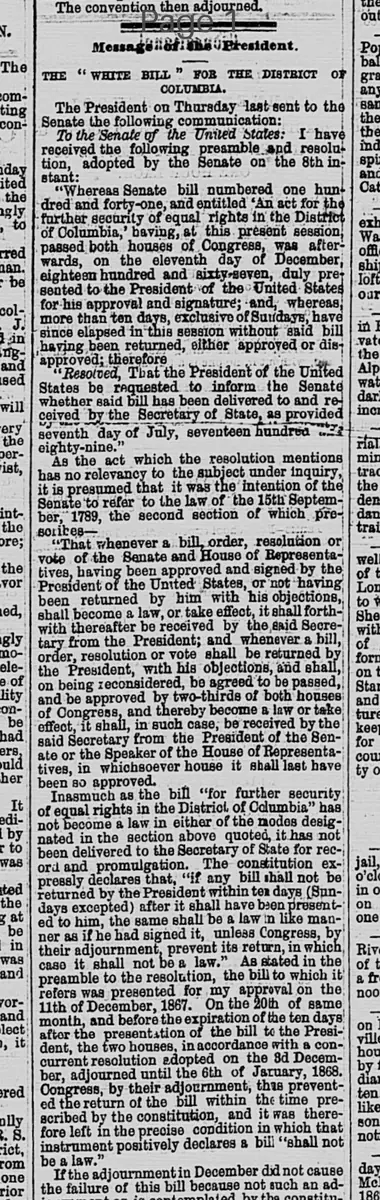
Message from the President.
THE WHITE BILL FOR THE DISTRICT OF COLUMBIA.
The President on Thursday last sent to the Senate the following communication:
To the Senate of the United States: I have received the following preamble and resolution, adopted by the Senate on the 8th instant:
"Whereas Senate bill numbered one hundred and forty-one, and entitled An act for the further security of equal rights in the District of Columbia,' having, at this present session passed both houses of Congress, was afterwards, on the eleventh day of December eighteen hundred and sixty-seven, duly presented to the President of the United States for his approval and signature; and, whereas, more than ten days, exclusive of Sundays, have since elapsed in this session without said bill having been returned, either approved or disapproved; therefore
"Resolved, That the President of the United States be requested to inform the Senate whether said bill has been delivered to and received by the Secretary of State, as provided seventh day of July, seventeen hundred eighty-nine."
As the act which the resolution mentions has no relevancy to the subject under inquiry, it is presumed that it was the intention of the Senate to refer to the law of the 15th September, 1789, the second section of which prescribes—
"That whenever a bill, order, resolution or vote of the Senate and House of Representatives, having been approved and signed by the President of the United States, or not having been returned by him with his objections, shall become a law, or take effect, it shall forthwith thereafter be received by the said Secretary from the President; and whenever a bill, order, resolution or vote shall be returned by the President, with his objections, and shall, on being reconsidered, be agreed to be passed, and be approved by two-thirds of both houses of Congress, and thereby become a law or take effect, it shall, in such case, be received by the said Secretary from the President of the Senate or the Speaker of the House of Representatives, in whichsoever house it shall last have been so approved."
Inasmuch as the bill "for further security of equal rights in the District of Columbia" has not become a law in either of the modes designated in the section above quoted, it has not been delivered to the Secretary of State for record and promulgation. The constitution expressly declares that, "if any bill shall not be returned by the President within ten days (Sundays excepted) after it shall have been presented to him, the same shall be a law in like manner as if he had signed it, unless Congress, by their adjournment, prevent its return, in which case it shall not be a law." As stated in the preamble to the resolution, the bill to which it refers was presented for my approval on the 11th of December, 1867. On the 20th of same month, and before the expiration of the ten days after the presentation of the bill to the President, the two houses, in accordance with a concurrent resolution adopted on the 3d December, adjourned until the 6th of January, 1868. Congress, by their adjournment, thus prevented the return of the bill within the time prescribed by the constitution, and it was therefore left in the precise condition in which that instrument positively declares a bill "shall not be a law."
If the adjournment in December did not cause the failure of this bill because not such an adjournment as is contemplated by the constitution in the clause which I have cited, it must follow that such was the nature of the adjournments during the past year, on the 3d day of March until the first Wednesday of July, and from the 20th of July until the 21st of November. Other bills will therefore be affected by the decision which may be rendered in this case among them one having the same title as that named in the resolution, and containing similar provisions, which, passed by both houses in the month of July last, failed to become a law by reason of the adjournment of Congress before ten days for its consideration had been allowed the Executive.
ANDREW JOHNSON.
Washington, January 23, 1868.
THE WHITE BILL FOR THE DISTRICT OF COLUMBIA.
The President on Thursday last sent to the Senate the following communication:
To the Senate of the United States: I have received the following preamble and resolution, adopted by the Senate on the 8th instant:
"Whereas Senate bill numbered one hundred and forty-one, and entitled An act for the further security of equal rights in the District of Columbia,' having, at this present session passed both houses of Congress, was afterwards, on the eleventh day of December eighteen hundred and sixty-seven, duly presented to the President of the United States for his approval and signature; and, whereas, more than ten days, exclusive of Sundays, have since elapsed in this session without said bill having been returned, either approved or disapproved; therefore
"Resolved, That the President of the United States be requested to inform the Senate whether said bill has been delivered to and received by the Secretary of State, as provided seventh day of July, seventeen hundred eighty-nine."
As the act which the resolution mentions has no relevancy to the subject under inquiry, it is presumed that it was the intention of the Senate to refer to the law of the 15th September, 1789, the second section of which prescribes—
"That whenever a bill, order, resolution or vote of the Senate and House of Representatives, having been approved and signed by the President of the United States, or not having been returned by him with his objections, shall become a law, or take effect, it shall forthwith thereafter be received by the said Secretary from the President; and whenever a bill, order, resolution or vote shall be returned by the President, with his objections, and shall, on being reconsidered, be agreed to be passed, and be approved by two-thirds of both houses of Congress, and thereby become a law or take effect, it shall, in such case, be received by the said Secretary from the President of the Senate or the Speaker of the House of Representatives, in whichsoever house it shall last have been so approved."
Inasmuch as the bill "for further security of equal rights in the District of Columbia" has not become a law in either of the modes designated in the section above quoted, it has not been delivered to the Secretary of State for record and promulgation. The constitution expressly declares that, "if any bill shall not be returned by the President within ten days (Sundays excepted) after it shall have been presented to him, the same shall be a law in like manner as if he had signed it, unless Congress, by their adjournment, prevent its return, in which case it shall not be a law." As stated in the preamble to the resolution, the bill to which it refers was presented for my approval on the 11th of December, 1867. On the 20th of same month, and before the expiration of the ten days after the presentation of the bill to the President, the two houses, in accordance with a concurrent resolution adopted on the 3d December, adjourned until the 6th of January, 1868. Congress, by their adjournment, thus prevented the return of the bill within the time prescribed by the constitution, and it was therefore left in the precise condition in which that instrument positively declares a bill "shall not be a law."
If the adjournment in December did not cause the failure of this bill because not such an adjournment as is contemplated by the constitution in the clause which I have cited, it must follow that such was the nature of the adjournments during the past year, on the 3d day of March until the first Wednesday of July, and from the 20th of July until the 21st of November. Other bills will therefore be affected by the decision which may be rendered in this case among them one having the same title as that named in the resolution, and containing similar provisions, which, passed by both houses in the month of July last, failed to become a law by reason of the adjournment of Congress before ten days for its consideration had been allowed the Executive.
ANDREW JOHNSON.
Washington, January 23, 1868.
What sub-type of article is it?
Historical Event
What themes does it cover?
Justice
What keywords are associated?
Andrew Johnson
District Of Columbia
Equal Rights Bill
Congressional Adjournment
Constitutional Procedure
Presidential Veto
What entities or persons were involved?
Andrew Johnson
Where did it happen?
Washington
Story Details
Key Persons
Andrew Johnson
Location
Washington
Event Date
January 23, 1868
Story Details
President Johnson informs the Senate that the bill for equal rights in the District of Columbia, presented on December 11, 1867, did not become law because Congress adjourned on December 20, 1867, before the ten-day constitutional period for presidential action expired, preventing its automatic approval.