Thank you for visiting SNEWPapers!
Sign up free
Literary
June 26, 1845
Indiana State Sentinel
Indianapolis, Marion County, Indiana
What is this article about?
Instructional prose detailing the step-by-step process of germinating an acorn into a young oak tree using a bottle and water, emphasizing the plant's transformation and care needs, ending with wonder at nature's creative power. Attributed to the Gardener's Chronicle.
Clipping
OCR Quality
98%
Excellent
Full Text
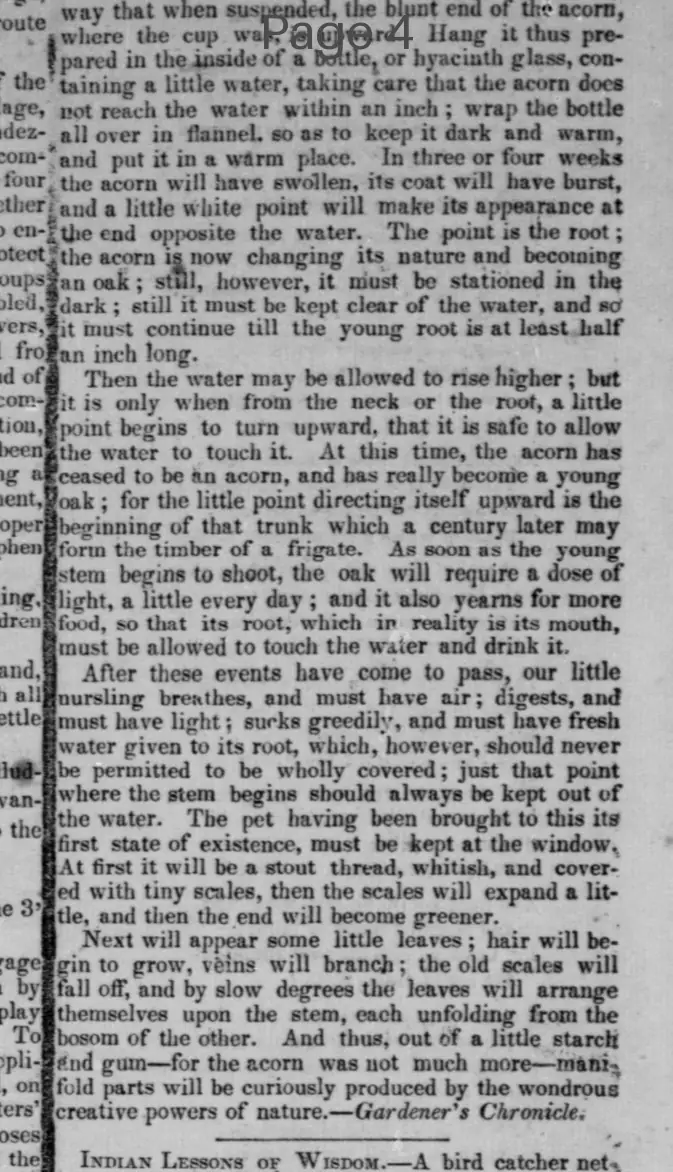
To propagate the oak from an acorn, pare it in the inside of a bottle, or hyacinth glass, containing a little water, taking care that the acorn does not reach the water within an inch; wrap the bottle all over in flannel, so as to keep it dark and warm, and put it in a warm place. In three or four weeks the acorn will have swollen, its coat will have burst, and a little white point will make its appearance at the end opposite the water. The point is the root; the acorn is now changing its nature and becoming an oak: still, however, it must be stationed in the dark: still it must be kept clear of the water, and so it must continue till the young root is at least half an inch long.
Then the water may be allowed to rise higher; but it is only when from the neck or the root, a little point begins to turn upward, that it is safe to allow the water to touch it. At this time, the acorn has ceased to be an acorn, and has really become a young oak: for the little point directing itself upward is the beginning of that trunk which a century later may form the timber of a frigate. As soon as the young stem begins to shoot, the oak will require a dose of light, a little every day; and it also yearns for more food, so that its root, which in reality is its mouth, must be allowed to touch the water and drink it.
After these events have come to pass, our little nursling breathes, and must have air; digests, and must have light; sucks greedily, and must have fresh water given to its root, which, however, should never be permitted to be wholly covered; just that point where the stem begins should always be kept out of the water. The pet having been brought to this its first state of existence, must be kept at the window. At first it will be a stout thread, whitish, and covered with tiny scales, then the scales will expand a little, and then the end will become greener.
Next will appear some little leaves; hair will begin to grow, veins will branch: the old scales will fall off, and by slow degrees the leaves will arrange themselves upon the stem, each unfolding from the bosom of the other. And thus, out of a little starch and gum—for the acorn was not much more—manifold parts will be curiously produced by the wondrous creative powers of nature.—Gardener's Chronicle.
Then the water may be allowed to rise higher; but it is only when from the neck or the root, a little point begins to turn upward, that it is safe to allow the water to touch it. At this time, the acorn has ceased to be an acorn, and has really become a young oak: for the little point directing itself upward is the beginning of that trunk which a century later may form the timber of a frigate. As soon as the young stem begins to shoot, the oak will require a dose of light, a little every day; and it also yearns for more food, so that its root, which in reality is its mouth, must be allowed to touch the water and drink it.
After these events have come to pass, our little nursling breathes, and must have air; digests, and must have light; sucks greedily, and must have fresh water given to its root, which, however, should never be permitted to be wholly covered; just that point where the stem begins should always be kept out of the water. The pet having been brought to this its first state of existence, must be kept at the window. At first it will be a stout thread, whitish, and covered with tiny scales, then the scales will expand a little, and then the end will become greener.
Next will appear some little leaves; hair will begin to grow, veins will branch: the old scales will fall off, and by slow degrees the leaves will arrange themselves upon the stem, each unfolding from the bosom of the other. And thus, out of a little starch and gum—for the acorn was not much more—manifold parts will be curiously produced by the wondrous creative powers of nature.—Gardener's Chronicle.
What sub-type of article is it?
Essay
What themes does it cover?
Nature
Agriculture Rural
What keywords are associated?
Oak Propagation
Acorn Germination
Plant Growth
Gardening Guide
Nature Creation
What entities or persons were involved?
Gardener's Chronicle
Literary Details
Author
Gardener's Chronicle
Subject
Propagating An Oak From An Acorn
Key Lines
The Point Is The Root; The Acorn Is Now Changing Its Nature And Becoming An Oak
The Little Point Directing Itself Upward Is The Beginning Of That Trunk Which A Century Later May Form The Timber Of A Frigate
Out Of A Little Starch And Gum—For The Acorn Was Not Much More—Manifold Parts Will Be Curiously Produced By The Wondrous Creative Powers Of Nature