Thank you for visiting SNEWPapers!
Sign up free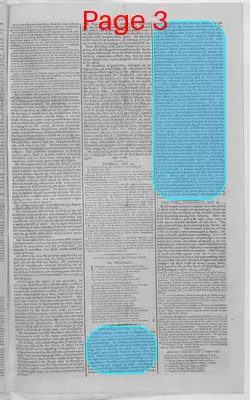
Editorial
May 26, 1790
Gazette Of The United States
New York, New York County, New York
What is this article about?
Editorial from Stockbridge, May 17, 1790, asserts liberty's necessity for happiness and warns against single-branch governments, drawing from history. It critiques France's National Assembly for hastily abolishing distinctions, seizing clergy property, and stripping the King's power, predicting future instability despite current peace.
Clipping
OCR Quality
95%
Excellent
Full Text
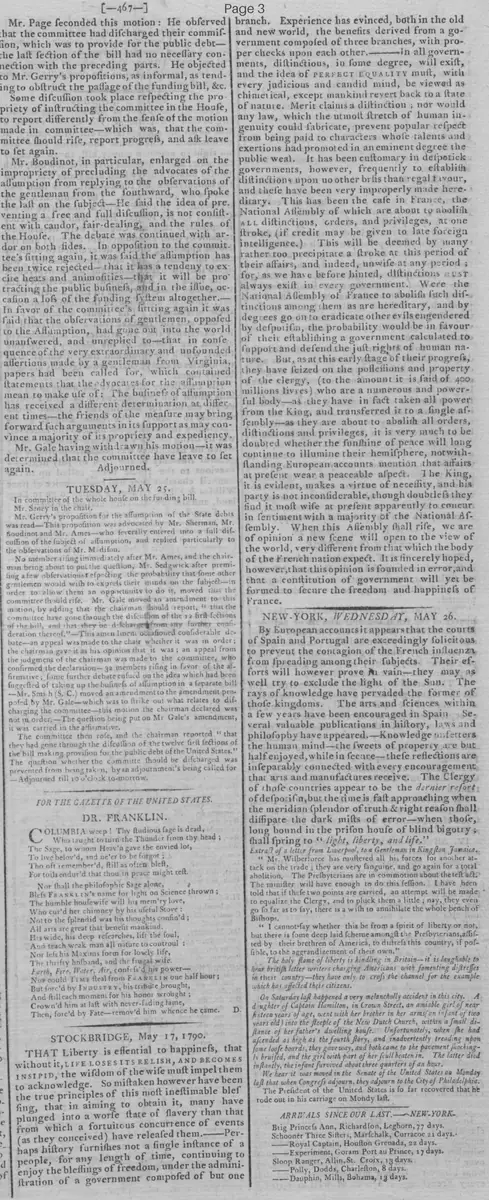
STOCKBRIDGE, May 17, 1790.
THAT Liberty is essential to happiness, the wisdom of the wise must impel them to acknowledge.
Without it, LIFE LOSES ITS RELISH, AND BECOMES
So mistaken however have been the true principles of this most inestimable blessing, that in aiming to obtain it, many have plunged into a worse state of slavery than that from which a fortuitous concurrence of events (as they conceived) have released them.—Perhaps history furnishes not a single instance of a people, for any length of time, continuing to enjoy the blessings of freedom, under the administration of a government composed of but one branch. Experience has evinced, both in the old and new world, the benefits derived from a government composed of three branches, with proper checks upon each other.—In all governments, distinctions, in some degree, will exist, and the idea of PERFECT EQUALITY must, with every judicious and candid mind, be viewed as chimerical, except mankind revert back to a state of nature. Merit claims a distinction; nor would any law, which the utmost stretch of human ingenuity could fabricate, prevent popular respect from being paid to characters whose talents and exertions had promoted in an eminent degree the public weal. It has been customary in despotic governments, however, frequently to establish distinctions upon no other basis than regal favour, and these have been very improperly made hereditary. This has been the case in France, the National Assembly of which are about to abolish ALL distinctions, orders, and privileges, at one stroke, (if credit may be given to late foreign intelligence.) This will be deemed by many rather too precipitate a stroke at this period of their affairs, and indeed, unwise at any period; for, as we have before hinted, distinctions must always exist in every government. Were the National Assembly of France to abolish such distinctions among them as are hereditary, and by degrees go on to eradicate other evils engendered by despotism, the probability would be in favour of their establishing a government calculated to support and defend the just rights of human nature. But, as at this early stage of their progress, they have seized on the possessions and property of the clergy, (to the amount it is said of 400 millions livres) who are a numerous and powerful body—as they have in fact taken all power from the King, and transferred it to a single assembly—as they have about to abolish all orders, distinctions and privileges, it is very much to be doubted whether the sunshine of peace will long continue to illumine their hemisphere, notwithstanding European accounts mention that affairs at present wear a peaceable aspect. The King, it is evident, makes a virtue of necessity, and his party is not inconsiderable, though doubtless they find it most wise at present apparently to concur in sentiment with a majority of the National Assembly. When this Assembly shall rise, we are of opinion a new scene will open to the view of the world, very different from that which the body of the French nation expect. It is sincerely hoped, however, that this opinion is founded in error, and that a constitution of government will yet be formed to secure the freedom and happiness of France.
THAT Liberty is essential to happiness, the wisdom of the wise must impel them to acknowledge.
Without it, LIFE LOSES ITS RELISH, AND BECOMES
So mistaken however have been the true principles of this most inestimable blessing, that in aiming to obtain it, many have plunged into a worse state of slavery than that from which a fortuitous concurrence of events (as they conceived) have released them.—Perhaps history furnishes not a single instance of a people, for any length of time, continuing to enjoy the blessings of freedom, under the administration of a government composed of but one branch. Experience has evinced, both in the old and new world, the benefits derived from a government composed of three branches, with proper checks upon each other.—In all governments, distinctions, in some degree, will exist, and the idea of PERFECT EQUALITY must, with every judicious and candid mind, be viewed as chimerical, except mankind revert back to a state of nature. Merit claims a distinction; nor would any law, which the utmost stretch of human ingenuity could fabricate, prevent popular respect from being paid to characters whose talents and exertions had promoted in an eminent degree the public weal. It has been customary in despotic governments, however, frequently to establish distinctions upon no other basis than regal favour, and these have been very improperly made hereditary. This has been the case in France, the National Assembly of which are about to abolish ALL distinctions, orders, and privileges, at one stroke, (if credit may be given to late foreign intelligence.) This will be deemed by many rather too precipitate a stroke at this period of their affairs, and indeed, unwise at any period; for, as we have before hinted, distinctions must always exist in every government. Were the National Assembly of France to abolish such distinctions among them as are hereditary, and by degrees go on to eradicate other evils engendered by despotism, the probability would be in favour of their establishing a government calculated to support and defend the just rights of human nature. But, as at this early stage of their progress, they have seized on the possessions and property of the clergy, (to the amount it is said of 400 millions livres) who are a numerous and powerful body—as they have in fact taken all power from the King, and transferred it to a single assembly—as they have about to abolish all orders, distinctions and privileges, it is very much to be doubted whether the sunshine of peace will long continue to illumine their hemisphere, notwithstanding European accounts mention that affairs at present wear a peaceable aspect. The King, it is evident, makes a virtue of necessity, and his party is not inconsiderable, though doubtless they find it most wise at present apparently to concur in sentiment with a majority of the National Assembly. When this Assembly shall rise, we are of opinion a new scene will open to the view of the world, very different from that which the body of the French nation expect. It is sincerely hoped, however, that this opinion is founded in error, and that a constitution of government will yet be formed to secure the freedom and happiness of France.
What sub-type of article is it?
Constitutional
Foreign Affairs
What keywords are associated?
Liberty
Government Branches
French Revolution
National Assembly
Constitutional Balance
Distinctions In Society
Clergy Property
What entities or persons were involved?
National Assembly Of France
King Of France
Clergy
Editorial Details
Primary Topic
Balanced Government And French Revolutionary Reforms
Stance / Tone
Advocacy For Three Branch Government With Checks, Cautious Critique Of French Assembly's Radicalism
Key Figures
National Assembly Of France
King Of France
Clergy
Key Arguments
Liberty Is Essential To Happiness
Single Branch Governments Lead To Slavery
Three Branch Governments With Checks Provide Benefits
Perfect Equality Is Chimerical; Distinctions Based On Merit Are Necessary
Hereditary Distinctions In Despotism Are Improper
French Assembly's Abolition Of All Distinctions Is Precipitate And Unwise
Seizure Of Clergy Property And Stripping King's Power Risks Instability
Hopes For A Stable Constitution In France