Thank you for visiting SNEWPapers!
Sign up free
Editorial
November 29, 1798
Gazette Of The United States, & Philadelphia Daily Advertiser
Philadelphia, Philadelphia County, Pennsylvania
What is this article about?
Essays by Virginiensis defend the federal Alien Law's constitutionality against an Albemarle, Virginia remonstrance, arguing it fulfills the duty to protect states from foreign invasion, particularly French threats, by allowing removal of dangerous aliens. Compares to Virginia's similar state law and notes its benefits in expelling suspects like Volney.
Merged-components note: Merged continuation of the Virginiensis editorial across pages due to textual flow.
Clippings
1 of 2
OCR Quality
95%
Excellent
Full Text
The Gazette.
PHILADELPHIA,
THURSDAY EVENING, NOVEMBER 29.
From the Columbian MIRROR.
NUMBER I.
TO THE PEOPLE OF VIRGINIA.
Fellow Citizens,
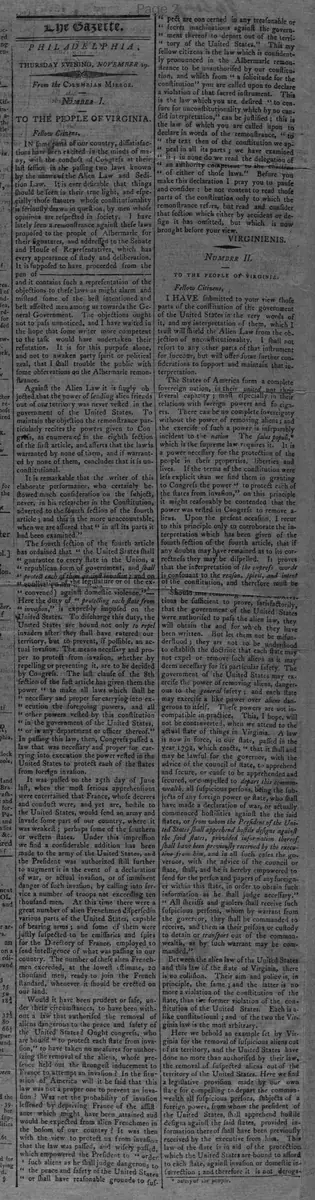
IN some parts of our country, dissatisfactions have been excited in the minds of many, with the conduct of Congress at their last session in the passing two laws known by the names of the Alien Law and Sedition Law. It is ever desirable that things should be seen in their true light, and especially those statutes, whose constitutionality is seriously drawn in question, by men whose opinions are respected in society. I have lately seen a remonstrance against these laws proposed to the people of Albemarle for their Signatures, and addressed to the Senate and House of Representatives, which has every appearance of study and deliberation. It is supposed to have proceeded from the pen of [blank] and it contains such a representation of the objections to these laws as might alarm and mislead some of the best intentioned and best affected men among us towards the General Government. The objections ought not to pass unnoticed, and I have waited in the hope that some writer more competent to the task would have undertaken their refutation. It is for this purpose alone, and not to awaken party spirit or political zeal, that I shall trouble the public with some observations on the Albemarle remonstrance.
Against the Alien Law it is singly objected that the power of sending alien friends out of our territory was never vested in the government of the United States. To maintain the objection the remonstrance particularly recites the powers given to Congress, as enumerated in the eighth section of the first article, and asserts that the law is warranted by none of them, and if warranted by none of them, concludes that it is unconstitutional.
It is remarkable that the writer of this elaborate performance, who certainly bestowed much consideration on the subject, never, in his researches in the Constitution, adverted to the fourth section of the fourth article; and this is the more unaccountable, when we are assured that "in all its parts it had been examined."
The fourth section of the fourth article has ordained that "the United States shall guarantee to every state in the Union, a republican form of government, and shall protect each of them against invasion: and on application of the legislature or of the executive convened against domestic violence."
Here the duty of "protecting each state from invasion," is expressly imposed on the United States! To discharge this duty, the United States are bound not only to repel invaders after they shall have entered our territory, but to prevent, if possible, an actual invasion. The means necessary and proper to protect from invasion, whether by repelling or preventing it, are to be decided by Congress. The last clause of the 8th section of the first article has given them the power "to make all laws which shall be necessary and proper for carrying into execution the foregoing powers, and all other powers vested by this constitution in the government of the United States, or in any department or officer thereof."
In passing this law, then, Congress passed a law that was necessary and proper for carrying into execution the power vested in the United States to protect each of the states from foreign invasion.
It was passed on the 25th day of June last, when the most serious apprehensions were entertained that France, whose decrees and conduct were, and yet are, hostile to the United States, would send an army and invade some part of our country, where it was weakest; perhaps some of the southern or western states. Under this impression we find a considerable addition has been made to the army of the United States, and the President was authorized still further to augment it in the event of a declaration of war, or actual invasion, or of imminent danger of such invasion, by calling into service a number of troops not exceeding ten thousand men. At this time there were a great number of alien Frenchmen dispersed in various parts of the United States, capable of bearing arms; and some of them were justly suspected to be emissaries and spies for the Directory of France, employed to send intelligence of what was passing in our country. The number of these alien Frenchmen exceeded, at the lowest estimate, 20 thousand men, ready to join the French standard, whenever it should be erected on our land.
Would it have been prudent or safe, under these circumstances, to have been without a law that authorized the removal of aliens dangerous to the peace and safety of the United States? Ought congress, who are bound "to protect each state from invasion," to have taken no measures for authorizing the removal of the aliens, whose presence held out the strongest inducement to France to attempt an invasion? In the situation of America will it be said that this law was not a proper one to prevent an invasion? Was not the probability of invasion lessened by depriving France of the assistance which might have been attained and would be expected from alien Frenchmen in the bosom of our country? It was then with the view to protect us from invasion that the law was passed, and wisely passed, which empowered the President to "order such aliens as he shall judge dangerous to the peace and safety of the United States or shall have reasonable grounds to suspect are concerned in any treasonable or secret machinations against the government thereof to depart out of the territory of the United States." This my fellow citizens is the law which is confidently pronounced in the Albemarle remonstrance to be unauthorized by our constitution, and which from "a solicitude for the constitution" you are called upon to declare a violation of that sacred instrument. This is the law which you are desired "to censure for unconstitutionality which by no candid interpretation," can be justified; this is the law of which you are called upon to declare in words of the remonstrance, "to the text then of the constitution we appeal in all its parts; we have examined it; in none do we read the delegation of an authority competent to the enaction of either of those laws." Before you make this declaration I pray you to pause and consider: be not content to read those parts of the constitution only to which the remonstrance refers, but read and consider that section which either by accident or design it has omitted, but which is now brought before your view.
VIRGINIENSIS.
NUMBER II.
TO THE PEOPLE OF VIRGINIA.
Fellow Citizens,
I HAVE submitted to your view those parts of the constitution of the government of the United States in the very words of it, and my interpretation of them, which I trust will shield the Alien Law from the objection of unconstitutionality. I shall not resort to any other parts of that instrument for succour, but will offer some further considerations to support and maintain that interpretation.
The States of America form a complete sovereign nation, in their united not their several capacity; most especially in their relations with foreign powers and foreigners. There can be no complete sovereignty without the power of removing aliens; and the exercise of such a power is inseparably incident to the nation The jus populi, which is the supreme law requires it. It is a power necessary for the protection of the people in their properties, liberties and lives. If the terms of the constitution were less explicit than we find them in granting to Congress the power "to protect each of the states from invasion," on this principle it might reasonably be contended that the power was vested in Congress to remove aliens. Upon the present occasion, I recur to this principle only to corroborate the interpretation which has been given of the fourth section of the fourth article, that if any doubts may have remained as to its correctness they may be dispelled. It proves that the interpretation of the express words is consonant to the reason, spirit, and intent of the constitution, and therefore must be correct.
Should communications be sufficient to prove, satisfactorily, that the government of the United States were authorized to pass the alien law, they will obtain the end for which they have been written. But let them not be misunderstood; they are not to be understood to establish the doctrine that each state may not expel or remove such aliens as it may deem necessary for its particular safety. The government of the United States may exercise the power of removing aliens, dangerous to the general safety; and each state may exercise a like power over aliens dangerous to itself. These powers are not incompatible in practice. This, I hope, will not be controverted, when we attend to the actual state of things in Virginia. A law is now in force, in our state, passed in the year 1792, which enacts, "that it shall and may be lawful for the governor, with the advice of the council of state, to apprehend and secure, or cause to be apprehended and secured, or compelled to depart this commonwealth, all suspicious persons, being the subjects of any foreign power or state, who shall have made a declaration of war, or actually commenced hostilities against the said States, or from whom the President of the United States shall apprehend hostile designs against the said states, provided information thereof shall have been previously received by the executive from him, and in all such cases the governor, with the advice of the council of state, shall, and he is hereby empowered to send for the person and papers of any foreigner within this state, in order to obtain such information as he shall judge necessary."
"All sheriffs and gaolers shall receive such suspicious persons, whom by warrant from the governor, they shall be commanded to receive, and them in their prisons or custody to detain or transport out of the commonwealth, as by such warrant may be commanded."
Between the alien law of the United States and this law of the state of Virginia, there is no collision. Their aim and policy is, in principle, the same; and the latter is no more a violation of the constitution of the state, than the former violation of the constitution of the United States. Each is alike constitutional; and of the two the Virginia law is the most arbitrary.
Here we behold an example set by Virginia for the removal of suspicious aliens out of its territory, and the United States have done no more than authorized by their law, the removal of suspected aliens out of the territory of the United States. Here we find a legislative provision made by our own state for compelling to depart the commonwealth all suspicious persons, subjects of a foreign power, from whom the president of the United States shall apprehend hostile designs against the said states, provided information thereof shall have been previously received by the executive from him. This law of the state is in aid of the protection which the United States are bound to afford to each state, against invasion or domestic insurrection; and therefore it is not derogatory of the power of Congress, or derogatory of the sovereignty of the people.
History or inconsistent with, the powers vested in the general government. As the United States and each state may call out the militia of the state to suppress an insurrection each state respectively, to the United States and each state may exercise the power of removing aliens out of each state respectively. In these cases there may be a concurrence of power for the same end the safety of the people.
Nor from these observations is it to be inferred, that if congress have a power to remove aliens out of the United States in a summary way, they have the like power to remove citizens. A citizen is a party to the social compact, which has conferred on him certain rights of which he may not be arbitrarily deprived, but an alien is not a member of the society ;--among these a citizen has a right to remain in the territory of the United States, unless he commits an offence for which that right is forfeited by law ; and if charged with such offence, he would be entitled to a speedy trial by an impartial jury, as in other cases. The citizens consequently have no cause of disquietude in consequence either of the law of congress or of the law of Virginia, authorizing the removal of aliens
Having made these explanations, I shall detain you no longer on the constitutionality of the alien law, which I hope has been shown to your entire satisfaction. That it has produced very beneficial effects in strengthening our country at this perilous time, will scarcely be doubted.--In consequence of it a great many alien Frenchmen, and among them the notorious emissary Volney, have left America, from a fear that it might be executed on them. They were conscious that they would, if in their power, join the standard of France whenever it should be erected within our territory; and they reasonably concluded it was safest and most convenient for them to go immediately out of our country before they were ordered.
This, my fellow citizens, is a candid view of the alien law, which has given occasion to so much clamour among us, and which some of you, from the misrepresentation made of it in the Albemarle remonstrance, might be induced to reprobate as a violation of our invaluable constitution. The appeal is made to you.-- Does it afford any just cause of complaint? On the contrary, is it not a new proof of the vigilance and wisdom of Congress anxious to protect our favoured country from foreign invasion?
VIRGINIENSIS.
PHILADELPHIA,
THURSDAY EVENING, NOVEMBER 29.
From the Columbian MIRROR.
NUMBER I.
TO THE PEOPLE OF VIRGINIA.
Fellow Citizens,
IN some parts of our country, dissatisfactions have been excited in the minds of many, with the conduct of Congress at their last session in the passing two laws known by the names of the Alien Law and Sedition Law. It is ever desirable that things should be seen in their true light, and especially those statutes, whose constitutionality is seriously drawn in question, by men whose opinions are respected in society. I have lately seen a remonstrance against these laws proposed to the people of Albemarle for their Signatures, and addressed to the Senate and House of Representatives, which has every appearance of study and deliberation. It is supposed to have proceeded from the pen of [blank] and it contains such a representation of the objections to these laws as might alarm and mislead some of the best intentioned and best affected men among us towards the General Government. The objections ought not to pass unnoticed, and I have waited in the hope that some writer more competent to the task would have undertaken their refutation. It is for this purpose alone, and not to awaken party spirit or political zeal, that I shall trouble the public with some observations on the Albemarle remonstrance.
Against the Alien Law it is singly objected that the power of sending alien friends out of our territory was never vested in the government of the United States. To maintain the objection the remonstrance particularly recites the powers given to Congress, as enumerated in the eighth section of the first article, and asserts that the law is warranted by none of them, and if warranted by none of them, concludes that it is unconstitutional.
It is remarkable that the writer of this elaborate performance, who certainly bestowed much consideration on the subject, never, in his researches in the Constitution, adverted to the fourth section of the fourth article; and this is the more unaccountable, when we are assured that "in all its parts it had been examined."
The fourth section of the fourth article has ordained that "the United States shall guarantee to every state in the Union, a republican form of government, and shall protect each of them against invasion: and on application of the legislature or of the executive convened against domestic violence."
Here the duty of "protecting each state from invasion," is expressly imposed on the United States! To discharge this duty, the United States are bound not only to repel invaders after they shall have entered our territory, but to prevent, if possible, an actual invasion. The means necessary and proper to protect from invasion, whether by repelling or preventing it, are to be decided by Congress. The last clause of the 8th section of the first article has given them the power "to make all laws which shall be necessary and proper for carrying into execution the foregoing powers, and all other powers vested by this constitution in the government of the United States, or in any department or officer thereof."
In passing this law, then, Congress passed a law that was necessary and proper for carrying into execution the power vested in the United States to protect each of the states from foreign invasion.
It was passed on the 25th day of June last, when the most serious apprehensions were entertained that France, whose decrees and conduct were, and yet are, hostile to the United States, would send an army and invade some part of our country, where it was weakest; perhaps some of the southern or western states. Under this impression we find a considerable addition has been made to the army of the United States, and the President was authorized still further to augment it in the event of a declaration of war, or actual invasion, or of imminent danger of such invasion, by calling into service a number of troops not exceeding ten thousand men. At this time there were a great number of alien Frenchmen dispersed in various parts of the United States, capable of bearing arms; and some of them were justly suspected to be emissaries and spies for the Directory of France, employed to send intelligence of what was passing in our country. The number of these alien Frenchmen exceeded, at the lowest estimate, 20 thousand men, ready to join the French standard, whenever it should be erected on our land.
Would it have been prudent or safe, under these circumstances, to have been without a law that authorized the removal of aliens dangerous to the peace and safety of the United States? Ought congress, who are bound "to protect each state from invasion," to have taken no measures for authorizing the removal of the aliens, whose presence held out the strongest inducement to France to attempt an invasion? In the situation of America will it be said that this law was not a proper one to prevent an invasion? Was not the probability of invasion lessened by depriving France of the assistance which might have been attained and would be expected from alien Frenchmen in the bosom of our country? It was then with the view to protect us from invasion that the law was passed, and wisely passed, which empowered the President to "order such aliens as he shall judge dangerous to the peace and safety of the United States or shall have reasonable grounds to suspect are concerned in any treasonable or secret machinations against the government thereof to depart out of the territory of the United States." This my fellow citizens is the law which is confidently pronounced in the Albemarle remonstrance to be unauthorized by our constitution, and which from "a solicitude for the constitution" you are called upon to declare a violation of that sacred instrument. This is the law which you are desired "to censure for unconstitutionality which by no candid interpretation," can be justified; this is the law of which you are called upon to declare in words of the remonstrance, "to the text then of the constitution we appeal in all its parts; we have examined it; in none do we read the delegation of an authority competent to the enaction of either of those laws." Before you make this declaration I pray you to pause and consider: be not content to read those parts of the constitution only to which the remonstrance refers, but read and consider that section which either by accident or design it has omitted, but which is now brought before your view.
VIRGINIENSIS.
NUMBER II.
TO THE PEOPLE OF VIRGINIA.
Fellow Citizens,
I HAVE submitted to your view those parts of the constitution of the government of the United States in the very words of it, and my interpretation of them, which I trust will shield the Alien Law from the objection of unconstitutionality. I shall not resort to any other parts of that instrument for succour, but will offer some further considerations to support and maintain that interpretation.
The States of America form a complete sovereign nation, in their united not their several capacity; most especially in their relations with foreign powers and foreigners. There can be no complete sovereignty without the power of removing aliens; and the exercise of such a power is inseparably incident to the nation The jus populi, which is the supreme law requires it. It is a power necessary for the protection of the people in their properties, liberties and lives. If the terms of the constitution were less explicit than we find them in granting to Congress the power "to protect each of the states from invasion," on this principle it might reasonably be contended that the power was vested in Congress to remove aliens. Upon the present occasion, I recur to this principle only to corroborate the interpretation which has been given of the fourth section of the fourth article, that if any doubts may have remained as to its correctness they may be dispelled. It proves that the interpretation of the express words is consonant to the reason, spirit, and intent of the constitution, and therefore must be correct.
Should communications be sufficient to prove, satisfactorily, that the government of the United States were authorized to pass the alien law, they will obtain the end for which they have been written. But let them not be misunderstood; they are not to be understood to establish the doctrine that each state may not expel or remove such aliens as it may deem necessary for its particular safety. The government of the United States may exercise the power of removing aliens, dangerous to the general safety; and each state may exercise a like power over aliens dangerous to itself. These powers are not incompatible in practice. This, I hope, will not be controverted, when we attend to the actual state of things in Virginia. A law is now in force, in our state, passed in the year 1792, which enacts, "that it shall and may be lawful for the governor, with the advice of the council of state, to apprehend and secure, or cause to be apprehended and secured, or compelled to depart this commonwealth, all suspicious persons, being the subjects of any foreign power or state, who shall have made a declaration of war, or actually commenced hostilities against the said States, or from whom the President of the United States shall apprehend hostile designs against the said states, provided information thereof shall have been previously received by the executive from him, and in all such cases the governor, with the advice of the council of state, shall, and he is hereby empowered to send for the person and papers of any foreigner within this state, in order to obtain such information as he shall judge necessary."
"All sheriffs and gaolers shall receive such suspicious persons, whom by warrant from the governor, they shall be commanded to receive, and them in their prisons or custody to detain or transport out of the commonwealth, as by such warrant may be commanded."
Between the alien law of the United States and this law of the state of Virginia, there is no collision. Their aim and policy is, in principle, the same; and the latter is no more a violation of the constitution of the state, than the former violation of the constitution of the United States. Each is alike constitutional; and of the two the Virginia law is the most arbitrary.
Here we behold an example set by Virginia for the removal of suspicious aliens out of its territory, and the United States have done no more than authorized by their law, the removal of suspected aliens out of the territory of the United States. Here we find a legislative provision made by our own state for compelling to depart the commonwealth all suspicious persons, subjects of a foreign power, from whom the president of the United States shall apprehend hostile designs against the said states, provided information thereof shall have been previously received by the executive from him. This law of the state is in aid of the protection which the United States are bound to afford to each state, against invasion or domestic insurrection; and therefore it is not derogatory of the power of Congress, or derogatory of the sovereignty of the people.
History or inconsistent with, the powers vested in the general government. As the United States and each state may call out the militia of the state to suppress an insurrection each state respectively, to the United States and each state may exercise the power of removing aliens out of each state respectively. In these cases there may be a concurrence of power for the same end the safety of the people.
Nor from these observations is it to be inferred, that if congress have a power to remove aliens out of the United States in a summary way, they have the like power to remove citizens. A citizen is a party to the social compact, which has conferred on him certain rights of which he may not be arbitrarily deprived, but an alien is not a member of the society ;--among these a citizen has a right to remain in the territory of the United States, unless he commits an offence for which that right is forfeited by law ; and if charged with such offence, he would be entitled to a speedy trial by an impartial jury, as in other cases. The citizens consequently have no cause of disquietude in consequence either of the law of congress or of the law of Virginia, authorizing the removal of aliens
Having made these explanations, I shall detain you no longer on the constitutionality of the alien law, which I hope has been shown to your entire satisfaction. That it has produced very beneficial effects in strengthening our country at this perilous time, will scarcely be doubted.--In consequence of it a great many alien Frenchmen, and among them the notorious emissary Volney, have left America, from a fear that it might be executed on them. They were conscious that they would, if in their power, join the standard of France whenever it should be erected within our territory; and they reasonably concluded it was safest and most convenient for them to go immediately out of our country before they were ordered.
This, my fellow citizens, is a candid view of the alien law, which has given occasion to so much clamour among us, and which some of you, from the misrepresentation made of it in the Albemarle remonstrance, might be induced to reprobate as a violation of our invaluable constitution. The appeal is made to you.-- Does it afford any just cause of complaint? On the contrary, is it not a new proof of the vigilance and wisdom of Congress anxious to protect our favoured country from foreign invasion?
VIRGINIENSIS.
What sub-type of article is it?
Constitutional
Foreign Affairs
Immigration
What keywords are associated?
Alien Law
Constitutionality
Invasion Protection
French Aliens
Albemarle Remonstrance
Sedition Law
National Security
What entities or persons were involved?
Congress
United States Government
President
France
Directory Of France
Albemarle Remonstrance
Virginiensis
Editorial Details
Primary Topic
Defense Of The Alien Law's Constitutionality
Stance / Tone
Strongly Supportive Of The Alien Law
Key Figures
Congress
United States Government
President
France
Directory Of France
Albemarle Remonstrance
Virginiensis
Key Arguments
Power To Remove Aliens Derives From Constitutional Duty To Protect States From Invasion
Necessary And Proper Clause Supports The Alien Law
Law Prevents French Invasion By Removing Suspicious Alien Frenchmen
Albemarle Remonstrance Overlooks Article Iv, Section 4
Distinguishes Between Aliens And Citizens' Rights
Virginia's Own Law On Suspicious Aliens Is Similar And Constitutional
Law Led To Departure Of Dangerous Aliens Like Volney