Thank you for visiting SNEWPapers!
Sign up free
The Rhode Island American, And General Advertiser
Providence, Providence County, Rhode Island
What is this article about?
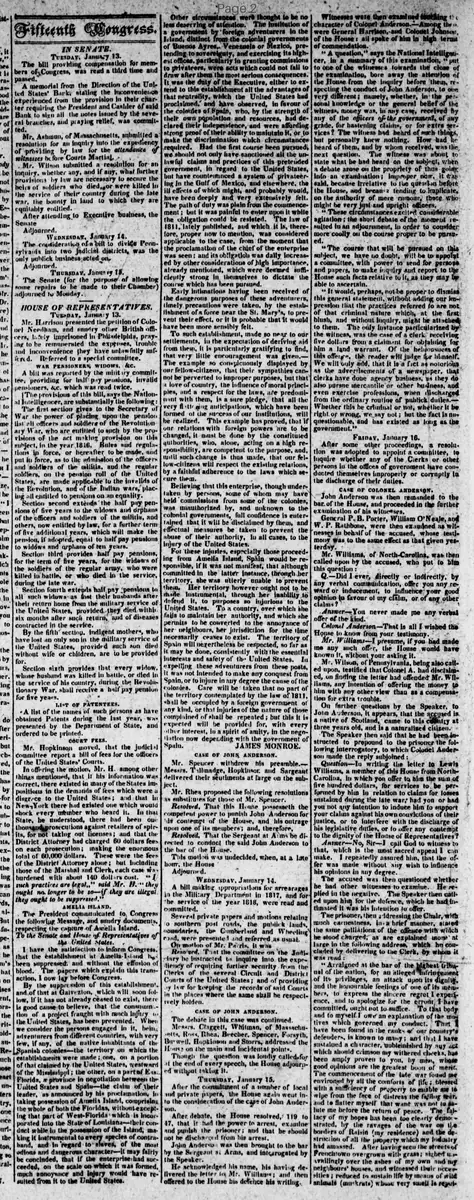
U.S. Congress proceedings Jan. 13-16, 1818: bills on member compensation, pensions for war widows/orphans, Pennsylvania judicial districts; discussion of court fees abuses; President's report on bloodless suppression of Amelia Island pirate base; trial of John Anderson for bribery attempt, ending in reprimand and release.
Merged-components note: Congressional proceedings, including the President's message on Amelia Island and the case of John Anderson, continued across pages; relabeled the story continuation to domestic_news.
Clippings
1 of 2
OCR Quality
Full Text
IN SENATE.
Tuesday, January 13.
The bill providing compensation for members of Congress, was read a third time and passed.
A memorial from the Direction of the United States' Bank, stating the inconvenience experienced from the provision in their charter requiring the President and Cashier of said Bank to sign all the notes issued by the several branches, and praying relief, was committed.
Mr. Ashmun, of Massachusetts, submitted a resolution for an inquiry into the expediency of providing by law for the attendance of witnesses before Courts Martial.
Mr. Wilson submitted a resolution for an inquiry whether any, and if any, what further provisions by law are necessary to secure the heirs of soldiers who died, or were killed in the service of their country during the late war, the bounty in land to which they are equitably entitled.
After attending to Executive business, the Senate adjourned.
Wednesday, January 14.
The consideration of a bill to divide Pennsylvania into two judicial districts was the only public business acted on.
Adjourned.
Thursday, January 15.
The Senate (for the purpose of allowing some repairs to be made to their Chamber) adjourned to Monday.
HOUSE OF REPRESENTATIVES.
Tuesday, January 13.
Mr. Harrison presented the petition of Colonel Needham, and sundry other British officers, lately imprisoned in Philadelphia, praying to be remunerated the expenses, trouble and inconvenience they have unlawfully suffered. Referred to a special committee.
WAR PENSIONERS, WIDOWS, &C.
A bill was reported by the military committee: providing for half pay pensions, invalid pensioners, &c. which was read twice.
[The provisions of this bill, says the National Intelligencer, are substantially the following:
The first section gives to the Secretary of War the power of placing, upon the pension list all officers and soldiers of the Revolutionary War, who are entitled to such by the provisions of the act making provision on this subject, in the year 1816. Rules and regulations in force, or hereafter to be made, and put in force, as to the admission of the officers and soldiers of the militia, and the regular soldiers, on the pension roll of the United States,' are made applicable to the invalids of the Revolution, and of the Indian wars, placing all entitled to pensions on an equality.
Section second extends the half pay pensions of five years to the widows and orphans of the officers and soldiers of the militia, and others, now entitled by law, for a further term of five additional years, which will make the pension, if adopted, equal to half pay pensions to widows and orphans of ten years.
Section third provides half pay pensions, for the term of five years, for the widows of the soldiers of the regular army, who were killed in battle, or who died in the service, during the late war.
Section fourth extends half pay pensions to all such widows as lost their husbands after their return home from the military service of the United States, provided they died within six months after such return, and of diseases contracted in the service.
By the fifth section, indigent mothers, who have lost an only son in the military service of the United States, provided such son died without wife or children, are to be provided for.
Section sixth provides that every widow, whose husband was killed in battle, or died in the service of his country, during the Revolutionary War, shall receive a half pay pension for five years.
LIST OF PATENTEES.
A list of the names of such persons as have obtained Patents during the last year, was presented by the Department of State, and ordered to be printed.
COURT FEES.
Mr. Hopkinson moved, that the judicial committee report a bill of fees for the officers of the United States' Courts.
In offering the motion, Mr. H. among other things mentioned, that if his information was correct, there existed in many of the States impositions in the demands of fees which were a disgrace to the United States; and that in New-York there had existed one which would shock every member who heard it. In that State, he understood, there had been one thousand prosecutions against retailers of spirits, for not taking out licenses; and that the District Attorney had charged 60 dollars fees on each prosecution; making the enormous total of 60,000 dollars. These were the fees of the District Attorney alone; but including those of the Marshal and Clerk, each case was burdened with about 140 dollars cost. "If such practices are legal," said Mr. H." they might no longer to be so—if they are illegal, they ought to be suppressed."
AMELIA ISLAND.
The President communicated to Congress the following Message, and sundry documents, respecting the capture of Amelia Island.
To the Senate and House of Representatives of the United States.
I have the satisfaction to inform Congress, that the establishment at Amelia Island has been suppressed, and without the effusion of blood. The papers which explain this transaction, I now lay before Congress.
By the suppression of this establishment, and of that at Galveston, which will soon follow, if it has not already ceased to exist, there is good cause to believe, that the consummation of a project fraught with much injury to the United States, has been prevented. When we consider the persons engaged in it, being adventurers from different countries, with very few, if any, of the native inhabitants of the Spanish colonies—the territory on which the establishments were made; one, on a portion of that claimed by the United States, westward of the Mississippi; the other, on a part of East Florida, a province in negotiation between the United States and Spain—the claim of their leader, as announced by his proclamation, in taking possession of Amelia Island, comprising the whole of both the Floridas, without exception that part of West-Florida which is incorporated into the State of Louisiana—their conduct while in the possession of the Island, making it instrumental to every species of contraband, and in regard to slaves, of the most odious and dangerous character—it may fairly be concluded, that if the enterprise had succeeded, on the scale on which it was formed, much annoyance and injury would have resulted from it to the United States.
Other circumstances, were thought to be no less deserving of attention. The institution of a government by foreign adventurers in the Island, distinct from the colonial governments of Buenos Ayres, Venezuela or Mexico, pretending to sovereignty, and exercising its highest offices, particularly in granting commissions to privateers, were acts which could not fail to draw after them the most serious consequences.
It was the duty of the Executive, either to extend to this establishment all the advantages of that neutrality, which the United States had proclaimed, and have observed, in favour of the colonies of Spain, who, by the strength of their own population and resources, had declared their independence, and were affording strong proof of their ability to maintain it, or to make the discrimination which circumstances required. Had the first course been pursued, we should not only have sanctioned all the unlawful claims and practices of this pretended government, in regard to the United States, but have countenanced a system of privateering in the Gulf of Mexico, and elsewhere, the ill effects of which might, and probably would, have been deeply and very extensively felt.
The path of duty was plain from the commencement; but it was painful to enter upon it while the obligation could be resisted. The law of 1811, lately published, and which it is, therefore, proper now to mention, was considered applicable to the case, from the moment that the proclamation of the chief of the enterprise was seen; and its obligation was daily increased by other considerations of high importance, already mentioned, which were deemed sufficiently strong in themselves to dictate the course which has been pursued.
Early intimations having been received of the dangerous purposes of these adventurers, timely precautions were taken, by the establishment of a force near the St. Mary's, to prevent their effect, or it is probable that it would have been more sensibly felt.
To such establishment, made so near to our settlements, in the expectation of deriving aid from them, it is particularly gratifying to find, that very little encouragement was given. The example so conspicuously displayed by our fellow-citizens, that their sympathies cannot be perverted to improper purposes, but that a love of country, the influence of moral principles, and a respect for the laws, are predominant with them, is a sure pledge, that all the very flattering anticipations, which have been formed of the success of our institutions, will be realized. This example has proved, that if our relations with foreign powers are to be changed, it must be done by the constituted authorities, who, alone, acting on a high responsibility, are competent to the purpose, and, until such change is thus made, that our fellow-citizens will respect the existing relations, by a faithful adherence to the laws which secure them.
Believing that this enterprise, though undertaken by persons, some of whom may have held commissions from some of the colonies, was unauthorized by, and unknown to the colonial governments, full confidence is entertained that it will be disclaimed by them, and effectual measures be taken to prevent the abuse of their authority, in all cases, to the injury of the United States.
For these injuries, especially those proceeding from Amelia Island, Spain would be responsible, if it was not manifest, that although committed in the latter instance, through her territory, she was utterly unable to prevent them. Her territory however ought not to be made instrumental, through her inability to defend it, to purposes so injurious to the United States. To a country, over which she fails to maintain her authority, and which she permits to be converted to the annoyance of her neighbours, her jurisdiction for the time necessarily ceases to exist. The territory of Spain will nevertheless be respected, so far as it may be done, consistently with the essential interests and safety of the United States. In expelling these adventurers from these posts, it was not intended to make any conquest from Spain, or to injure in any degree the cause of the colonies. Care will be taken that no part of the territory contemplated by the law of 1811, shall be occupied by a foreign government of any kind, or that injuries of the nature of those complained of shall be repeated; but this it is expected will be provided for, with every other interest, in a spirit of amity, in the negotiation now depending with the government of Spain.
JAMES MONROE.
CASE OF JOHN ANDERSON.
Mr. Spencer withdrew his preamble.
Messrs. Tallmadge, Hopkinson and Sargeant delivered their sentiments at large on the subject.
Mr. Rhea proposed the following resolutions as substitutes for those of Mr. Spencer.
Resolved, That this House possesseth the competent power to punish John Anderson for his contempt of the House, and his outrage upon one of its members; and, therefore,
Resolved, That the Sergeant at Arms be directed to conduct the said John Anderson to the bar of the House.
This motion was undecided, when, at a late hour, the House adjourned.
Wednesday, January 14.
A bill making appropriations for arrearages in the Military Department in 1817, and for the service of the year 1818, were read and committed.
Several private papers and motions relating to southern post roads, the public lands, boundaries, the Cumberland and Wheeling road, were presented and referred as usual.
On motion of Mr. Parris, it was
Resolved, That the committee on the Judiciary be instructed to inquire into the expediency of requiring further security from the Clerks of the several Circuit and District Courts of the United States; and of providing by law for keeping the records of said Courts in the places where the same shall be respectively holden.
CASE OF JOHN ANDERSON.
The debate in this case was continued.
Messrs. Craggett, Whitman, of Massachusetts, Ross, Rhea, Beecher, Spencer, Forsyth, Burwell, Hopkinson and Storrs, addressed the House on the main and incidental points.
Though the question was loudly called for at the end of every speech, the House adjourned without taking it.
Thursday, January 15.
After the commitment of a number of local and private papers, the House again went into the consideration of the case of John Anderson.
After debate, the House resolved, 119 to 47, that it had the power to arrest, examine and punish the prisoner; and that he should not be discharged from his arrest.
John Anderson was then brought to the bar by the Sergeant at Arms, and interrogated by the Speaker.
He acknowledged his name, his having delivered the letter to Mr. Williams; and then offered to the House his defence in writing.
Witnesses were then examined in relation to the character of Colonel Anderson. Among the witnesses were General Harrison, and Colonel Johnson of the House: all spoke of him in high terms of commendation.
"A question," says the National Intelligencer, in a summary of this examination, "put to one of the witnesses towards the close of the examination, bore away the attention of the House from the inquiry before them, respecting the conduct of John Anderson, to one very different; namely, whether, in the personal knowledge or the general belief of the witness, money was, in any case, received by any of the officers of the government, of any grade, for hastening claims, or for extra services? The witness had heard of such things, but personally knew nothing. How had he heard of them, and by whom received, was the next question. The witness was about to state what he had heard on the subject, when a debate arose on the propriety of thus going into an examination; improper now, it was said, because irrelevant to the question before the House, and because tending to implicate, on the authority of mere rumour, those who might be very just and upright officers.
"These circumstances excited considerable agitation; the short debate of the moment resulted in an adjournment, in order to consider more coolly on the course proper to be pursued.
"The course that will be pursued on this subject, we have no doubt, will be to appoint a committee, with power to send for persons and papers, to make inquiry and report to the House such facts relative to it, as they may be able to ascertain.
"It would, perhaps, not be proper to dismiss this general statement, without adding our impression that the practices referred to are not of that criminal nature which, at the first blush, and without inquiry, might be attached to them. The only instance particularized by the witness, was the case of a clerk receiving five dollars from a claimant for obtaining or him a land warrant. Of the heinousness of this offence, the reader will judge for himself. We will only add, that it is a fact as notorious as the advertisements of a newspaper, that clerks have done agency business, as they do also pursue mercantile or other business, and even exercise professions, when discharged from the ordinary routine of public duties. Whether this be criminal or not, whether it be right or wrong, we say not; but the fact is unquestionable, and has existed as long as the government."
Friday, January 16.
After some other proceedings, a resolution was adopted to appoint a committee, to inquire whether any of the Clerks or other persons in the offices of government have conducted themselves improperly or corruptly in the discharge of their duties.
CASE OF COLONEL ANDERSON.
"John Anderson was then remanded to the bar of the House, and proceeded in the further examination of his witnesses.
General P. B. Porter, William O'Neale, and W. P. Rathbone, were then examined as witnesses in behalf of the accused, whose testimony was to the same effect as that given yesterday.
Mr. Williams, of North-Carolina, was then called upon by the accused, who put to him this question:
Q.—Did I ever, directly or indirectly, by any verbal communication, offer you any reward or inducement, to influence your good opinion in favour of my claim, or of any other claims?
Answer—You never made me any verbal offer of the kind.
Colonel Anderson—That is all I wished the House to know from your testimony.
Mr. Williams—I presume, if you had made me any such offer, the House would have known it, without your asking it.
Mr. Wilson, of Pennsylvania, being also called upon, testified that Colonel A. had disclaimed, on finding the letter had offended Mr. Williams, any intention of offering the money to him with any other view than as a compensation for extra trouble.
On further questions by the Speaker, to John Anderson, it appears, that the accused is a native of Scotland, came to this country at three years old, and is a naturalized citizen.
The Speaker then said that he had been instructed to propound to the prisoner the following interrogatory, to which Colonel Anderson made the reply subjoined:
Question—In writing the letter to Lewis Williams, a member of this House from North-Carolina, in which you offer to him the sum of five hundred dollars, for services to be performed by him in relation to claims or losses sustained during the late war; had you or had you not any intention to induce him to support your claims against his own convictions of their justice, or to interfere with the discharge of his legislative duties, or to offer any contempt to the dignity of the House of Representatives?
Answer—No, Sir—I call God to witness to that, which is the most sacred appeal I can make. I repeatedly assured him, that the offer was made without any wish to influence his opinions in any degree.
The accused was then questioned whether he had other witnesses to examine. He replied in the negative. The Speaker then called upon him for the defence, which he had intimated it was his intention to offer.
The prisoner, then addressing the Chair, with much earnestness, in a brief manner, stated the same palliations of the offence with which he stood charged; as are explained at large in the following address, which, he concluded by delivering to the Clerk, by whom it was read:
"Arraigned at the bar of the highest tribunal of the nation, for an alleged infringement of its privileges, an attack upon its dignity and the honourable feelings of one of its members, to express the sincere regret I experience, and to apologize for the error, I have committed, ought not to suffice. To that body and to myself I owe an explanation of the motives which governed my conduct. That I have been found in the ranks of our country's defenders, is known to many; and that I have sustained a character, unblemished by any act which should crimson my withered cheeks, has been amply proven to you, by men, whose good opinions are the greatest boon of merit.
The commencement of the late war found me environed by all the comforts of life: blessed with a sufficiency of property to enable me to wipe from the face of distress the afflicting tear, and to flatter myself that want was not to palliate me before the return of peace. The fallacy of my hopes has been too clearly demonstrated, by the ravages of the war on the borders of Raisin (my residence) and the destruction of all the property which my industry had amassed. After having seen the effects of Frenchtown overgrown with grass; sighed availing over the ashes of my own and my neighbours' houses, and witnessed their necessities; reduced to sustain life by means of wild animals (muskrats) whose very smell is repugnant dire to the stomach; I gladly hailed the beneficence of my government in the enactment of the law, usually called the property act; and, in mouth of January, 1817, I took leave of friends and fellow-sufferers, and repaired to Washington to manage their claims. On my arrival, found that the act under which they expected relief had been suspended, and I was forced to return with this unwelcome information. Tears of disappointment suffused the countenances of every one—my heart sympathized with theirs, and I then determined to prosecute their claims to a result. With this view, I had been in this city more than a month. Over anxious to accomplish my object, exalted with the success which had attended some of the claims, and convinced that the committee chairman was overwhelmed with business, my inexperience in reference to legislative proceedings induced me to suppose that, to insure despatch, I might, without impropriety, approach the chairman of that committee, with a proposal to compensate him for extra trouble. That I have erred, grossly erred, I am convinced; and my only consolation is, that error is no crime, when it is of the head, not of the heart. Had I acted with less precipitation, and consulted the views of others, I should not at this time find myself in the disagreeable dilemma that I am. I should have acted more consistent with myself. Whatever semblance my request of secrecy may assume, I can with truth aver, that its basis in my mind was a desire that those for whom I act should have to acknowledge their increased gratitude for the promptitude with which their claims should have been acted upon.
It cannot be denied, that after being assured that my own claims would be allowed, I had less cause to think of obtaining, by corruption, the payment of claims which I almost knew the justice of Congress could not refuse in the sequel. Despatch, then, was all I wished for, all I could gain; and I think that the world and this honourable body, will admit that the benefit of the relief would be in proportion to the time which should elapse in affording it; at least, that in this view it would be appreciated by those who have yet fresh in their recollection that a husband, a wife, a father, a child, a brother, or sister, was tomahawked, shot or burnt alive by the savage enemy, their heart inhumanly torn from their bodies, and whilst yet smoking with the vital heat, were triumphantly exhibited to their weeping eyes.
Let it be recollected that they have witnessed, whilst wandering without shelter, and almost unclothed, the heart-rending scene, dead bodies exposed to the voracious appetites of the swine, and these animals eagerly contending for a leg or an arm. Lest this picture may be supposed to be exaggerated, I annex the correspondence which took place between the Hon. A. B. Woodward, and General Proctor, in the year 1813, and shortly after the event occurred. Let it be known that most, if not all, the articles they could collect from the ruins of houses were generously, most generously, appropriated in the purchase of prisoners of war, for the purpose of screening them from the bloody tomahawk; that these purchases were made under such circumstances as not to entitle them to reimbursement under the 'Act relating to the ransom of American captives of the late war;' and let it also be known that such are the sufferers, such the merits of the claimants I represent—and I feel confident that the clouds of indignation which, for a moment, threatened to burst over my frosty head, will be dispelled by the benign influence of philanthropy—an influence which has ever, and I trust ever will, characterize my conduct.
That I should be anxious to afford a prompt solace to the sufferings of my fellow-citizens, will not be wondered at, when it is known that they extended every kindness and protection to my family (from whom I was separated during most of the war) and at a time when the Indians were accustomed to dance before the door of my house; calling upon my wife to come out and select her husband's scalp. Relying upon the maxim, that 'to err is human, to forgive divine,' I throw myself upon the indulgence of this honourable body, and the magnanimity of the honourable gentleman whose feelings I have had the misfortune to wound. If my services form no claim to indulgence, perhaps my sufferings and those of my family may. I stand here prepared to meet all the consequences of an error committed without any sinister intention.
In conclusion, I must be permitted to remark that, during a confinement, from which I have forborne to adopt any legal measures to extricate myself, the only feelings of pain which have had access to my breast, were those produced by the knowledge that an opinion was prevalent that, presuming on the misfortunes of my fellow-sufferers, I had bought up their claims at a very reduced price. If this honourable body would permit, I would, under the solemnity of an oath, call upon God to bear testimony that this opinion is without basis.
JOHN ANDERSON.
January, 1818.
The prisoner, being asked if he had anything further to say, and answering in the negative, was taken from the bar: and the House proceeded to deliberate on the course now proper to be pursued.
Mr. Forsyth offered for consideration a motion in substance like that which was ultimately adopted, but which proposed Wednesday next, as the day on which John Anderson should be brought to the bar.
A variety of propositions, suggestions, and remarks, were made on this occasion, which it would be difficult, if it were important, accurately to report.
The will of the House was ultimately consummated, by the passage of a resolution in the following words:
Resolved, That John Anderson has been guilty of a contempt and a violation of the privileges of the House, and that he be brought to the bar of the House this day, and be there reprimanded by the Speaker for the outrage he has committed, and then discharged from the custody of the Sergeant at Arms.
Whereupon John Anderson was brought to the bar of the House, and addressed by the Speaker as follows:
John Anderson: You have been brought before this House upon a charge of having committed a breach of its privileges in attempting to bribe one of its members filling a high and responsible situation. The House has patiently heard you in your defence; and in proportion to the pleasure which it has derived from the concurrent testimonies in support of your character and good conduct heretofore, is its deep regret that you have deliberately attempted to commit a crime so entirely incompatible with the high standing you have heretofore maintained. You have the less apology for the attempt which you made, because yourself experienced the justice of this House but a few days before, by the passage of two bills in your favour, founded on petitions presented to the House. Your attempt to corrupt the fountain of legislation, to undermine the integrity of branch of the National Legislature, is a crime of so deep a dye that even you must acknowledge and be sensible of it. And if, John Anderson, you could have been successful in such an attempt; if it were possible that Representatives of the people could have been found, so lost to their duty as to accept your offer, you must yourself see the dreadful consequence of such a deplorable state of things. In your turn you might fall a victim: for your rights, liberty and your property, might in the end equally suffer with those of others. The House has seen with pleasure, that, at a very early period after making your base offer, you disclaimed, with symptoms of apparent repentance and contrition, any intention to corrupt the integrity of a member; and in directing me to pronounce your discharge, the House indulges the hope, that, on your return home, you will be more fully convinced of the magnitude of your offence, and by the future tenor of your life endeavour to obliterate, as far as it may be possible, the stain your conduct on this occasion has impressed on the high and honourable character you appear to have previously sustained. You are discharged from the custody of the Sergeant at Arms.
Whereupon John Anderson was discharged from custody:
And the House adjourned to Monday.
What sub-type of article is it?
What keywords are associated?
What entities or persons were involved?
Where did it happen?
Domestic News Details
Primary Location
Washington
Event Date
January 13 16, 1818
Key Persons
Outcome
john anderson reprimanded by speaker and discharged from custody; various bills read, committed, or passed including compensation for congress members, war pensions for widows and orphans, judicial districts for pennsylvania; president's message on suppression of amelia island establishment without bloodshed.
Event Details
Proceedings of the Fifteenth Congress in Senate and House of Representatives from January 13 to 16, 1818, including passage of bill for congressional compensation, memorials on bank charter and witnesses for courts martial, resolutions on soldiers' heirs bounties, division of Pennsylvania into judicial districts, petitions from British officers, war pension bill for Revolutionary War invalids, widows, orphans, and mothers, list of patentees, motion on court fees highlighting impositions, President's message detailing suppression of Amelia Island establishment by adventurers and its implications for U.S. neutrality and relations with Spain, and extended debate and examination in the case of John Anderson accused of attempting to bribe Representative Lewis Williams with $500 for expediting war claims, culminating in resolution finding him in contempt, reprimand, and discharge.