Thank you for visiting SNEWPapers!
Sign up free
Editorial
January 14, 1796
Gazette Of The United States
Philadelphia, Philadelphia County, Pennsylvania
What is this article about?
The Lay Preacher critiques superstition in American life, exemplified in farming traditions, outdated medical practices, fashionable dress, women's prudishness, and political ingratitude toward President Washington and the government.
Clipping
OCR Quality
95%
Excellent
Full Text
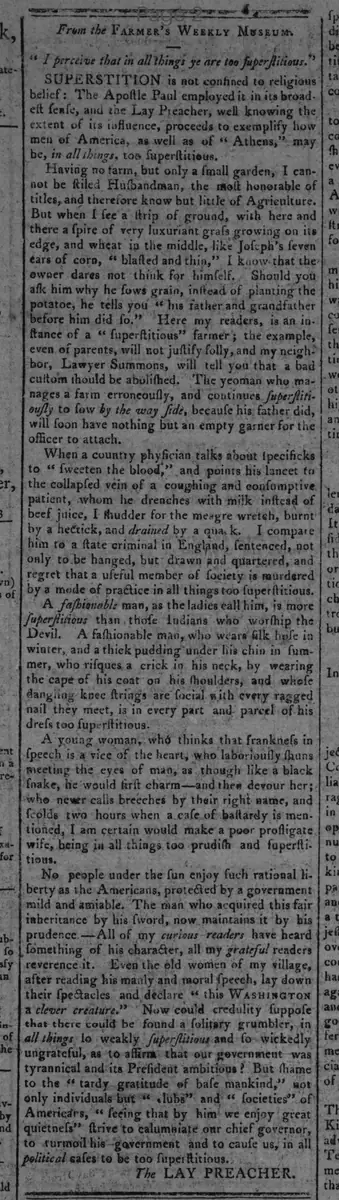
From the Farmer's Weekly Museum
I perceive that in all things we are too superstitious.
SUPERSTITION is not confined to religious belief: The Apostle Paul employed it in its broadest sense, and the Lay Preacher, well knowing the extent of its influence, proceeds to exemplify how men of America, as well as of "Athens," may be, in all things, too superstitious.
Having no farm, but only a small garden, I cannot be styled Husbandman, the most honorable of titles, and therefore know but little of Agriculture. But when I see a strip of ground, with here and there a spire of very luxuriant grass growing on its edge, and wheat in the middle, like Joseph's seven ears of corn, "blasted and thin," I know that the owner dares not think for himself. Should you ask him why he sows grain, instead of planting the potatoe, he tells you "his father and grandfather before him did so." Here, my readers, is an instance of a "superstitious" farmer; the example even of parents, will not justify folly, and my neighbor, Lawyer Summons, will tell you that a bad custom should be abolished. The yeoman who manages a farm erroneously, and continues superstitiously to sow by the way side, because his father did, will soon have nothing but an empty garner for the officer to attach.
When a country physician talks about specifics to "sweeten the blood," and points his lancet to the collapsed vein of a coughing and consumptive patient, whom he drenches with milk instead of beef juice, I shudder for the meagre wretch, burnt by a hectick, and drained by a quack. I compare him to a state criminal in England, sentenced, not only to be hanged, but—drawn and quartered, and regret that a useful member of society is murdered by a mode of practice in all things too superstitious.
A fashionable man, as the ladies call him, is more superstitious than those Indians who worship the Devil. A fashionable man, who wears silk hose in winter, and a thick pudding under his chin in summer, who risks a crick in his neck, by wearing the cape of his coat on his shoulders, and whose dangling knee strings are social with every ragged nail they meet, is in every part and parcel of his dress too superstitious.
A young woman, who thinks that frankness in speech is a vice of the heart, who laboriously shuns meeting the eyes of man, as though like a black snake, he would first charm—and then devour her; who never calls breeches by their right name, and holds her breath two hours when a case of bastardy is mentioned, I am certain would make a poor profligate wife, being in all things too prudish and superstitious.
No people under the sun enjoy such rational liberty as the Americans, protected by a government mild and amiable. The man who acquired this fair inheritance by his sword, now maintains it by his prudence. All of my curious readers have heard something of his character, all my grateful readers reverence it. Even the old women of my village, after reading his manly and moral speech, lay down their spectacles and declare "this Washington is a clever creature." Now could credulity suppose that there could be found a solitary grumbler, in all things so weakly superstitious and so wickedly ungrateful, as to affirm that our government was tyrannical and its President ambitious? But shame to the "tardy gratitude of base mankind," not only individuals but "clubs" and "societies" of Americans, "seeing that by him we enjoy great quietness" strive to calumniate our chief governor, to turmoil his government and to cause us, in all political senses to be too superstitious.
The LAY PREACHER.
I perceive that in all things we are too superstitious.
SUPERSTITION is not confined to religious belief: The Apostle Paul employed it in its broadest sense, and the Lay Preacher, well knowing the extent of its influence, proceeds to exemplify how men of America, as well as of "Athens," may be, in all things, too superstitious.
Having no farm, but only a small garden, I cannot be styled Husbandman, the most honorable of titles, and therefore know but little of Agriculture. But when I see a strip of ground, with here and there a spire of very luxuriant grass growing on its edge, and wheat in the middle, like Joseph's seven ears of corn, "blasted and thin," I know that the owner dares not think for himself. Should you ask him why he sows grain, instead of planting the potatoe, he tells you "his father and grandfather before him did so." Here, my readers, is an instance of a "superstitious" farmer; the example even of parents, will not justify folly, and my neighbor, Lawyer Summons, will tell you that a bad custom should be abolished. The yeoman who manages a farm erroneously, and continues superstitiously to sow by the way side, because his father did, will soon have nothing but an empty garner for the officer to attach.
When a country physician talks about specifics to "sweeten the blood," and points his lancet to the collapsed vein of a coughing and consumptive patient, whom he drenches with milk instead of beef juice, I shudder for the meagre wretch, burnt by a hectick, and drained by a quack. I compare him to a state criminal in England, sentenced, not only to be hanged, but—drawn and quartered, and regret that a useful member of society is murdered by a mode of practice in all things too superstitious.
A fashionable man, as the ladies call him, is more superstitious than those Indians who worship the Devil. A fashionable man, who wears silk hose in winter, and a thick pudding under his chin in summer, who risks a crick in his neck, by wearing the cape of his coat on his shoulders, and whose dangling knee strings are social with every ragged nail they meet, is in every part and parcel of his dress too superstitious.
A young woman, who thinks that frankness in speech is a vice of the heart, who laboriously shuns meeting the eyes of man, as though like a black snake, he would first charm—and then devour her; who never calls breeches by their right name, and holds her breath two hours when a case of bastardy is mentioned, I am certain would make a poor profligate wife, being in all things too prudish and superstitious.
No people under the sun enjoy such rational liberty as the Americans, protected by a government mild and amiable. The man who acquired this fair inheritance by his sword, now maintains it by his prudence. All of my curious readers have heard something of his character, all my grateful readers reverence it. Even the old women of my village, after reading his manly and moral speech, lay down their spectacles and declare "this Washington is a clever creature." Now could credulity suppose that there could be found a solitary grumbler, in all things so weakly superstitious and so wickedly ungrateful, as to affirm that our government was tyrannical and its President ambitious? But shame to the "tardy gratitude of base mankind," not only individuals but "clubs" and "societies" of Americans, "seeing that by him we enjoy great quietness" strive to calumniate our chief governor, to turmoil his government and to cause us, in all political senses to be too superstitious.
The LAY PREACHER.
What sub-type of article is it?
Moral Or Religious
Social Reform
Partisan Politics
What keywords are associated?
Superstition
Farming Practices
Medical Quackery
Fashion Absurdities
Women's Prudishness
Political Ingratitude
Washington Praise
What entities or persons were involved?
Lay Preacher
Washington
Apostle Paul
Lawyer Summons
Editorial Details
Primary Topic
Critique Of Superstition In American Society
Stance / Tone
Moral Exhortation Against Superstition And Ingratitude
Key Figures
Lay Preacher
Washington
Apostle Paul
Lawyer Summons
Key Arguments
Superstition Extends Beyond Religion To Daily Practices
Farmers Cling To Outdated Traditions Like Poor Crop Choices
Country Physicians Use Harmful, Superstitious Medical Methods
Fashionable Men Follow Absurd Dress Customs
Young Women Exhibit Excessive Prudishness In Behavior
Americans Ungratefully Criticize A Benevolent Government And President Washington