Thank you for visiting SNEWPapers!
Sign up free
Literary
January 27, 1776
The Virginia Gazette
Richmond, Williamsburg, Richmond County, Virginia
What is this article about?
An essay from the Virginia Gazette detailing the process of making bay salt in coastal marshes using sea water, sun, and wind. It describes preparation, crystallization, refinement, and suitability for York County's marshy grounds, urging local industry. Signed PLUS ULTRA, Poquoson, January 18, 1776.
Merged-components note: Merged image with the literary essay due to spatial overlap in bounding boxes and sequential reading order; the image likely illustrates the article on making bay salt.
Clipping
OCR Quality
85%
Good
Full Text
For the VIRGINIA GAZETTE.
THE MAKING of BAY SALT.
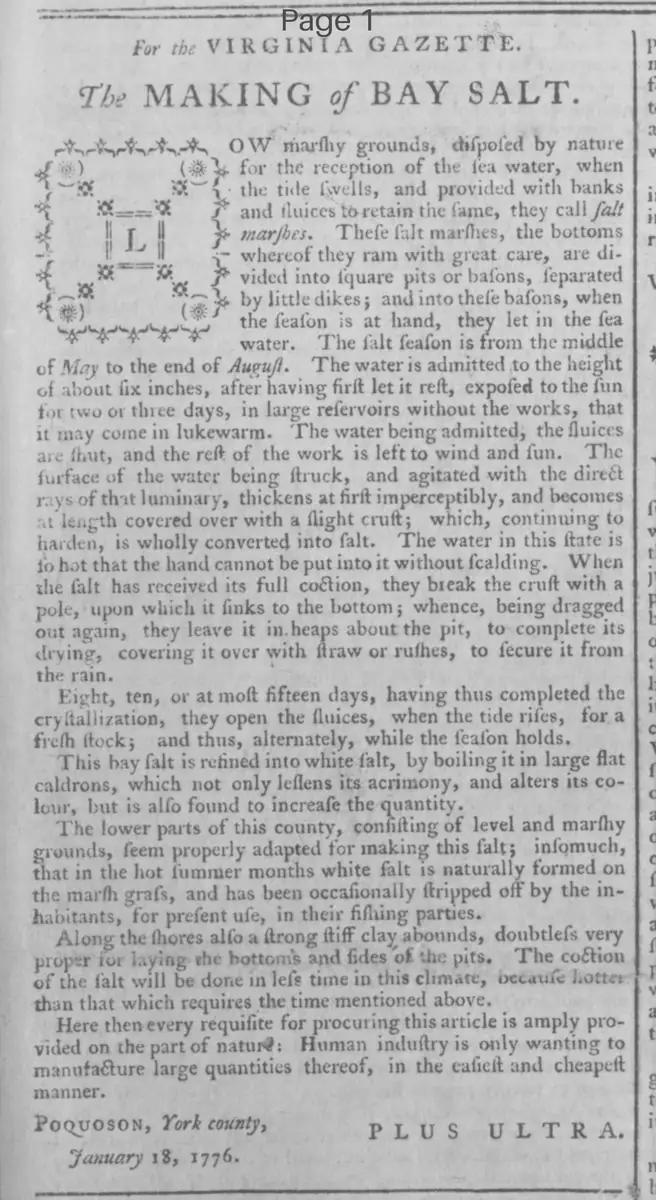
On marshy grounds, disposed by nature for the reception of the sea water, when the tide swells, and provided with banks and sluices to retain the same, they call salt marshes. These salt marshes, the bottoms whereof they ram with great care, are divided into square pits or basins, separated by little dikes; and into these basins, when the season is at hand, they let in the sea water. The salt season is from the middle of May to the end of August. The water is admitted to the height of about six inches, after having first let it rest, exposed to the sun for two or three days, in large reservoirs without the works, that it may come in lukewarm. The water being admitted, the sluices are shut, and the rest of the work is left to wind and sun. The surface of the water being struck, and agitated with the direct rays of this luminary, thickens at first imperceptibly, and becomes at length covered over with a slight crust; which, continuing to harden, is wholly converted into salt. The water in this state is so hot that the hand cannot be put into it without scalding. When the salt has received its full coction, they break the crust with a pole, upon which it sinks to the bottom; whence, being dragged out again, they leave it in heaps about the pit, to complete its drying, covering it over with straw or rushes, to secure it from the rain.
Eight, ten, or at most fifteen days, having thus completed the crystallization, they open the sluices, when the tide rises, for a fresh stock; and thus, alternately, while the season holds.
This bay salt is refined into white salt, by boiling it in large flat caldrons, which not only lessens its acrimony, and alters its colour, but is also found to increase the quantity.
The lower parts of this county, consisting of level and marshy grounds, seem properly adapted for making this salt; insomuch, that in the hot summer months white salt is naturally formed on the marsh grass, and has been occasionally stripped off by the inhabitants, for present use, in their fishing parties.
Along the shores also a strong stiff clay abounds, doubtless very proper for laying the bottoms and sides of the pits. The coction of the salt will be done in less time in this climate, because hotter than that which requires the time mentioned above.
Here then every requisite for procuring this article is amply provided on the part of nature: Human industry is only wanting to manufacture large quantities thereof, in the easiest and cheapest manner.
Poquoson, York county,
PLUS ULTRA.
January 18, 1776.
THE MAKING of BAY SALT.
On marshy grounds, disposed by nature for the reception of the sea water, when the tide swells, and provided with banks and sluices to retain the same, they call salt marshes. These salt marshes, the bottoms whereof they ram with great care, are divided into square pits or basins, separated by little dikes; and into these basins, when the season is at hand, they let in the sea water. The salt season is from the middle of May to the end of August. The water is admitted to the height of about six inches, after having first let it rest, exposed to the sun for two or three days, in large reservoirs without the works, that it may come in lukewarm. The water being admitted, the sluices are shut, and the rest of the work is left to wind and sun. The surface of the water being struck, and agitated with the direct rays of this luminary, thickens at first imperceptibly, and becomes at length covered over with a slight crust; which, continuing to harden, is wholly converted into salt. The water in this state is so hot that the hand cannot be put into it without scalding. When the salt has received its full coction, they break the crust with a pole, upon which it sinks to the bottom; whence, being dragged out again, they leave it in heaps about the pit, to complete its drying, covering it over with straw or rushes, to secure it from the rain.
Eight, ten, or at most fifteen days, having thus completed the crystallization, they open the sluices, when the tide rises, for a fresh stock; and thus, alternately, while the season holds.
This bay salt is refined into white salt, by boiling it in large flat caldrons, which not only lessens its acrimony, and alters its colour, but is also found to increase the quantity.
The lower parts of this county, consisting of level and marshy grounds, seem properly adapted for making this salt; insomuch, that in the hot summer months white salt is naturally formed on the marsh grass, and has been occasionally stripped off by the inhabitants, for present use, in their fishing parties.
Along the shores also a strong stiff clay abounds, doubtless very proper for laying the bottoms and sides of the pits. The coction of the salt will be done in less time in this climate, because hotter than that which requires the time mentioned above.
Here then every requisite for procuring this article is amply provided on the part of nature: Human industry is only wanting to manufacture large quantities thereof, in the easiest and cheapest manner.
Poquoson, York county,
PLUS ULTRA.
January 18, 1776.
What sub-type of article is it?
Essay
What themes does it cover?
Commerce Trade
Nature
What keywords are associated?
Bay Salt
Salt Marshes
Sea Water
Crystallization
Virginia
York County
Industry
What entities or persons were involved?
Plus Ultra
Literary Details
Title
The Making Of Bay Salt.
Author
Plus Ultra
Subject
On Making Bay Salt In Virginia
Key Lines
The Salt Season Is From The Middle Of May To The End Of August.
The Water In This State Is So Hot That The Hand Cannot Be Put Into It Without Scalding.
Here Then Every Requisite For Procuring This Article Is Amply Provided On The Part Of Nature: Human Industry Is Only Wanting To Manufacture Large Quantities Thereof, In The Easiest And Cheapest Manner.