Thank you for visiting SNEWPapers!
Sign up free
Editorial
August 31, 1801
The National Intelligencer And Washington Advertiser
Washington, District Of Columbia
What is this article about?
Editorial from London Oracle discusses hopeful signs for peace between Britain and France after nine years of war, but warns of obstacles from Bonaparte's expansionist ambitions in Italy, Spain, Germany, and Turkey, potentially leading to future conflicts.
Clipping
OCR Quality
95%
Excellent
Full Text
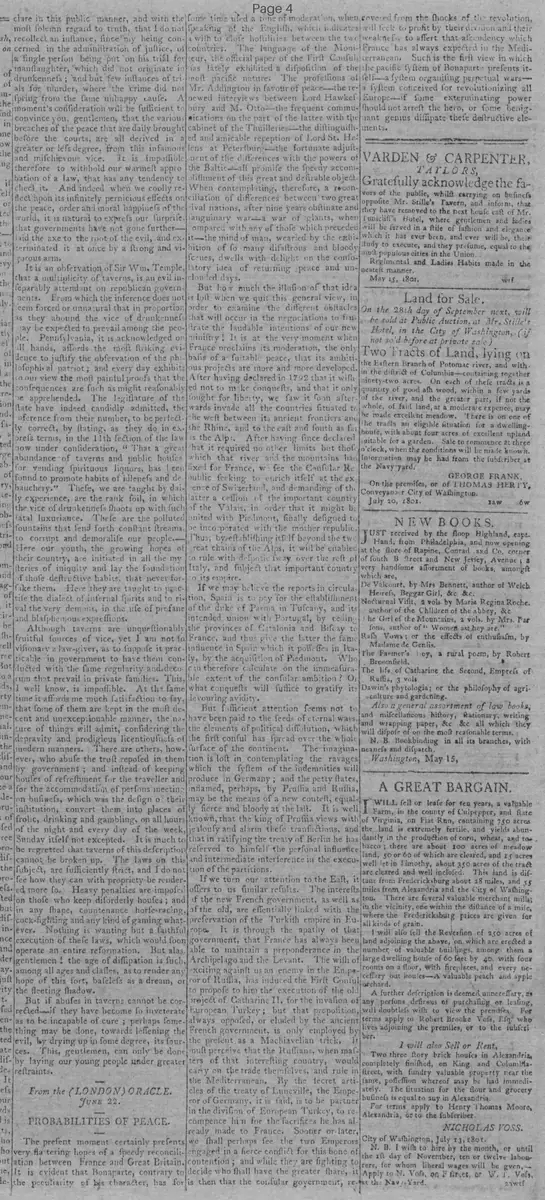
From the (LONDON) ORACLE.
JUNE 22.
PROBABILITIES OF PEACE.
The present moment certainly presents very flattering hopes of a speedy reconciliation between France and Great Britain. It is evident that Bonaparte, contrary to the peculiarity of his character, has for some time used a tone of moderation, when speaking of the English, which indicates a wish to close hostilities between the two countries. The language of the Moniteur, the official paper of the First Consul, has lately exhibited a disposition of the most pacific nature. The professions of Mr. Addington in favour of peace—the renewed interviews between Lord Hawkesbury and M. Otto—the frequent communications on the part of the latter with the cabinet of the Thuilleries—the distinguished and amicable reception of Lord St. Helens at Petersburgh—the fortunate adjustment of the differences with the powers of the Baltic—all promise the speedy accomplishment of this great and desirable object.
When contemplating, therefore, a reconciliation of differences between two great rival nations, after nine years obstinate and sanguinary war—a war of giants, when compared with any of those which preceded it—the mind of man, wearied by the exhibition of so many disastrous and bloody scenes, dwells with delight on the consolatory idea of returning peace and unclouded days.
But how much the illusion of that idea is lost when we quit this general view, in order to examine the different obstacles that will occur in the negotiations to frustrate the laudable intentions of our new ministry! It is at the very moment when France proclaims its moderation, the only basis of a suitable peace, that its ambitious projects are more and more developed. After having declared in 1792 that it wished not to make conquests, and that it only sought for liberty, we saw it soon afterwards invade all the countries situated to the west between its ancient frontiers and the Rhine, and to the east and south as far as the Alps. After having since declared that it required no other limits but those which that river and the mountains had fixed for France, we see the Consular Republic seeking to enrich itself at the expense of Switzerland, and demanding of the latter a cession of the important country of the Valais, in order that it might be united with Piedmont, finally designed to be incorporated with the mother republic. Thus, by establishing itself beyond the two great chains of the Alps, it will be enabled to rule with despotic sway over the rest of Italy, and subject that important country to its empire.
If we may believe the reports in circulation, Spain is to pay for the establishment of the duke of Parma in Tuscany, and its intended union with Portugal, by ceding the provinces of Catalonia and Biscay to France, and thus give the latter the same influence in Spain which it possesses in Italy, by the acquisition of Piedmont. Who can therefore calculate on the immeasurable extent of the consular ambition? Of what conquests will suffice to gratify its devouring avidity.
But sufficient attention seems not to have been paid to the seeds of eternal wars, the elements of political dissolution, which the first consul has spread over the whole surface of the continent. The imagination is lost in contemplating the ravages which the system of the indemnities will produce in Germany; and the petty states, inflamed, perhaps, by Prussia and Russia, may be the means of a new contest, equally fierce and bloody as the last. It is well known, that the king of Prussia views with jealousy and alarm these transactions, and that in ratifying the treaty of Berlin he has reserved to himself the personal influence and intermediate interference in the execution of the partitions.
If we turn our attention to the East, it offers to us similar results. The interests of the new French government, as well as of the old, are essentially linked with the preservation of the Turkish empire in Europe. It is through the apathy of that government, that France has always been able to maintain a preponderance in the Archipelago and the Levant. The wish of exciting against us an enemy in the Emperor of Russia, has induced the First Consul to propose to him the execution of the old project of Catharine II. for the invasion of European Turkey; but that proposition, always opposed, or eluded by the ancient French government, is only employed by the present as a Machiavellian trick. It must perceive that the Russians, when masters of that interesting country, would carry on the trade themselves, and rule in the Mediterranean. By the secret articles of the treaty of Luneville, the Emperor of Germany, it is said, is to be partner in the division of European Turkey, to recompense him for the sacrifices he has already made to France. Sooner or later, we shall perhaps see the two Emperors engaged in a fierce conflict for this bone of contention; and while they are fighting to decide who shall have the greater share, it is then that the consular government, recovered from the shocks of the revolution, will seek to profit by their division and their weakness, to assert that ascendency which France has always expected in the Mediterranean. Such is the first view in which the pacific system of Bonaparte presents itself—a system organizing perpetual wars—a system conceived for revolutionizing all Europe—if some exterminating power should not arrest the hero, or some benignant genius dissipate these destructive elements.
JUNE 22.
PROBABILITIES OF PEACE.
The present moment certainly presents very flattering hopes of a speedy reconciliation between France and Great Britain. It is evident that Bonaparte, contrary to the peculiarity of his character, has for some time used a tone of moderation, when speaking of the English, which indicates a wish to close hostilities between the two countries. The language of the Moniteur, the official paper of the First Consul, has lately exhibited a disposition of the most pacific nature. The professions of Mr. Addington in favour of peace—the renewed interviews between Lord Hawkesbury and M. Otto—the frequent communications on the part of the latter with the cabinet of the Thuilleries—the distinguished and amicable reception of Lord St. Helens at Petersburgh—the fortunate adjustment of the differences with the powers of the Baltic—all promise the speedy accomplishment of this great and desirable object.
When contemplating, therefore, a reconciliation of differences between two great rival nations, after nine years obstinate and sanguinary war—a war of giants, when compared with any of those which preceded it—the mind of man, wearied by the exhibition of so many disastrous and bloody scenes, dwells with delight on the consolatory idea of returning peace and unclouded days.
But how much the illusion of that idea is lost when we quit this general view, in order to examine the different obstacles that will occur in the negotiations to frustrate the laudable intentions of our new ministry! It is at the very moment when France proclaims its moderation, the only basis of a suitable peace, that its ambitious projects are more and more developed. After having declared in 1792 that it wished not to make conquests, and that it only sought for liberty, we saw it soon afterwards invade all the countries situated to the west between its ancient frontiers and the Rhine, and to the east and south as far as the Alps. After having since declared that it required no other limits but those which that river and the mountains had fixed for France, we see the Consular Republic seeking to enrich itself at the expense of Switzerland, and demanding of the latter a cession of the important country of the Valais, in order that it might be united with Piedmont, finally designed to be incorporated with the mother republic. Thus, by establishing itself beyond the two great chains of the Alps, it will be enabled to rule with despotic sway over the rest of Italy, and subject that important country to its empire.
If we may believe the reports in circulation, Spain is to pay for the establishment of the duke of Parma in Tuscany, and its intended union with Portugal, by ceding the provinces of Catalonia and Biscay to France, and thus give the latter the same influence in Spain which it possesses in Italy, by the acquisition of Piedmont. Who can therefore calculate on the immeasurable extent of the consular ambition? Of what conquests will suffice to gratify its devouring avidity.
But sufficient attention seems not to have been paid to the seeds of eternal wars, the elements of political dissolution, which the first consul has spread over the whole surface of the continent. The imagination is lost in contemplating the ravages which the system of the indemnities will produce in Germany; and the petty states, inflamed, perhaps, by Prussia and Russia, may be the means of a new contest, equally fierce and bloody as the last. It is well known, that the king of Prussia views with jealousy and alarm these transactions, and that in ratifying the treaty of Berlin he has reserved to himself the personal influence and intermediate interference in the execution of the partitions.
If we turn our attention to the East, it offers to us similar results. The interests of the new French government, as well as of the old, are essentially linked with the preservation of the Turkish empire in Europe. It is through the apathy of that government, that France has always been able to maintain a preponderance in the Archipelago and the Levant. The wish of exciting against us an enemy in the Emperor of Russia, has induced the First Consul to propose to him the execution of the old project of Catharine II. for the invasion of European Turkey; but that proposition, always opposed, or eluded by the ancient French government, is only employed by the present as a Machiavellian trick. It must perceive that the Russians, when masters of that interesting country, would carry on the trade themselves, and rule in the Mediterranean. By the secret articles of the treaty of Luneville, the Emperor of Germany, it is said, is to be partner in the division of European Turkey, to recompense him for the sacrifices he has already made to France. Sooner or later, we shall perhaps see the two Emperors engaged in a fierce conflict for this bone of contention; and while they are fighting to decide who shall have the greater share, it is then that the consular government, recovered from the shocks of the revolution, will seek to profit by their division and their weakness, to assert that ascendency which France has always expected in the Mediterranean. Such is the first view in which the pacific system of Bonaparte presents itself—a system organizing perpetual wars—a system conceived for revolutionizing all Europe—if some exterminating power should not arrest the hero, or some benignant genius dissipate these destructive elements.
What sub-type of article is it?
Foreign Affairs
War Or Peace
What keywords are associated?
Peace Negotiations
French Ambitions
Bonaparte Moderation
European Conquests
Baltic Adjustments
Turkish Partition
Mediterranean Influence
German Indemnities
What entities or persons were involved?
Bonaparte
Mr. Addington
Lord Hawkesbury
M. Otto
Lord St. Helens
King Of Prussia
Emperor Of Russia
Emperor Of Germany
Editorial Details
Primary Topic
Probabilities Of Peace Between France And Great Britain Amid French Ambitions
Stance / Tone
Cautiously Optimistic But Skeptical Due To French Expansionism
Key Figures
Bonaparte
Mr. Addington
Lord Hawkesbury
M. Otto
Lord St. Helens
King Of Prussia
Emperor Of Russia
Emperor Of Germany
Key Arguments
Bonaparte's Recent Moderate Tone Suggests Desire For Peace
British Professions And Diplomatic Communications Indicate Reconciliation
French Ambitions Contradict Peace Rhetoric, With Conquests Beyond Natural Borders
France Seeks To Control Italy Via Valais And Piedmont
Spain May Cede Territories To France For Its Alliances
Indemnities In Germany Could Spark New Wars Involving Prussia And Russia
French Proposals For Partitioning Turkey Are A Ploy To Weaken Rivals
Bonaparte's System Organizes Perpetual Wars And Revolution In Europe