Thank you for visiting SNEWPapers!
Sign up free
The Nome Nugget
Nome, Nome County, Alaska
What is this article about?
Article explains Section 8 of the Selective Service Act, providing job security for WWII veterans by requiring employers to rehire them at old pay unless impossible, maintain benefits, protect from firing for a year, and allow court enforcement if violated. Reports the clause is working well with compromises via local boards and no court actions needed yet.
Clipping
OCR Quality
Full Text
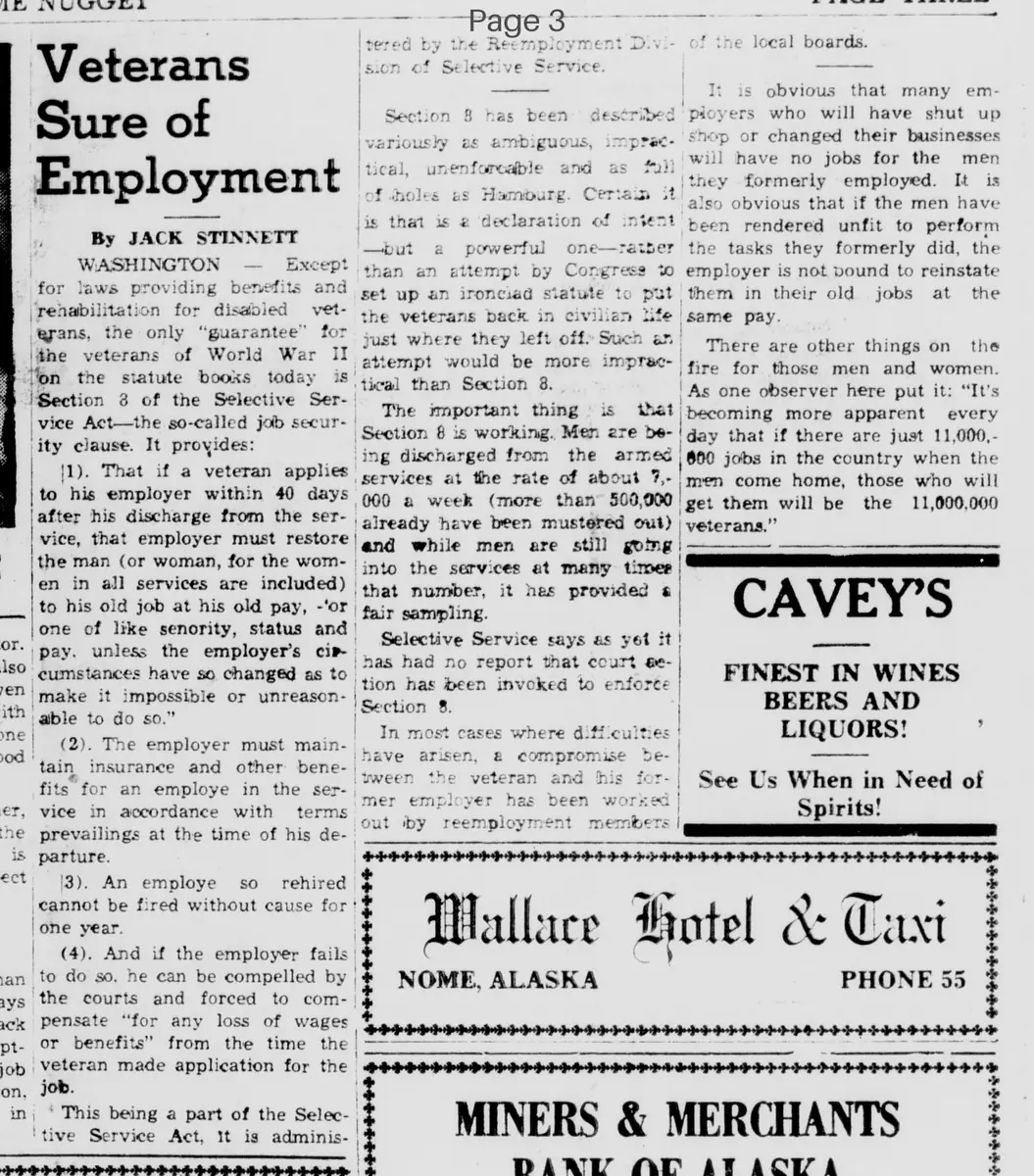
By JACK STINNETT
WASHINGTON
Except for laws providing benefits and rehabilitation for disabled veterans, the only "guarantee" for the veterans of World War II on the statute books today is Section 8 of the Selective Service Act-the so-called job security clause. It provides:
(1). That if a veteran applies to his employer within 40 days after his discharge from the service, that employer must restore the man (or woman, for the women in all services are included) to his old job at his old pay, or one of like seniority, status and pay, unless the employer's circumstances have so changed as to make it impossible or unreasonable to do so."
(2). The employer must maintain insurance and other benefits for an employee in the service in accordance with terms prevailing at the time of his departure.
(3). An employee so rehired cannot be fired without cause for one year.
(4). And if the employer fails to do so, he can be compelled by the courts and forced to compensate "for any loss of wages or benefits" from the time the veteran made application for the job.
This being a part of the Selective Service Act. It is administered by the Reemployment Division of Selective Service.
Section 8 has been described variously as ambiguous, impractical, unenforceable and as full of holes as Hamburg. Certain it is that is a declaration of intent -but a powerful one- rather than an attempt by Congress to set up an ironclad statute to put the veterans back in civilian life just where they left off. Such an attempt would be more impractical than Section 8.
The important thing is that Section 8 is working. Men are being discharged from the armed services at the rate of about 7,000 a week (more than 500,000 already have been mustered out) and while men are still going into the services at many times that number, it has provided a fair sampling.
Selective Service says as yet it has had no report that court action has been invoked to enforce Section 8.
In most cases where difficulties have arisen, a compromise between the veteran and his former employer has been worked out by reemployment members of the local boards.
It is obvious that many employers who will have shut up shop or changed their businesses will have no jobs for the men they formerly employed. It is also obvious that if the men have been rendered unfit to perform the tasks they formerly did, the employer is not bound to reinstate them in their old jobs at the same pay.
There are other things on the fire for those men and women.
As one observer here put it: "It's becoming more apparent every day that if there are just 11,000,000 jobs in the country when the men come home, those who will get them will be the 11,000,000 veterans."
What sub-type of article is it?
What keywords are associated?
Where did it happen?
Domestic News Details
Primary Location
Washington
Outcome
section 8 is working effectively with no reported court actions; reemployment achieved through compromises by local boards; applies to over 500,000 discharged veterans at 7,000 per week.
Event Details
Section 8 of the Selective Service Act requires employers to rehire WWII veterans within 40 days of discharge to old or equivalent jobs unless impossible, maintain benefits, protect from firing without cause for one year, and face court compulsion for violations. Administered by Reemployment Division; described as a declaration of intent rather than ironclad; effective via compromises despite criticisms.