Thank you for visiting SNEWPapers!
Sign up free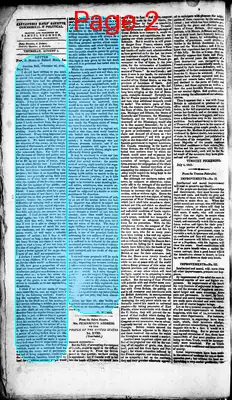
Alexandria Daily Gazette, Commercial & Political
Alexandria, Virginia
What is this article about?
George Mason writes to Richard Henry Lee from Gunston Hall on November 26, 1780, citing illness as reason for missing the assembly session. He urges filling Virginia's troop quota for the war, proposes incentives like exemptions for substitutes and deserter apprehenders, a vagrant act to enlist idle men, and opposes manumitting slaves for service, fearing enemy retaliation. He also addresses desertion penalties, salt import incentives, and western territory disputes.
Clipping
OCR Quality
Full Text
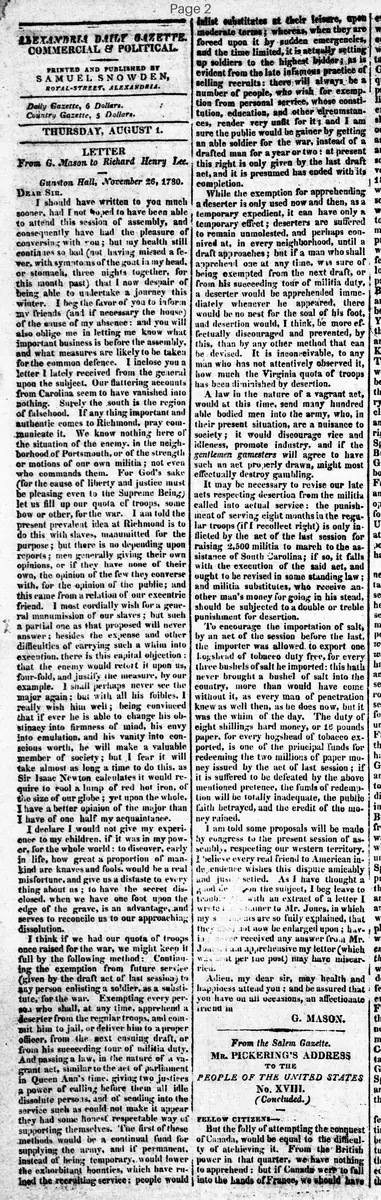
From G. Mason to Richard Henry Lee.
Gunston Hall, November 26, 1780.
DEAR SIR,
I should have written to you much sooner, had I not hoped to have been able to attend this session of assembly, and consequently have had the pleasure of conversing with you; but my health still continues so bad (not having missed a fever, with symptoms of the gout in my head, or stomach, three nights together, for this month past) that I now despair of being able to undertake a journey this winter. I beg the favor of you to inform my friends (and if necessary the house) of the cause of my absence: and you will also oblige me in letting me know what important business is before the assembly, and what measures are likely to be taken for the common defence. I enclose you a letter I lately received from the general upon the subject. Our flattering accounts from Carolina seem to have vanished into nothing. Surely the south is the region of falsehood. If any thing important and authentic comes to Richmond, pray communicate it. We know nothing here of the situation of the enemy in the neighborhood of Portsmouth, or of the strength or motions of our own militia; not even who commands them. For God's sake (for the cause of liberty and justice must be pleasing even to the Supreme Being) let us fill up our quota of troops, some how or other, for the war. I am told the present prevalent idea at Richmond is to do this with slaves, manumitted for the purpose; but there is no depending upon reports; men generally giving their own opinions, or if they have none of their own, the opinion of the few they converse with, for the opinion of the public; and this came from a relation of our eccentric friend. I most cordially wish for a general manumission of our slaves; but such a partial one as that proposed will never answer; besides the expense and other difficulties of carrying such a whim into execution, there is this capital objection: that the enemy would retort it upon us, four-fold, and justify the measure, by our example. I shall perhaps never see the major again; but with all his foibles, I really wish him well; being convinced that if ever he is able to change his obstinacy into firmness of mind, his envy into emulation, and his vanity into conscious worth, he will make a valuable member of society; but I fear it will take almost as long a time to do this, as Sir Isaac Newton calculates it would require to cool a lump of red hot iron, of the size of our globe; yet upon the whole, I have a better opinion of the major than I have of one half my acquaintance. I declare I would not give my experience to my children, if it was in my power, for the whole world: to discover, early in life, how great a proportion of mankind are knaves and fools, would be a real misfortune, and give us a distaste to every thing about us; to have the secret disclosed, when we have one foot upon the edge of the grave, is an advantage, and serves to reconcile us to our approaching dissolution.
I think if we had our quota of troops once raised for the war, we might keep it full by the following method: Continuing the exemption from future service (given by the draft act of last session) to any person enlisting a soldier, as a substitute, for the war. Exempting every person who shall, at any time, apprehend a deserter from the regular troops, and commit him to jail, or deliver him to a proper officer, from the next ensuing draft, or from his succeeding tour of militia duty. And passing a law, in the nature of a vagrant act, similar to the act of parliament in Queen Ann's time, giving two justices a power of calling before them all idle dissolute persons, and of sending into the service such as could not make it appear they had some honest respectable way of supporting themselves. The first of these methods would be a continual fund for supplying the army, and if permanent, instead of being temporary, would lower the exorbitant bounties, which have ruined the recruiting service: people would enlist substitutes at their leisure, get moderate terms; whereas, when they are forced upon it by sudden emergencies, and the time limited, it is actually setting up soldiers to the highest bidders, as is evident from the late infamous practice of selling recruits: there will always be a number of people, who wish for exemption from personal service, whose constitution, education, and other circumstances, render very unfit for it; and I am sure the public would be gainer by getting an able soldier for the war, instead of a drafted man for a year or two: at present this right is only given by the last draft act, and it is presumed has ended with its completion.
While the exemption for apprehending a deserter is only used now and then, as a temporary expedient, it can have only a temporary effect; deserters are suffered to remain unmolested, and perhaps connived at, in every neighborhood, until a draft approaches; but if a man who shall apprehend one at any time, was sure of being exempted from the next draft, or from his succeeding tour of militia duty, a deserter would be apprehended immediately whenever he appeared, there would be no rest for the sole of his foot, and desertion would, I think, be more effectually discouraged and prevented, by this, than by any other method that can be devised. It is inconceivable, to any man who has not attentively observed it, how much the Virginia quota of troops has been diminished by desertion.
A law in the nature of a vagrant act, would at this time, send many hundred able bodied men into the army, who, in their present situation, are a nuisance to society; it would discourage vice and idleness, promote industry, and if the gentlemen gamesters will agree to have such an act properly drawn, might most effectually destroy gambling.
It may be necessary to revise our late acts respecting desertion from the militia called into actual service: the punishment of serving eight months in the regular troops (if I recollect right) is only inflicted by the act of the last session for raising 2,500 militia to march to the assistance of South Carolina: if so, it falls with the execution of the said act, and ought to be revised in some standing law; and militia substitutes, who receive another man's money for going in his stead, should be subjected to a double or treble punishment for desertion.
To encourage the importation of salt by an act of the session before the last, the importer was allowed to export one hogshead of tobacco duty free, for every three bushels of salt he imported: this hath never brought a bushel of salt into the country, more than would have come without it, as every man of penetration knew as well then, as he does now, but it was the whim of the day. The duty of eight shillings hard money, or 16 pounds paper, for every hogshead of tobacco exported, is one of the principal funds for redeeming the two millions of paper money issued by the act of last session; if it is suffered to be defeated by the above mentioned pretence, the funds of redemption will be totally inadequate, the public faith betrayed, and the credit of the money ruined.
I am told some proposals will be made by congress to the present session of assembly, respecting our western territory. I believe every real friend to American independence wishes this dispute amicably and justly settled. As I have thought a good deal on the subject, I beg leave to trouble you with an extract of a letter I wrote last summer to Mr. Jones, in which my sentiments are so fully explained, that they do not now need to be enlarged upon; having never received any answer from Mr. Jones, I apprehend my letter (which was sent per the post) may have miscarried.
Adieu, my dear sir, may health and happiness attend you; and be assured that you have on all occasions, an affectionate friend
G. MASON.
What sub-type of article is it?
What themes does it cover?
What keywords are associated?
What entities or persons were involved?
Letter to Editor Details
Author
G. Mason
Recipient
Richard Henry Lee
Main Argument
urges virginia assembly to fill and maintain troop quota for the revolutionary war through permanent exemptions for substitutes, incentives for capturing deserters, and a vagrant act to enlist idle men; opposes manumitting slaves for service due to enemy retaliation risks and impracticality, preferring general emancipation.
Notable Details