Thank you for visiting SNEWPapers!
Sign up free
Martinsburg Gazette
Martinsburg, Berkeley County, West Virginia
What is this article about?
Extract from Col. John O'Fallon's speech on the Siege of Fort Meigs in 1813 during the War of 1812. Describes Gen. Harrison's defense against British and Indian forces led by Gen. Proctor and Tecumseh, including a foiled deception, reinforcements from Gen. Clay, and successful sorties by Col. Dudley and others, resulting in victory.
Clipping
OCR Quality
Full Text
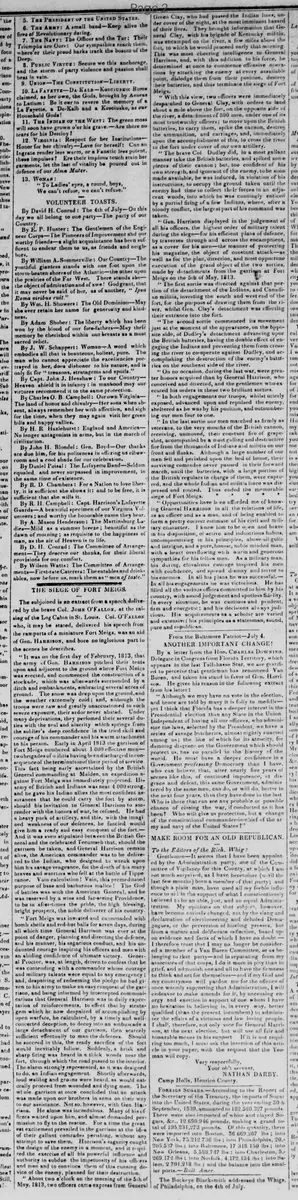
The subjoined is an extract from a speech delivered by the brave Col. John O'Fallon, at the raising of the Log Cabin in St. Louis. Col. O'Fallon who, it may be stated, delivered his speech from the ramparts of a miniature Fort Meigs, was an aid of Gen. Harrison, and bore no inglorious part in the scenes he describes.
"It was on the first day of February, 1813, that the army of Gen. Harrison pitched their tents upon and adjacent to the ground where Fort Meigs was erected, and commenced the construction of a stockade, which was afterwards surrounded by a ditch and embankments, embracing several acres of ground. The snow was deep upon the ground, and the weather extremely cold; and, although the troops were raw and greatly unaccustomed to such severe exposure, their ardor never abated. Under many deprivations, they performed their several duties with the zeal and alacrity which springs from the soldier's deep confidence in the tried skill and courage of his commander and his warm attachment to his person. Early in April 1813 the garrison of Fort Meigs numbered about 1,000 effective men—two brigades of militia having been discharged in consequence of the termination of their period of service. This fact being early ascertained by the British General commanding at Malden, an expedition against Fort Meigs was immediately projected. His army of British and Indians was near 4,000 strong, and he gave his Indian allies the most confident assurances that he could carry the fort by storm, should his invitation to General Harrison to surrender with the honors of war, be refused. He had a heavy park of artillery, and this, with the imagined weakness of our defences, he fancied would give him a ready and easy conquest of the fort.—And it was even stipulated between the British General and the celebrated Tecumseh that, should the garrison be taken, and General Harrison remain alive, the American commander was to be delivered to the Indian, who designed to wreak upon him his savage vengeance, for the death of his many braves and warriors who fell at the battle of Tippecanoe. Vain calculation! Vain, this premeditated purpose of base and barbarous malice! The God of battles was with the American General, and he was reserved by a wise and far-seeing Providence, to be in after-times the pride, the high blessing, bright prospect, the noble deliverer of his country.
"Fort Meigs was invested and cannonaded with bomb shells and red-hot balls for seven days, during all which time General Harrison was ever at the point of danger, planning and directing the defence, and his manner, his sagacious conduct, and his undaunted courage inspiring his officers and men with an abiding confidence of ultimate victory. General Proctor, was, at length, driven to confess that he was contending with a commander whose courage and military talents were equal to any emergency; and, despairing of redeeming the pledge he had given to his army to make an easy conquest of the garrison, and being informed by intercepted communications that General Harrison was in daily expectation of reinforcements, to effect that by stratagem which he now despaired of accomplishing by open warfare, he calculated, by a timely and well concerted deception, to decoy into an ambuscade a large detachment of our garrison, then scarcely sufficient effectually to man the defences. Should he succeed in this, the ready sacrifice of the fort would inevitably follow. Suddenly, a brisk and sharp firing was heard in a thick woods near the fort, through which the road passed to the interior. The alarm strongly represented, as it was designed to do, an Indian engagement. Shortly afterwards, loud wailing and groans were heard, as would naturally proceed from wounded and dying men. The whole garrison at once concluded that an attack was made upon our brothers in arms on their way to our assistance. Not so, however, with Gen. Harrison. He alone was incredulous. Many of his officers waited upon him, and almost demanded permission to fly to the rescue. For a time the greatest excitement prevailed in the garrison at the idea of their gallant comrades perishing, without any attempt to save them. Harrison's sagacity caught the design of the enemy in a moment, and it required the exercise of all his powerful influence and authority to subdue the impetuosity of his officers and men and to convince them of this cunning device of the enemy, planned for their destruction.
"About two o'clock on the morning of the 5th of May, 1813, two officers came express from General Green Clay, who had passed the Indian lines, under cover of the night, at the most imminent hazard of their lives. They brought information that General Clay, with his brigade of Kentucky militia, was encamped on the river, a few miles above the fort, to which he would proceed early that morning. This was most cheering intelligence to General Harrison, and, with this addition to his force, he determined at once to commence offensive operations by attacking the enemy at every assailable point, dislodge them from their position, destroy their batteries, and thus terminate the siege of Fort Meigs.
"With this view, two officers were immediately despatched to General Clay, with orders to land about a mile above the fort, on the opposite side of the river, a detachment of 300 men, under one of its most trustworthy officers; to move upon the British batteries, to carry them, spike the cannon, destroy the ammunition, and carriages, and, immediately upon the accomplishment of this, to cross the river to the fort under cover of our own artillery.
"The brave Col. Dudley did, in a most gallant manner take the British batteries, and spiked some pieces of their cannon; but, too confident of his own strength, and ignorant of the enemy, to be soon made available, he was induced, in violation of his instructions, to occupy the ground taken until the enemy had time to collect their forces in an adjacent woods, into which he was cunningly enticed by a partial firing of a few Indians, where, after a bloody conflict, the largest part of his command was taken.
"Gen. Harrison displayed in the judgement of all his officers, the highest order of military talent during the siege—for his efficient plans of defence, by traverses through and across the encampment, as a cover for his men—the manner of protecting his magazine, the object of constant attack—as well as for the plan, direction, and most opportune execution of the grand object of the two sorties made by detachments from the garrison at Fort Meigs on the 5th of May, 1813.
"The first sortie was directed against that portion of the detachment of the Indians, and Canadian militia, investing the south and west end of the fort, for the purpose of drawing them from the river, whilst Gen. Clay's detachment was effecting their entrance into the fort.
"The second sortie commenced its movement just at the moment of the appearance, on the opposite side, of Dudley's detachment advancing upon the British batteries, having the double effect of engaging the Indians and preventing them from crossing the river to co-operate against Dudley, and accomplishing the destruction of the enemy's batteries on the southeast side of the river.
"On no occasion, during the last war, were greater honors acquired than by General Harrison, who conceived and directed, and the gentlemen who executed his orders in these two brilliant sorties.
"In both engagements our troops, whilst utterly exposed, advanced upon and repulsed the enemy, sheltered as he was by his position, and outnumbering our men four to one.
"In the last sortie our men marched as firmly as veterans, to the very mouths of the British cannon, receiving, unmoved, their constant fire of grape-shot, accompanied by a most galling and destructive fire from the thousands of Indians and militia on our front and flanks. Although a large number of our men fell and perished upon the bed of honor, their surviving comrades never paused in their forward march, until the batteries, with a large portion of the British regulars in charge of them, were captured, and the whole Indian and militia force was dispersed and routed. Thus ended the memorable siege of Fort Meigs.
"Opportunities have been afforded me of knowing General Harrison in all the relations of life, as an officer and as a man, and of being enabled to form a pretty correct estimate of his civil and military character. I know him to be open and brave in his disposition, of active and industrious habits, uncompromising in his principles, above all guile and intrigue, and a pure, honest, noble minded man, with a heart overflowing with warm and generous sympathies for his fellow men. As a military man, his daring, chivalrous courage inspired his men with confidence, and spread dismay and terror to his enemies. In all his plans he was successful.—In all his engagements he was victorious. He has filled all the various offices committed to him by his country, with sound judgement and spotless fidelity. In every situation, he was cautious and prudent, firm and energetic; and his decisions always judicious. His acquirements as a scholar are varied and extensive; his principles as a statesman, sound, pure and republican."
What sub-type of article is it?
What themes does it cover?
What keywords are associated?
What entities or persons were involved?
Where did it happen?
Story Details
Key Persons
Location
Fort Meigs
Event Date
February 1813 To May 5, 1813
Story Details
Col. O'Fallon recounts the construction of Fort Meigs in February 1813, the British and Indian siege in April-May led by Gen. Proctor and Tecumseh, Harrison's defense against bombardment and a deception ambush, arrival of Clay's reinforcements, two successful sorties including Col. Dudley's partial success and capture, resulting in the rout of enemy forces and end of the siege.